 Sean P. Means
Few people in Utah initially knew about plans to build a massive data center campus in Box Elder County — though Gov. Spencer Cox and other state leaders met with celebrity investor Kevin O’Leary in January, and rumors about the proposals started spreading in February.
This timeline breaks down what we know about how the proposal came to be, and what’s happened since.
It includes government meetings, comments from officials, primary election results and more.
Box Elder County data center timeline:
Dec. 16, 2025 • Alexander Tarbet, a government strategist in Utah, sends an email to Gov. Spencer Cox’s office on behalf of celebrity investor and “Shark Tank” star Kevin O’Leary — saying O’Leary would be visiting Salt Lake City in January. In an exchange with Cox’s staff, Tarbet writes that O’Leary “has a data center facility in Alberta and would like to talk about doing one in UT.” (The Salt Lake Tribune learned of this exchange in late May, through a government records request.)
Jan. 8 • O’Leary met with Gov. Spencer Cox and other Utah leaders in Salt Lake City. The governor’s office later declines to release a planning document created for that meeting. The office does release photos from the visit, including one where O’Leary poses behind Cox’s desk.
(Governor's Office of Economic Opportunity) Celebrity investor and "Shark Tank" star Kevin O'Leary poses for a photo behind the desk of Utah Gov. Spencer Cox, during a visit to Salt Lake City on Jan. 8, 2026.
Feb. 17 • O’Leary posted a link to a news release saying his O’Leary Digital company had partnered with Utah developer West GenCo to start developing what he called “Wonder Valley Utah” in Box Elder County. The release said the campus would generate 7.5 gigawatts of power onsite.
O’Leary borrowed the “Wonder Valley” name from a similar project he announced in Alberta, Canada, in December 2024. Construction on the Canadian venture was scheduled to start this year, but that likely won’t begin until 2028, an official in an Alberta town near the site recently said.
Feb. 18 • At a meeting of the Bear River Water Conservancy District’s board, landowner and board trustee Tim Munns said representatives for West GenCo were looking at parcels to buy in Box Elder County for a proposed data center, and O’Leary was involved.
Munns said he was told the project’s backers were looking to take water from the Salt Wells Spring stream (near the northern tip of the Great Salt Lake), run it through desalinating plants and use it to cool turbines, then treat the water and return it to the aquifer.
(Trent Nelson | The Salt Lake Tribune) The north end of the Great Salt Lake and Hansel Valley, the area where the Stratos data center project is proposed, on Friday, May 1, 2026.
One board member said he had heard rumors about the project weeks earlier — but the meeting appears to be the first time anyone mentioned it in a public forum.
About three months later, on May 15, Utah Speaker of the House Mike Schultz told The Tribune he had also heard rumors about the proposal in February.
March 25 • Box Elder County commissioners met with MIDA representatives, and heard for the first time details about the Stratos proposal, a county spokesperson told The Tribune months later. Commissioners “expressed frustration” that the planning process had gone so far without them, the spokesperson said. No public notice was given for the meeting, which one expert told Fox 13 was likely a violation of the state’s Open and Public Meetings Act.
April 20 • Days before the data center plan was made public, an attorney for Box Elder County emailed a proposal to executives with Utah’s Military Installation Development Authority that outlined the costs the county expected to face if the project was approved.
The authority, often referred to as MIDA, is cheerleading the project. Its board is made up mostly of elected officials and chaired by Utah Senate President J. Stuart Adams.
The county sought $16.2 million upfront from O’Leary Ventures, most of it for public safety and emergency services, according to the email, which The Tribune received through a public records request.
Paul Morris, MIDA’s executive director and general counsel, replied that the figure was “quite a bit higher” than what O’Leary’s company expected. After negotiation, the developer ultimately agreed to spread that cost out over three years.
April 22 • MIDA representatives presented on the so-called Stratos project to the Box Elder County Commission — the first public hearing on the proposal.
Commissioners later said the public had a chance to weigh in during that meeting, not future ones, though few people at the time had knowledge of the proposal or opportunity to comment.
April 24 • The MIDA board heard a presentation about the Stratos project, including virtual testimony from O’Leary, who called it “Wonder Valley Utah.”
The board, made up mostly of elected officials and chaired by Utah Senate President J. Stuart Adams, approved several resolutions to move the project along.
A meeting scheduled later that day with the Box Elder County Commission, which was expected to vote on the proposal, was postponed for three days.
(Trent Nelson | The Salt Lake Tribune) The Box Elder County Commission meets on the Kevin O'Leary data center project in Brigham City on Monday, April 27, 2026.
April 27 • Some 80 protesters filled the Box Elder County Commission’s chamber, objecting to the project’s potential water use. They also decried the lack of public input. The commissioners opted to again delay the vote, this time by one week.
April 27-May 4 • The Box Elder County Commission had outside attorneys examine the interlocal agreement MIDA wanted them to approve. The Salt Lake City law firm charged the commission $20,000 for their work.
April 27-May 4 • Over the same period, more than 2,400 Utahns, including 310 Box Elder County residents, submitted comments and questions via an online form to the commission. Sentiments among county residents are mostly negative, a Tribune examination found.
April 30 • Gov. Cox, in his monthly news conference, lashed out at project critics, calling concerns that the process had been rushed “the dumbest thing ever.” (This comment came nearly four months after Cox first met O’Leary in January to talk about a data center plan.)
States, he added, have “an obligation to allow for these types of data centers to be built.” Eight days later, over X, Cox apologized for his comments, said “disagreement is part of good government” and vowed to “do better.”
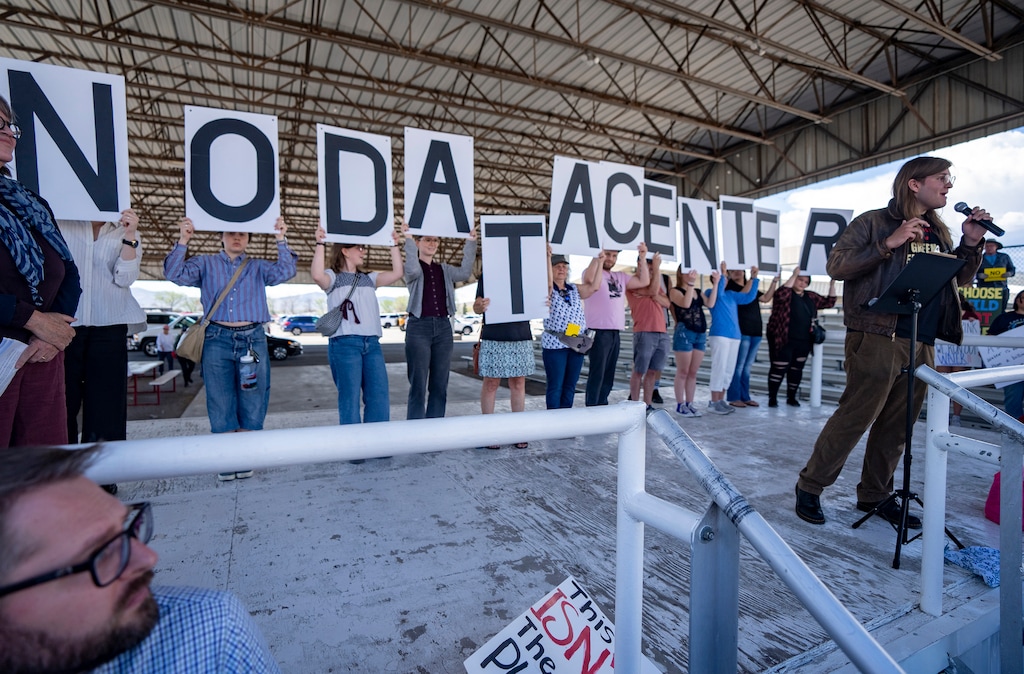
May 4 • In a contentious hearing, hundreds of protests shouted down Box Elder County’s commissioners, prompting the three leaders to leave the room and finish the meeting virtually.
They voted 3-0 to approve the interlocal agreement with MIDA. Protesters yelled “Shame!” and “Cowards!” as the meeting adjourned. O’Leary later claimed online, without proof, that protesters were “bused in” from out of state and paid to attend.
(Rick Egan | The Salt Lake Tribune) A protester leads the crowd in chants as the commissioners vote during a Box Elder County Commission meeting at the county fairgrounds in Tremonton onTuesday, May 4, 2026.
May 5 • Brigham City resident Brenna Williams filed an application for a referendum to put the Box Elder County Commission’s decision to approve the data center plan up to a public vote.
Three days later, she filed another application, to overturn the commission’s approval of the interlocal agreement with MIDA. If the county attorney approves, backers of the ballot drive — later named the Box Elder Accountability Referendum, or BEAR — must collect 5,422 signatures across four voter participation areas.
May 6 • O’Leary, posting on X, said some of the power generation for the proposed data center campus could come from renewable sources, such as “solar, wind and batteries” — contradicting a state official who said it would be powered “100% off the Ruby Pipeline,” the natural gas line that crosses the area.
O’Leary did not commit to actually using any of the renewables.
May 6 • A confrontation between state Sen. Jerry Stevenson, R-Layton, and a journalist for ABC4 Utah unfolded in the parking lot of the lawmaker’s plant nursery.
The journalist was reporting on a proposed boycott of the senator’s nursery, because Stevenson sits on the MIDA board that first approved the Box Elder data center project. ABC4 reported that Stevenson allegedly smacked a cellphone out of the journalist’s hands; Stevenson alleged that the ABC4 crew was trespassing on private property.
Layton police said they were investigating the confrontation.
May 7 • After thousands of Utahns filed protests, paying $15 each to do so, backers of a water-rights application — to move 1,900 acre-feet of water from ranching to the data center project — withdrew the request. The landowner, Bar H Ranch, said it intended to resubmit its application later.
May 7 • Robert Davies, a physics professor at Utah State University, calculated that the proposed data center project could create a massive heat island that stands to devastate the area’s ecology.
The next day, O’Leary appeared on CNN, arguing that the project is “not going to drain the Great Salt Lake” or “destroy air quality.”
(Trent Nelson | The Salt Lake Tribune) The CentraCom office in Fairview on Tuesday, Nov. 7, 2023.
May 7 • CentraCom, a Utah telecommunications company, confirmed that it is “not anywhere near” the data center project. The clarification came after social media speculation and a progressive political action committee suggested the two may be linked.
May 8 • For the first time, Republican candidates for the congressional district that includes Box Elder County (incumbent Blake Moore and challenger Karianne Lisonbee) spoke up about the data center plan. Lisonbee argued that the public has been cut out of the process, while Moore urged an end to “acrimony, threats and vitriol” against county commissioners.
May 14 • Some 400 people attended a rally at the Utah Capitol in opposition to the data center proposal. They presented a letter to Gov. Spencer Cox’s office, urging him to take “binding action” to preserve the Great Salt Lake; the letter was signed by around 6,000 people, organizers said.
(Chris Samuels | The Salt Lake Tribune) People protest the Stratos data center project at the Capitol in Salt Lake City, Thursday, May 14, 2026.
May 15 • Utah House Speaker Mike Schultz told The Tribune that “personally, and for my ranch, this data center is not a good thing” — and he wants to see more studies on the proposal’s environmental impact.
Schultz’s comments came after a local Democratic consulting firm alleged, without evidence, that he could profit from the project.
May 18 • O’Leary Digital releases its first renderings of what the buildings in his proposed data center campus might look like. The renderings show buildings with huge panes of glass with reflections of the mountain landscape. The company says the campus also will feature a mixed-use “innovation” district to offer amenities to the community, a 3,000-acre solar array and a 1,000-foot property buffer.
May 20 • Gov. Cox, four months after his initial meeting with O’Leary, acknowledged that the rollout of the Stratos data center plan “was not good,” and told reporters that similar decisions going forward should include his office and the Legislature. The same day, a legislative interim committee approved conducting a study on the effects of data centers on Utah’s wildlife, water and air.
May 28 • The Box Elder County Attorney announces that it will not allow a pair of referendums on the fall ballot, saying the county commissioners’ decision over the data center plan is not “legally referable to voters.” Backers of the Box Elder Accountability Referendum, or BEAR, say they will take the county to court.
May 28 • A 3.1 magnitude earthquake hits a few miles from the site of the proposed Box Elder County data center. It’s considered a minor quake, and would feel to anyone near the epicenter like a heavy truck driving past.
May 29 • Gov. Cox issued an executive order to ensure that the state will evaluate data center plans properly, weighing factors like water use — particularly around the Great Salt Lake. It’s not immediately clear what effect the order will have on the Box Elder County project.
June 1 • Senate President Stuart Adams, who chairs the MIDA board that approved the Stratos plan in April, announced that he wrote to O’Leary to urge that the investor reduce the size of the data center campus from 40,000 acres to 10,000 acres. Adams cited “public feedback and further review” as reasons for backpedaling on the project. O’Leary told The Tribune that Adams’ demand was “outrageous,” but that “I’m not walking away” from the project.
June 3 • Opponents to the Stratos project file two lawsuits. Members of the Box Elder Accountability Referendum sue Box Elder County, demanding a judge overturn the county attorney’s rejection of their ballot effort. And Alliance for a Better Utah, along with five Box Elder County residents, sue to have MIDA declared unconstitutional and its decisions null and void.
June 4 • O’Leary, answering Adams’ demands (see June 1 entry), presents a slimmed-down plan for the Stratos site, cutting the total space to 20,000 acres — and that buildings would take up only 10,000 acres.
June 10 • The Box Elder County Commission voted to impose a 180-day moratorium on new data centers and data center power plants on the county’s unincorporated land.
June 23 • Adams lost his state Senate seat in the Republican primary, and conceded to attorney Stephanie Hollist. Adams’ role as the chairman of MIDA, and a proponent of the Stratos data center proposal, was considered a drag on his reelection chances. Meanwhile, the two Box Elder County commissioners up for reelection, Lee Perry and Boyd Bingham, both lost to their GOP opponents; both voted to let the Stratos plan proceed.
June 25 • O’Leary, on a social media post, said he had “no evidence” that two Utah progressive groups were “proxies of the Chinese government,” as he had said several times on national news channels. O’Leary later confirmed that, before his statement, that he had received a demand letter — usually a preliminary step before a lawsuit — but wouldn’t say who sent it. Fox News Media later issued an apology for airing O’Leary’s accusations, and state Sen. Todd Weiler posted, “Oops. I was duped” by O’Leary’s comments.
June 26 • Dan Hemmert, a businessman and former state senator, is hired as MIDA’s new executive director, after Paul Morris retired.
July 15 • Alliance for a Better Utah and Elevate Strategies and their founders, Joshua Kanter and Gabrielle Finlayson, filed a federal defamation lawsuit against O’Leary and Fox News, over the accusations that those groups were being bankrolled by the Chinese government. The lawsuit argues that O’Leary’s charges on Fox News channels caused “devastating reputational harm, significant economic losses, severe emotional distress, and ongoing threats to their physical safety.”
July 29 • A MIDA spokesperson told The Tribune that its work on the Stratos project is “paused at this time as there is no action before us.” The agency is waiting for the appeal to the rejection of the ballot referendum to play out, the spokesperson said. However, O’Leary said the design phase of the project is “full steam ahead.”
— The Salt Lake Tribune intends to keep this timeline updated.