 Jason Batacao
When Utah entered the Big 12 two years ago, many fans hoped it would be a short-term layover before the Utes would move on to greener pastures.
And one conference, especially, had the greenest (i.e., money) of pastures: the Big Ten.
A fool’s hope? Maybe, even probably. But the University of Utah is one of 71 members of the Association of American Universities, meaning it is designated as one of the top research institutions in the nation — a longstanding preference for programs joining the Big Ten.
Utah’s football team — which won two Pac-12 championships in 2021 and 2022 — also makes it a strong allure.
But could proposed federal legislation in the Protect College Sports Act keep the Utes deadlocked in the Big 12 when the next media contracts expire in 2030?
That could be the case if the bill is ultimately passed.
“The bill attempts to prevent the formation of a Super League,” the NCAA’s senior vice president of external affairs, Tim Buckley, told The Salt Lake Tribune.
“We believe that it’s possible that the legislation could change to give some flexibility on that front. So maybe there could be the possibility for moving for those large conferences to add a new school or two.”
In the current iteration of the Protect College Sports Act, the bill would grant the NCAA and conferences certain antitrust exemptions. It would ultimately allow the NCAA to enforce rules without court overrides or state laws on sports betting cases, eligibility cases, transfer limits and spending caps.
The bill, if passed, would permit enforceable spending limits for rosters (reportedly up to $51 million) and implement a five-year standard eligibility window and a one-time transfer limit.
In Utah’s case, the biggest stake may be the limits set on conference movement.
According to recent reports, conversations have centered around capping conference totals at 19 or 20 teams.
The Big Ten currently has 18 member institutions, which would leave open only one or two spots.
And that’s if a new program would want to deal with the proposed headaches that would come from changing conferences.
Under the bill, if a program decided to leave one power conference for another, it would be required to be independent for five seasons.
And then there are the financial penalties.
“What does it take to leave one’s conference and join another? Those are currently all dictated by conference-by-conference agreements,” Buckley said. “There are usually ramifications for leaving a conference before a set time period. Those conference agreements are not impacted in any way by this legislation.”
According to the University of Utah’s signed agreement with the Big 12, obtained via public records request, Utah is exempt from the conference clause that would keep it signed to the Big 12 for 99 years.
(Bethany Baker | The Salt Lake Tribune) From left, University of Utah President Taylor Randall, head football coach Morgan Scalley, and athletic director Mark Harlan hold up a jersey during an introductory news conference at the University of Utah in Salt Lake City on Tuesday, Jan. 6, 2026.
The university did agree, however, to be bound by any change to Section 1.2.3 that is “limited to the withdrawal and sanction provisions of Section 3 of the Bylaws,” according to the contract.
Section 3 states that any member leaving the Big 12 would be responsible for a buyout fee that would be equal to the sum of the program’s payment in the final two years of its Big 12 contract.
Utah would also be responsible for any legal fees associated with a move.
When Texas and Oklahoma left for the SEC in 2024, both programs paid $50 million to the Big 12 as part of their conference buyouts.
So suffice it to say, a buyout would cost millions if the Utes were to leave before the Big 12’s media agreement expires.
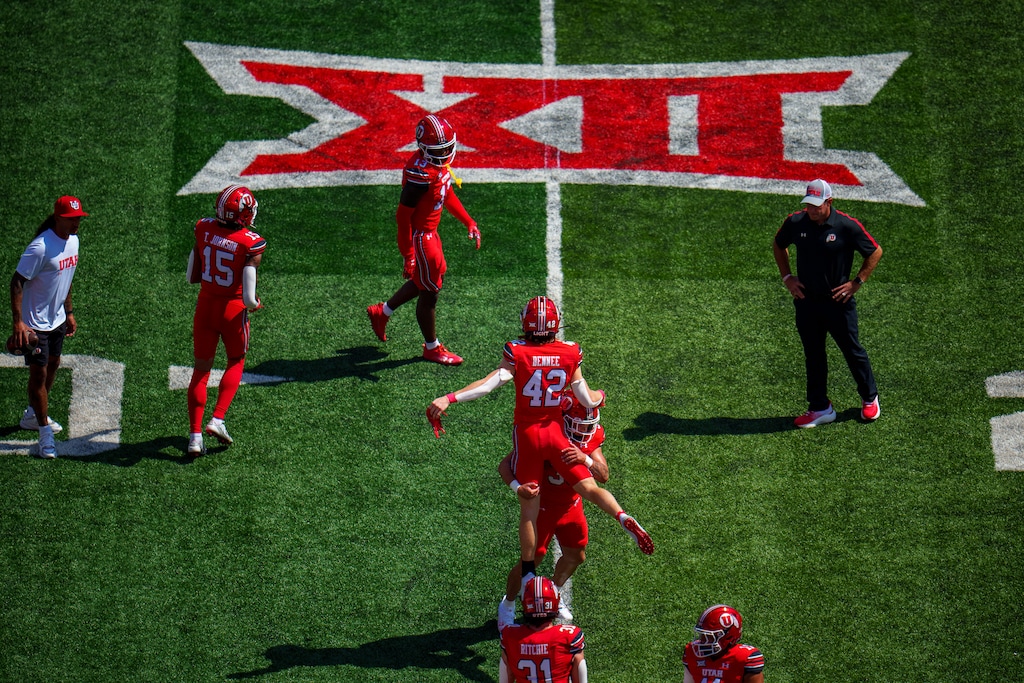
(Trent Nelson | The Salt Lake Tribune) The Big 12 Conference logo as the Utah Utes prepare to host the Baylor Bears, NCAA football in Salt Lake City on Saturday, Sept. 7, 2024.
But while conference realignment provisions are set to be limited in the Protect College Sports Act, the NCAA’s stance is different from several lawmakers.
“The NCAA believes that the best thing that the legislation can do is not get too deep into the weeds in issues like schools moving from conference to conference,” Buckley said. “We understand the need that senators have expressed to deal with the formation of a super league, but it’s our hope — and what we’re trying to achieve — is avoiding really specific and a lot of strings getting attached to legislation regarding conference realignment.”
The Protect College Sports Act still has to be voted on and codified into law for provisions limiting a super league to be put into place. The bill has already faced pushback from leaders in both the Big Ten and the SEC regarding conference expansion limitations.
Despite ongoing conversations between key stakeholders, the Protect College Sports Act might not receive a Senate floor vote before the August 2026 recess.
And with the 2026 midterms coming up in November, its window to pass would be extremely tight.
For now, conversations remain ongoing, and the future of college sports remains, like always, in flux.
“We are looking for Congress to empower the association and the conferences to set reasonable rules around total years of eligibility and reasonable rules around sports betting infractions,” Buckley said, “so that way [these rules] can be applied equally across the country without us being taken to court.”