The hype was real around the up-and-coming Utah Mammoth last year: A team armed with rising talent, a ton of pace and an ownership group ready and willing to invest in the on-ice product.
Eventually, that hype has to turn into something tangible. In this case, a breakthrough in the playoffs.
The Mammoth’s resilience was a standout in Round 1, but ultimately their inexperience caught up to them. Now, with a few more veterans in tow, Utah’s looking to build on that.
The projection
Making the playoffs is the first step. Proving playoff consistency is a lot harder. What separates the best from the rest is partly their ability to (almost) always get there; they are near-locks in September and prove as much by April.
The Mammoth got their first taste of playoff glory last spring. This season is about proving they belong for good. In a weaker Western Conference, they have the inside track over a number of teams, but there still is a chasm between Utah and the best of the West.
Earning more respect starts with their response to their first playoff season. Will the Mammoth stagnate with a season in the mid-90s, as expected here, or take the next step?
The big question
Does Utah have the star power to compete with the top of the Central Division?
At a few different points in the first round of the Stanley Cup playoffs, the Mammoth looked like they had a jump on the Vegas Golden Knights. One of those came in Game 2, when Logan Cooley pounced on a net-front puck to beat Carter Hart, even the series 1-1 and give Utah its first postseason win in franchise history. The chance came after linemate Dylan Guenther carried the puck through the offensive zone, beat a Golden Knights defenseman and rang a shot off the post.
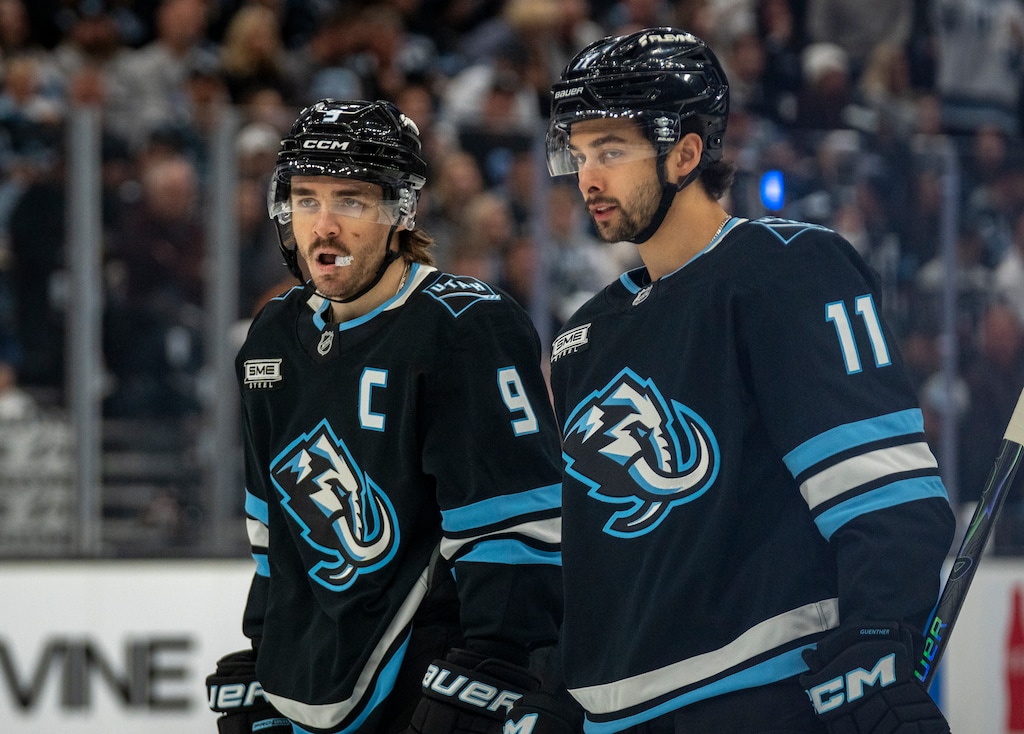
Things ultimately didn’t work out for last season’s version of the Mammoth — they went up 2-1 in the series before losing three straight — but the Guenther-Cooley connection is one that should pay dividends for years to come. Both players are high-end offensive pieces with a huge toolbox and All-Star potential, and Guenther, at 23, is the older of the two. In short order, they could be the best center-winger combo in the division.
Guenther, a 40-goal scorer in 2025-26 and the more established of the two, has serious skill with muscle memory-type finishing — with both a quick release and a deadly one-time shot — along with the size to be a prototypical power forward as he enters his prime years.
“I think he could score 50 in his sleep the next couple years,” a former player told The Athletic for our Player Tiers project. “I don’t think he’s gonna be a 30-goal guy ever again. I think he’s gonna have 40 to 50, the rest of his career.”
Cooley, meanwhile, is one of the league’s most dynamic skaters and took a major step forward as a producer last season, scoring at a 36-goal pace. If he continues on his current developmental track, it’s only a matter of time before he ascends toward the level of a franchise-level player. There are other centers in the NHL who have Cooley’s offensive upside — but not many.
The two also clearly mesh well together; they were each other’s most frequent linemates at five-on-five last season, and in their minutes together, Utah outscored opponents 31-22 and finished on the right side of the expected goal share. It’ll be interesting to see who settles in as the third man; JJ Peterka saw some time with them last season, but he now is a Boston Bruin. Their results with Kailer Yamamoto were actually stronger, but he profiles more as a bottom-sixer.
The clearest fit might be former New York Islander Anders Lee, who signed to a three-year contract worth $5.4 million annually. Lee is 36 but is still capable of scoring 20 goals or thereabouts while adding solid play on the forecheck. There’s a world in which Lee’s ability to successfully do the dirty work helps Guenther and Cooley elevate their games even further, but based on last season, they’d be good bets to accomplish that on their own.
They already are very good players. If they level up, the Mammoth will, too.
The wild card
Does MacKenzie Weegar have gas left in the tank?
Ahead of the 2025-26 season, there were signs that Weegar’s game was in decline. He’d long been excellent at moving the puck in all three zones, but lost a step in ’24-25 with the Calgary Flames. He also didn’t create as many chances, didn’t join the rush as much and became a mistake machine when retrieving pucks and exiting the zone. With him on the ice in ’25-26, offensively and defensively, Calgary’s results were worse across the board. By the time Utah acquired him, the Flames had been outscored 59-30 in his minutes and controlled about 47 percent of the expected goal share.
Things stabilized a bit after the trade — not unexpected, given he was going from a terrible team to a good one — but the Mammoth need that trend to continue in his first full season with the team. If Mikhail Sergachev takes a step as a bus-driving first-pair defenseman, Weegar will benefit, but at this point, it’s tough not to conclude that he’s best served against easier competition.
The strengths
The Mammoth’s dynamic forward group isn’t just a strength; it’s becoming a part of this team’s identity.
In the top six, there are two forward pairs leading the way: Cooley and Guenther, along with Clayton Keller and Nick Schmaltz. Cooley and Guenther rightfully lead the conversation as Utah’s rising stars, but Keller and Schmaltz have earned a lot of credit for continuously leveling up over the years, despite all of the chaos around them at times.
Keller can do a little bit of everything for the Mammoth. He helps fuel the team’s transition and can create looks off the cycle. He has an effective shot and is an excellent set-up man for his teammates. Schmaltz has the offensive juice too; in over 1,000 minutes of five-on-five action with Keller, they combined for a 58 percent xG rate and 65-42 scoring edge.
What contributed to that was their growth without the puck, where Schmaltz in particular was the standout. If he can keep that two-way level up while taking more consistent center reps, it should give the Mammoth a lot more versatility this season.
Utah’s center depth behind Cooley was one of the most glaring holes last season. By experimenting more with Schmaltz at center, adding Vincent Trocheck and matching the Barrett Hayton offer sheet, the Mammoth have more strength down the middle.
Hayton hasn’t lived up to his draft pedigree and was miscast, at times, as a top-six center. His defense is solid and he can generate a lot of his own chances, but the finishing just isn’t where it needs to be. With Trocheck and Schmaltz in the mix, there is a lot less pressure on him to score as much; instead, he shifts into a more fitting third-line role.
Lee will also see a more fitting role at this point in his career. He gets to be one of The Guys in Utah, and brings a net-front presence that should go against the grain of some of the Mammoth’s high-flying skill. The same goes for Trocheck; while his last couple of seasons in New York were rough, he has shown that he can complement elite puck-movers while adding a pesky two-way presence. Add in utility players like Lawson Crouse and Kailer Yamamoto, and this team officially has a much more diverse set of skills behind its core.
Maybe the most exciting development is Tij Iginla having the chance to make the big club. He had a bounce back 2025-26, which put him in the All-Star tier of prospects. If Daniil But becomes a mainstay, there is even more youth to offset some of the veteran adds.
On defense, Maveric Lamoureux and Dmitri Simashev are also in the mix for the starting-night roster. Similar to Iginla up front, there’s depth ahead of both of them on defense — John Marino is coming off a great season and Nate Schmidt’s a solid depth option. There is a balancing act that Utah looks ready for, because the team can afford to be patient if any of them aren’t ready for meaningful minutes, but there is a clear path to assuming a legitimate role, too.
The weaknesses
The Mammoth don’t have many holes up and down the lineup. The forward group is pretty stacked. The defense should be solid if both Simashev and Lamoureux can make the cut. The goaltending tandem of Karel Vejmelka and Sebastian Cossa should be capable, too.
But a team with playoff aspirations needs to do more than just fill out roles. The one thing that stands out about this team is that there is no overwhelmingly great player at their respective role or position.
Take the goaltending situation. The first thing that comes to mind with Vejmelka generally isn’t his actual caliber of play; it’s that he is a workhorse goalie who can start a ton of games. Maybe Cossa will prove to be a more reliable backup and lighten his load. Maybe that will help maximize Vejmelka in the games he does start.
The blue line, as a whole, is just fine, too. The depth is there, but there is one clear hole at the top that holds this group back. Mikhail Sergachev’s all-around game just hasn’t consistently met the mark as a true No. 1 defenseman on a contender. He has all the tools to be The Guy, but sometimes looks out of his depth in a matchup role.
Sergachev’s plus-5.7 Offensive Rating puts Utah’s blue line right in the middle. But his struggles without the puck bring this team’s Defensive Rating down to 22nd. As it stands, there is no heir apparent to the role, either. Lamoureux projects closer to a No. 5, while Simashev’s ceiling is around a No. 2 or 3.
Up front, the Mammoth could also use a little more oomph at the top. The potential is there, at least, with players like Cooley and Guenther developing into stars in real time. But just how much can these two grow over the next 84 games?
If Cooley can keep following in Jack Eichel’s footsteps to become an elite force in transition and more of a two-way threat, it would go a long way. But for now, what stands out — especially in a Central Division loaded with game-breaking talent — is that this team doesn’t have any MVP- or franchise-level players.
Since most of Utah’s offseason adds were veterans, it’s clear the team is counting on internal growth to be the difference up front. It’s up to the coaches to keep fostering development for their more established risers and the newcomers, while balancing the demands of trying to compete now.
The best case: 111 points
The Mammoth are the next big thing thanks to Cooley and Guenther turning into one of the league’s most feared duos. They flip the Central’s power structure on its head with a division-winning season.
The worst case: 81 points
Utah’s big bets to take the next step don’t gel as expected. Add some key injuries to the mix and the Mammoth take a step back after last year’s breakthrough, leaving legitimate questions regarding the team’s ultimate ceiling.
The bottom line
The Mammoth have established themselves as a legitimate playoff threat and have the inside track to get back to the playoffs this season. But there are levels to the playoff field and unless there is major growth at the top of the lineup, Utah will likely see itself on the bottom floor this season.
This article originally appeared in The Athletic.