 Gordon Monson
Kelly Poppinga clearly remembers the day in December when his boss, ballyhooed BYU defensive coordinator Jay Hill, vacated that position in Provo to join Kyle Whittingham’s staff at Michigan. And he remembers with even more exactness the day shortly thereafter, the one at the start of January when his bigger boss, Kalani Sitake, informed him that he, Poppinga, was the man now called upon to not only replace the departed DC, but to replicate his success, his acclaim.
“That was an exciting day,” he says.
A day long enough ago now for K-Pop, as they call him here, to have wrapped his mind and soul around the question everyone involved with BYU football wants answered: Now that the master is gone, what will your defense look and play like?
His response comes easy, with no anxiety, no equivocation, no fear, no hesitation. And no ego.
“Our defense won’t change much,” he says. “There’s a couple of different flavors we’ll put in, but the base of it is what we’ve already been running.”
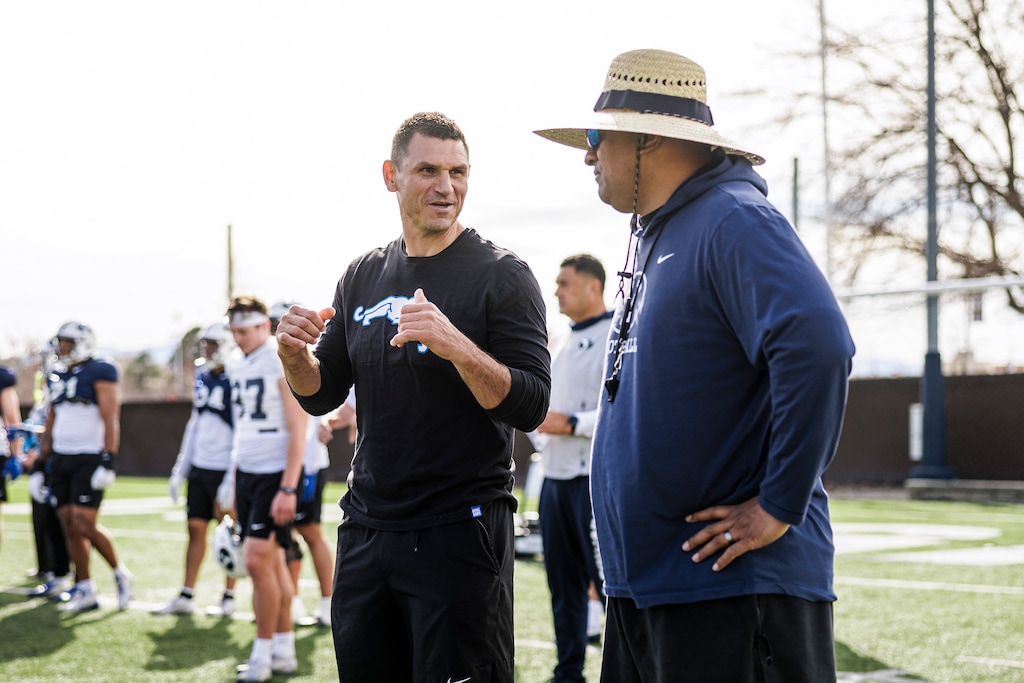
(Aaron Cornia|BYU) Defensive coordinator Kelly Poppinga looks to build on what his predecessor did at BYU.
Hill got a whole lot of the credit for BYU’s prowess over the past two seasons, a 23-4 record through that span, the wins often coming by way of the Cougars’ rugged resistance. Hill utilized a multiple-front, middle-post, man-free, cover-three defense, with variances mixed in, alternating between man and zone coverages, between throwing the house at the quarterback and dropping just as many assets into the back end.
“It wasn’t very complicated,” Poppinga says. “But sometimes it could be.”
And that’s the way it will be again. Just complicated enough with proper timing to confuse quarterbacks who, under the new coordinator’s direction, will have difficulty reading and recognizing and reacting to what they’re facing from down to down. At least that’s the intention.
And the expectation.
“That’s our challenge as a defensive staff, to take this to a whole other level,” Poppinga says. “There’s a ton of stuff we can continue to improve on to make our defense what it can be. And, yes, you — we — can feel the expectation. …”
He pauses, then carries on.
“… We’ll be sound. We’ll be disciplined. We’ll play extremely hard with high effort, high intensity. Guys are going to be flying around. It’ll be attacking. We plan to be versatile in what we do. You’ve got to move the pieces, and we will.”
As important as the philosophical and technical aspects are to putting the hammer down on opposing offenses, there’s also the human side to heading, managing and motivating a group capable of doing so. Poppinga whispers that the talent and experience on BYU’s defense in 2026 is about as deep as it’s ever been. We’ll dive further into that in a minute. But he also understands that he’s the leader of the pack now, and he believes he’s fully capable — with support from other assistants and Sitake — of throttling straight into that role.
“I feel prepared, that I’m ready to call a defense,” he says. “This is my 18th year [in coaching]. If I’m not prepared by now, I must have done something terribly wrong.”
(Aaron Cornia|BYU) BYU defensive coordiantor Kelly Poppinga speaks to the media.
Poppinga has been immersed in football much longer than just that. He was pretty much baptized into the game from an early age; his font being the basement of his family’s home in Evanston, Wyoming. That’s where he padded up and engaged in battles with his older siblings, Casey and Brady, usually ending up on the business end of their brotherly brutality.
It sounds like a cliché, but that business punctured holes into walls, frequently left there by Kelly’s body parts being slammed into them.
“Football was a part of us,” he says. “So were other sports and outdoor activities. We were either burning something down or blowing something up or shooting something. We fished, we hunted, we four-wheeled, we snowboarded, we drove trucks through mud and snow. That’s who we were. But it’s true, my dad literally had to go down into the basement with the plaster and patch those holes up. I was the little brother getting the crap beat out of me. But I learned from those guys.”
Learned that it was better to give than to receive. K-Pop grew, then, to be a linebacker.
Casey, 48, played at Utah State, then ricocheted through three NFL teams over a short period. Brady, 46, played at BYU, then for the Green Bay Packers for six years, finishing up his pro career with St. Louis and Dallas.
Kelly, 44, played for two years at Utah State and two years at BYU, where he was elevated to team captain during his senior season. He caromed around the NFL for a year, fortuitously enough landing on the Arizona Cardinals the year they went to the Super Bowl. He stood on the sideline as a practice-squad player, taking in the spectacle of it all.
His father, Dennis, was a tight end at BYU from 1968-71.
Not to be left out on the Poppinga Family Richter Scale of Toughness, his mom, Vicki, was a labor-and-delivery nurse who worked the late shift. “She’d work all night, then come home and get us ready for school,” Kelly says.
After his playing days ended, Poppinga returned to BYU as a graduate assistant under Bronco Mendenhall, then as an outside linebackers coach — mentoring players such as Kyle Van Noy and Fred Warner — and special teams coordinator. When Mendenhall left for Virginia, Poppinga went with him, eventually becoming co-defensive coordinator. Later, he coached at Boise State before Sitake hired him back at BYU in 2022, where he worked under Hill.
Now, he’s replaced him. And he’s cool with it.
(Aaron Cornia|BYU) Defensive coordinator Kelly Poppinga coaches during a practice at BYU.
Poppinga has players in the fold to keep him cool, talented players he says, too numerous to name, fearful that he’ll miss one or two or three or four. Nonetheless, stellar defenders include guys like Isaiah Glasker, Cade Uluave, Evan Johnson, Faletau Satuala, Keanu Tanuvasa and more.
Uluave, an accomplished linebacker who transferred in from Cal for his senior season, said in a short time he’s already absorbed much from his new coaches: “I wanted to get developed here and I think Coach Pop has done a great job.”
In so many words, Poppinga says the guys up front are capable of containing the run and pressuring the quarterback, the linebackers are explosive and instinctive and the DBs are proven.
On that last count, Poppinga says: “We’re better than we’ve ever been, where we have guys who can match up. We have the personnel to be able to play man and then some blended zones. That gives you your best chance to play great defense. When you can lock up and take an offense’s best players away, that’s a great weapon.
“You’ve got to stay healthy, and we have the pieces to be real good, but … eyes on the trail.”
Eyes on the what? On the trail.
That’s the motto Poppinga has come up with for his defense.
Turns out, BYU’s new defensive coordinator is a madman for mountain biking. He rides as often as he can to get away from the pressures of coaching. He fails at that, naturally, as demo’ed by this little ditty he’s having printed on team T-shirts. Notions for solid and innovative defense chase him like a schnauzer on a slab of meat. “Some of my best ideas have come on my mountain bike,” he says.
Stuff like, “Keep your eyes on the trail”?
“If you don’t, that’s when you get in a wreck,” he explains. “Same with football. We use that to remind our players to stay focused, to stay humble and hungry, to keep going, to keep getting better.”
Back to the question at hand: What will Poppinga’s defense look and play like?
“We have great talent, great coaches,” K-Pop says. “We’ll have answers. We’ll have answers.”