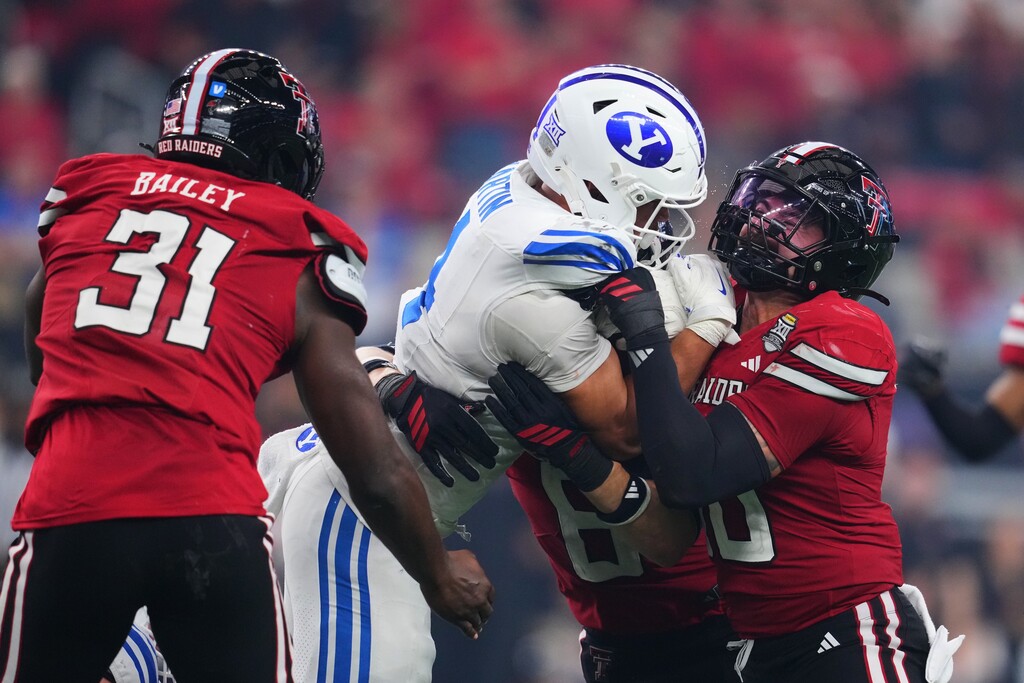
This summer, The Athletic’s college football staff embarked on an ambitious project to find out how much every Power 4 school spent on its 2026 roster. We worked to get as many independent, trustworthy estimates as possible from people inside and outside a program: those who broker the deals, direct the teams from the sidelines on Saturdays and watch the games from luxury boxes.
Here’s a breakdown of our findings in the Big 12 and some thoughts on what the data tells us.
Texas Tech, predictably, is at the top — but not as high as some think
The Red Raiders set the pace last year in the Big 12, spending upward of $25 million on their “open checkbook” roster that won the Big 12 championship and made the College Football Playoff. It was money well spent, and Tech had no intentions of slowing down.
Billionaire booster and Tech board chairman Cody Campbell hasn’t been shy about the Red Raiders’ commitment to spending, so some have speculated that Tech has one of the most expensive rosters in the country. But that isn’t the case this year.
One reason is that Tech is spending a lot less than expected on quarterback after Brendan Sorsby’s departure shaved $3 million to $4 million off the Red Raiders’ roster. Sorsby was expected to earn between $4 million and $5 million but was allowed to keep what the program paid him before he left the team, believed to be around $1 million.
BYU’s number informs Kalani Sitake’s public comments
Texas Tech and BYU were often assumed by conference rivals in 2025 to be head and shoulders above the rest of the league in spending. But this year, it appears only Texas Tech is on an island, and BYU is much closer to the rest of the pack.
Sitake, the Cougars’ 11th-year head coach who is 86-45 overall and 25-4 since the start of the 2024 season, has publicly emphasized his program’s need for more. In an August interview with Cougar Sports, Sitake said, “We can do way more at a faster rate.”
The school and its alumni stepped up to keep Sitake last year when Penn State considered him for its head coaching job. Now he’s pushing for more for his roster, which is justifiable given the results. Sitake doesn’t just want to compete for Big 12 championships — he wants to be consistently in the national discussion. His team just missed the CFP the last two seasons. With some exceptions, most CFP contenders are spending above $30 million, which is significantly higher than the Cougars’ estimated range.
Aside from Texas Tech, the Big 12 has the smallest top-to-bottom variance
The Big 12 is often considered the standard-bearer for unpredictability and top-to-bottom competitiveness. In the league’s latest 16-team iteration, there isn’t a large gap in roster talent or resources, and that’s reflected in the roster budgets, too (except Texas Tech, of course).
The player-spending separation between the No. 2 and No. 16 team in the Big 12 appears to be no more than $12 million and possibly as low as $9 million. That’s a big difference from the ACC ($21 million-$24 million difference between last and second), the SEC ($25 million) and the Big Ten ($32 million-$38 million).
Oklahoma State’s surprisingly low number
The Cowboys signed a top-10 transfer class headlined by a high-priced quarterback (Drew Mestemaker, who’s believed to be making around $3.5 million this season) and a coveted running back (Caleb Hawkins) and receiver (Wyatt Young). It wouldn’t be shocking, based on known positional rates for transfers, if that trio accounted for around $5 million. Each could have commanded more than they’re getting paid by Oklahoma State on the open market but likely took a little bit less than their highest offers because they were following their head coach, Eric Morris, from North Texas.
But this is a team that added 92 new players, including more than 50 transfers. It’s not cheap, but the Cowboys managed to construct the roster for less than $20 million. Not bad, considering they took down a team last week that spent more than double that in Oregon.
It should be noted that Oklahoma State lagged behind its peers in roster spending in the last few years of the Mike Gundy era, so in many ways, the program is still playing catch-up.
New P4 programs in the bottom half of the spending race
The Big 12 has three schools that are still relatively new to the power conference landscape. Cincinnati, Houston and UCF were all in the American in 2022 before joining the Big 12 in 2023. That means they weren’t getting the type of media revenue dollars that legacy Big 12 schools were, a difference of roughly $30 million annually at the time they entered. Plus, those schools didn’t receive full shares of conference money distributions until their third year as members (they received prorated shares of a little less than $20 million their first two years).
So those three are still trying to close a gap in overall revenue before we even discuss roster budgets. UCF and Houston appear closer to the middle of the pack, while Cincinnati is in the bottom quarter of the league. Of those three, Houston seems to be getting the most bang for its buck. The Cougars won 10 games last year and are considered a Big 12 title contender this year after signing a top-25 transfer class and a top-35 recruiting class.