 Gordon Monson
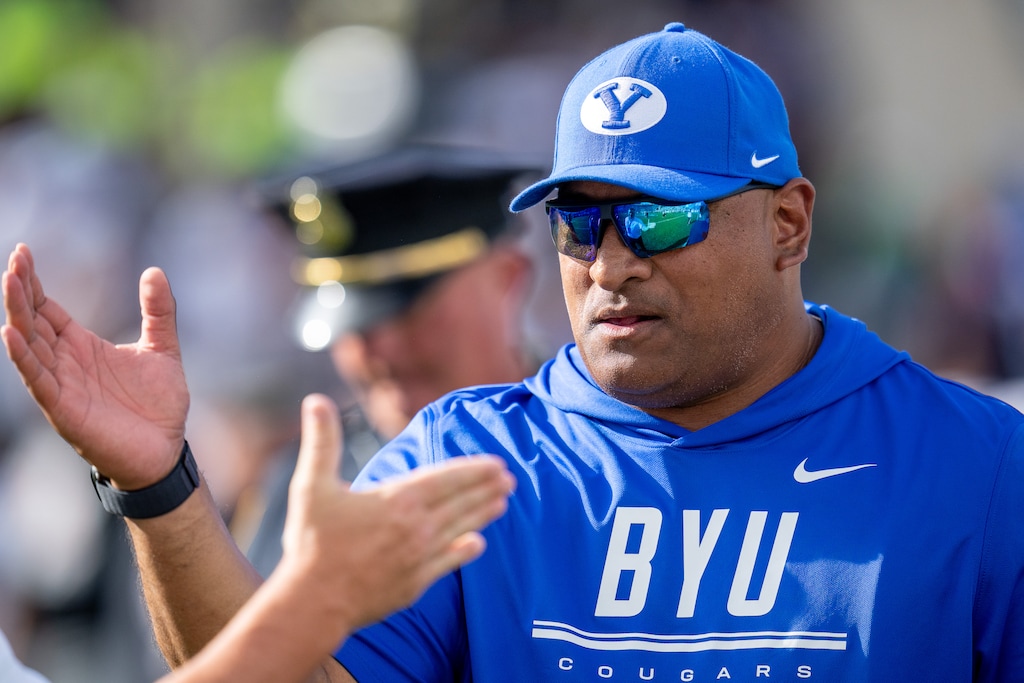
Those who complained that 1) BYU was buying its way to football success in some outrageous, extraordinary way, and 2) Kalani Sitake was a spoiled-brat kind of coach when he barked that he had to do the most with the least (resources) were wrong on both counts.
That’s the takeaway from the recent report from The Athletic that noted and compared the estimated money that Power 4 college football programs spend on their rosters in order to advance their teams toward competitive success.
BYU was found, according to the report, to fall pretty much in the middle of the pack in its spending, somewhere in the $20 million to $25 million range. By comparison, the top 10 money-chuckers were — Ohio State ($49-54M), Oregon ($48-54M), Texas ($45-55M), LSU ($47-50M), Texas A&M ($45-50M), Miami ($44-50M), Notre Dame ($41-48M), Ole Miss ($39-45M), Tennessee ($41-43M) and Alabama ($38-42M).
The Cougars’ top-spending Big 12 opponent was, not surprisingly, Texas Tech, which was found to spend about the same as Alabama, followed by TCU, which was in the $22 million to $25 million range.
Prominent schools that ranked ahead of BYU, other than those already mentioned, were USC, Indiana, Michigan, Florida, South Carolina, Auburn, Nebraska, Georgia, Oklahoma, Clemson, Penn State, Wisconsin, Missouri, UCLA, Mississippi State, Virginia Tech, Florida State, Vanderbilt, Georgia Tech, Kentucky, NC State, Arkansas, Louisville, Maryland, Michigan State, Northwestern, Washington and then … BYU.
The report noted that Utah was 11 slots down from the Cougars, spending an estimated $18 million to $22 million.
What exactly does a list like this say?
First, it says that if a school wants to be at or near the top of college football, it has to shell out for its players. It has to pay to give itself a chance to play. That’s a given, not an entitlement, not just in football but in many facets of life.
While these numbers are estimates, it’s still a clear indicator, in a general sense at least, that to compete with college football behemoths, your resources have to be monstrous, too. Not to a T, but somewhere in the ballpark.
Indiana won the College Football Playoff last season, and it ranked 13th on this list. Notre Dame was seventh, and the Irish didn’t even qualify for the playoff. Nothing’s exact, certainly not in any single year. But in the modern game, if a school seeks to be the best, it’d better live — and open up the wallet — like the best. In that way, college football is like a lot of other businesses. Winning requires investing. Schools that are unwilling or unable to do so … well, they’d better be satisfied with finishing second, third, fourth, fifth or last.
The questions all schools that have access to the necessary funds must ask are: How bad do we want to win? Is winning worth the cost to us? Are we getting the most out of what we are spending? If we are doing that, how much more can we get by laying out a bit more?
There are a thousand other questions, but this much is fact: BYU is getting, if not the most, a whole lot out of what it is spending. How much more can it get if it enables those who can contribute to the resources to go ahead and stack those contributions higher?
That’s the tantalizing question that dances in Sitake’s mind.
In a season like this one, when winning the Big 12 and making the playoff seem to be the expected-but-still-unattained goal, how much more certain would those achievements be with the same resources that, say, Texas Tech expends? It must bump and jangle around in Sitake’s brain, the amount that Penn State ($29-32M) is spending, considering that advantage could have been his if he had taken that head coaching job.
My math isn’t great, but last time anybody checked, $29-32 million is more than $20-25 million. If Sitake was promised that the gap between those two outlays would be bridged or shortened — as well as other gaps, too — if he stayed in Provo, his frustration is completely understandable.
If all of this is a turn-off to some more traditional football fans, those who think athletes should consider themselves privileged to play college ball and should be satisfied with a scholarship and little more than playing for the glory of the school, and then that schools themselves should collect all the financial goodies off the backs of those athletes … well, that might have been the case back when fans were wearing raccoon-skin and bearskin coats, waving pennants and swallowing goldfish; it’s not the case now.
If schools want to rise to the top of college football, they have to pay the price, a price. It’s not a guarantee. But if they have vision and they’re fortunate, they’ll have the proper people — coaches, recruiters, trainers, administrators, boosters — in place to take advantage of the resources they have. It’s a double-fisted deal.
BYU needs more to do more. Sitake knows that. School bosses should, too. If they don’t intend to compete at that high level in football, fine. Whatever. Back off and back down and relax. Be Southwest Presbyterian State. Be thrilled with the Cougarettes winning national championships.
Otherwise, go for it. Do what’s required. If it doesn’t work out, it’s better to shoot for the stars and land in the trees than to shoot for the trees and land in the mud.
As to whether football really is worth the investment, ask folks at and around Indiana about that, as they celebrated — celebrate, still — the trophy earned with that investment this past season. They got what they paid for — and a little more.