 Jason Batacao
In Casidy Fried’s senior season with Utah Tech volleyball, she racked up 152 kills and 137 blocks. Senior Kennedi Knudsen led the team with 267 kills and was honored by the Western Athletic Conference.
Now both women want a fifth year of eligibility, and they’re suing the NCAA in hopes of getting an injunction that would let them play, according to a suit filed Monday in 5th District Court in Washington County. They’re currently enrolled at Utah Tech University and awaiting roster spots on the Trailblazers team, it said.
The lawsuit is one of dozens of lawsuits filed against the NCAA across the country over a new rule it adopted this year allowing college athletes five years of eligibility. No other athletes are known to have filed lawsuits in Utah.
Former Utah State basketball players MJ Collins Jr. and Kolby King were among the athletes who sued the NCAA in Ohio after its eligibility rule changes in June. After a judge’s ruling, both were deemed eligible. Collins transferred to Cincinnati, and King transferred to Auburn.
Fried and Knudsen allege that the NCAA breached its bylaws by not grandfathering in Class of 2022 athletes under the new five-in-five eligibility rule; the old rule capped eligibility after athletes competed in four seasons.
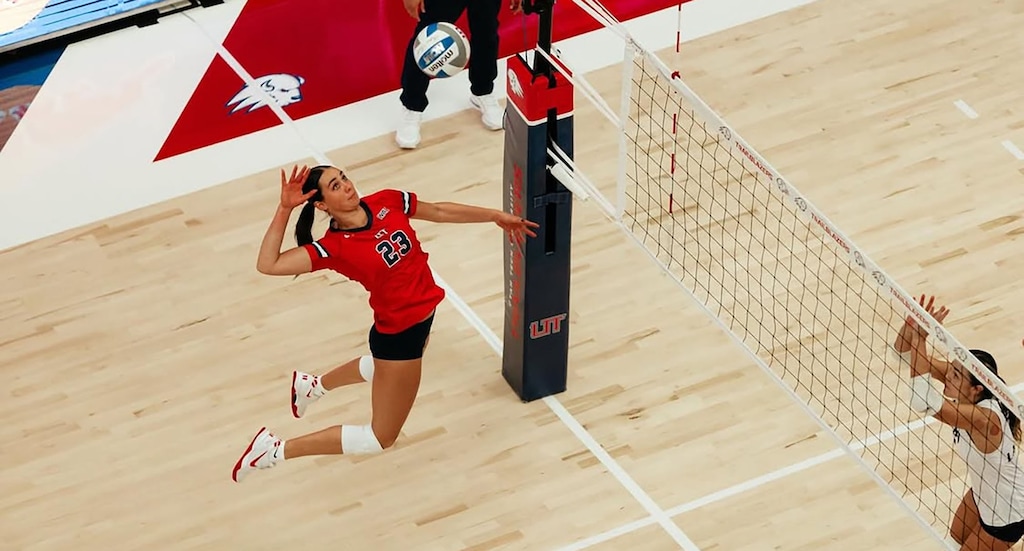
(Utah Tech) Utah Tech volleyball player Kennedi Knudsen cheers with her team.
Fried and Knudsen claim that if the NCAA’s position stands, both risk having their monetary aid reduced or pulled entirely. According to their lawsuit, neither could afford to finish her program without the financial support tied to competing for the Trailblazers.
The university declined to comment, stating the lawsuit is a personal matter between the two student-athletes and the NCAA.
The NCAA did not immediately respond to a request for comment.
In previous lawsuits, the NCAA has argued that the “five-for-five” model should not be applied retroactively because it could create widespread roster disruption.
Fried and Knudsen claim that won’t be the case at Utah Tech. The volleyball team has filled only 15 of its 18 roster spots this season, the suit said.
Fried and Knudsen claim that they should already be eligible under the NCAA’s actual rulebook, which now caps eligibility by years since enrollment rather than seasons played.
They also argue that the NCAA’s justification for blocking them exists only in a press release, not the bylaws themselves.
Fried and Knudsen also claim the NCAA’s “seasons-of-competition rule” violates the Utah Antitrust Act. The lawsuit argues the rule amounts to an agreement among competing schools to lock a category of athletes out of the market for roster spots, scholarships, revenue-sharing and NIL deals.
Without being granted a permanent or preliminary injunction, the Utah Tech starters would be unable to suit up for the 2026-27 season.
No hearing date has been set in the Fried and Knudsen case yet. But a related development looms: The Judicial Panel on Multidistrict Litigation is set to convene in Chicago on Sept. 24, 2026, to consider consolidating a wave of similar antitrust suits challenging the NCAA’s eligibility rules — a decision that could shape how, and where, this case moves forward.
The Trailblazers have already played eight games this season, starting the year 5-3, with key wins coming against Oregon State and San Jose State.
Jason Batacao, a former Oklahoma City resident who graduated from the University of Oklahoma, covers the University of Utah for The Salt Lake Tribune. When he’s not covering the Utes, Jason enjoys watching movies, playing on his Xbox Series X and reading books.