 Peggy Fletcher Stack
On one side, Micah Christensen descends from English settlers who arrived on the Mayflower, and on the other, Jews who fled violent pogroms in Russia. Both immigrant families landed in Utah and instilled in their children a love of the arts and the sacred.
Christensen’s two legacies now are merged in his newly acquired building near downtown Salt Lake City (and a few blocks from his family business, Anthony’s Fine Art and Antiques): the historic B’nai Israel Temple, which opened this weekend as the Salt Lake Art Museum.
(Trent Nelson | The Salt Lake Tribune) The Salt Lake Art Museum, formerly B’nai Israel Temple, on Monday, July 20, 2026.
“I’d like to think that my great-grandfather, Philip Louis Fishler, a Jewish refugee who loved opera and art and who worshipped in this building,” Christensen says, “would be happy with its new use.”
The Jewish landmark was dedicated in 1891, two years before Mormon pioneers completed the iconic Salt Lake Temple. And for the next eight decades the imposing structure at 249 S. 400 East served as the center for much of Jewish life in the Beehive State.
In a Sept. 27, 1890, story about the temple’s construction, The Salt Lake Tribune wrote that the building would be “an ornament to the city.”
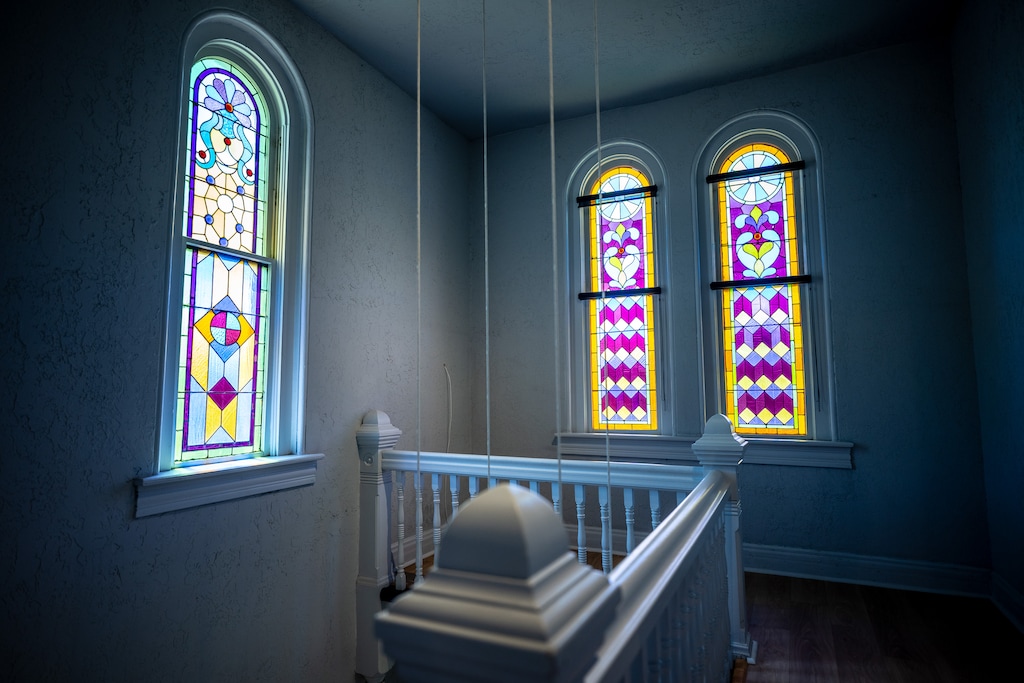
(Trent Nelson | The Salt Lake Tribune) Stained glass at the Salt Lake Art Museum, formerly B’nai Israel Temple, on Monday, July 20, 2026.
Indeed, for many it was.
It was “a place of education and instruction and finally a place where people came because they wanted to feel close to the community and to the Almighty,” Laurence Loeb, who served as the first cantor at the temple, recalls in a video interview for the museum. “It was the heart and soul of the founding Jewish community in Salt Lake.”
A pioneering community
(Trent Nelson | The Salt Lake Tribune) The Salt Lake Art Museum, formerly B'nai Israel Temple, on Monday, July 20, 2026.
Jewish immigrants began arriving in Utah in the 1850s. They met in houses, Masonic halls or “premises lent to them by the Mormon church,” according to background information provided by the National Register of Historic Places.
Some came from synagogues in Western Europe, including Germany, where “Jews began to acquire rights as citizens in the European countries in which they lived,” explains the history of the Reform Movement, “enabling them to dress as their neighbors did, study in public schools and universities, and pursue the occupations they desired.”
The movement caught on in the U.S. and B’Nai Israel, formed 1881, was among the first synagogues in the West to identify with it.
“This was a building where I felt pride in my religion, where people who were immigrants felt comfortable being here,” former Utah Sen. and Rep. Patrice Arent says in a video that is showing at the museum, “and where we learned about Judaism.”
(Trent Nelson | The Salt Lake Tribune) The Salt Lake Art Museum, formerly B'nai Israel Temple, on Monday, July 20, 2026.
Temple leaders hired Philip Meyer, a German native and nephew of Utah merchant Frederick Auerbach, to design the new synagogue. Henry Monheim, who worked on Salt Lake City Hall, was the temple’s supervising architect.
It “showcases Romanesque Revival architecture,” reads the museum’s website. “Its main facade features rusticated Kyune sandstone, while brick comprises the side walls and the drum beneath the dome.”
It was modeled after earlier synagogues in Berlin, Christensen says, and followed a traditional sitting format, where the galleries upstairs were for the women, with the men downstairs.
(Trent Nelson | The Salt Lake Tribune) A display on B'nai Israel Temple at the Salt Lake Art Museum on Monday, July 20, 2026.
“However, because it was a Reform synagogue from the very beginning, they almost immediately boarded up these areas and turned them into classrooms,” he says. “The men and women then met downstairs.”
Some traditionalists were “uncomfortable with that approach,” Christensen says, and so, in 1895, Conservative members created another synagogue, Congregation Montefiore, a few blocks away.
In the early 1970s, the two congregations merged to form Congregation Kol Ami — which means “all my people,” and accommodates Reform and Conservative members alike.
The past ‘in conversation with the present’
(Trent Nelson | The Salt Lake Tribune) Sam Hart, Micah Christensen and Chris Jensen at the Salt Lake Art Museum on Monday, July 20, 2026.
After the merger, the old synagogue housed several restaurants and businesses. It was put up for sale by 2023, and Christensen — in a partnership with historic preservationist Christopher Jensen — bought it for $3 million a year later.
The pair immediately began the transformation into an art museum.
It promises “to provide a dynamic space for exhibitions, lectures, competitions, and educational programs,” the museum’s website says. “Through regular retrospective exhibitions on both historic and contemporary artists, we honor Utah’s artistic legacy while fostering the talents that will shape its future.”
The focus will be on Utah artists.
(Trent Nelson | The Salt Lake Tribune) An exhibit on Julia Reagan at the Salt Lake Art Museum on Monday, July 20, 2026.
For his part, Jensen, the museum’s executive director, loves the juxtaposition of old and new.
“When you look up and you see these art glass windows sticking out and glimpsing over the walls at you,” he says, “I want you to know that in this place the past is in conversation with the present.”
In a modern context, it is about “the Jewish experience in America, but also the Jewish experience across the world,” he says, “and how both right now on the left and the right we have an antisemitic issue happening.”
Jensen also notes that architecture itself is art.
(Trent Nelson | The Salt Lake Tribune) The Salt Lake Art Museum, formerly B'nai Israel Temple, on Monday, July 20, 2026.
“When you look at how the temple was built and constructed, it’s very artistic in how it was done,” he says. “It’s a piece of art itself.”
More than ever, Jensen says the state needs museums.
In the latest census, he reports, “Utah had more artists per capita than any other state,” but it also “has the fewest art museums, second behind West Virginia.”
For his part, Christensen finds meaning in the twin uses of his building.
“Artists are absolutely inspired,” he says. “Their works are the fruit of that inspiration. The job of a museum is to be a steward of that fruit; to magnify it for the public so that we can all be knit closer together.”
Not too dissimilar, the collector notes, from the job of faith communities like Judaism.
(Trent Nelson | The Salt Lake Tribune) The Salt Lake Art Museum, formerly B'nai Israel Temple, on Monday, July 20, 2026.