 Peggy Fletcher Stack
 David Noyce
Utah Lt. Gov. Deidre Henderson began her political life as a 33-year-old stay-at-home Latter-day Saint mom of five, watching conservative talk show hosts on TV.
In 2007, Henderson decided it was time to jump into the fray herself. She started by volunteering with Jason Chaffetz’s congressional campaign, eventually becoming his campaign manager. By 2012, she ran for — and won — a state Senate seat.
She became known, according to The New Yorker, “for pragmatism but also for stubborn resolve on matters of conviction.” That was a quality Henderson would draw on again and again after Gov. Spencer Cox picked her to be his lieutenant governor.
As Utah’s chief election officer, she has had to battle the federal government, the Trump administration and members of her own Republican Party. When she refused the Department of Justice’s demand for Utah’s complete voter rolls, she faced lawsuits, investigations and threats of possible imprisonment — and even had to hire security to protect her — but held her ground.
The question is: Where did that courage come from?
Here are edited excerpts from The Salt Lake Tribune’s “Mormon Land” podcast, in which Henderson talked about her faith, her strength, her political convictions, the latest elections and why she has great hope for American democracy.
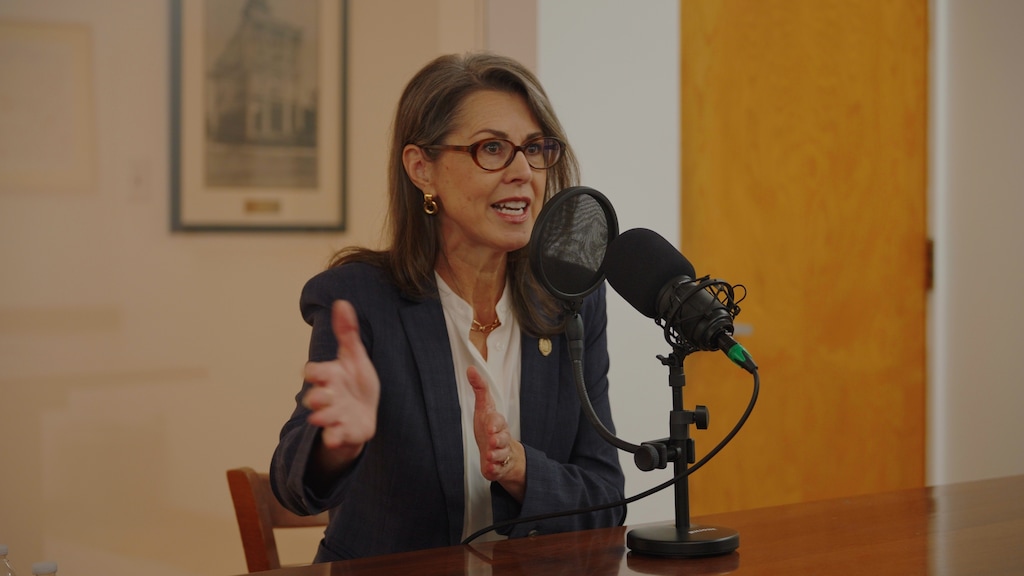
(Trevor Christensen | The Salt Lake Tribune) Lt. Gov. Deidre Henderson speaks with "Mormon Land" hosts Peggy Fletcher Stack and David Noyce. Henderson's first dive into electoral politics happened when she was in seventh grade.
Were you always interested in politics?
No, I kind of considered myself a political junkie, but I wasn’t interested in going into politics in any way. I actually ran for seventh grade secretary at Bennion Junior High. I was shy. I was too scared to ask people to vote for me, or tell them why I would be a good seventh grade secretary. And so I hid in the girls’ bathroom when they had the assembly where the winners were announced. I lost that race, and so I didn’t think politics was for me. But I did pay attention to national politics.
At what point did you imagine yourself running for office?
I never imagined myself running for anything after seventh grade. I thought my political career was over. … I think my mother was more surprised than anybody when I told her I was going to run for the Utah Senate in 2012. But I had paid attention to politics. I’d always voted. I wanted to get involved but didn’t know how. In the fall of 2007, my youngest child started school. I was looking for what was next for me. I really prayed hard for some direction. I needed guidance. In January of 2008, I guess my prayer was answered when my grandmother moved to Springville, and her new Relief Society president went to visit her. She happened to be the deputy campaign manager for a congressional race, and my grandmother said, “Oh, my granddaughter loves politics.” Her Relief Society president called me and invited me to come and meet the candidate. I volunteered to make phone calls and ended up working all year for free.
What were your politics then and how have they evolved?
I’m a lifelong Republican. I’ve always been quite conservative. When you’re listening to talk radio, there’s a lot of “we good, they bad” happening. So, yeah, I was influenced by a lot of that when I ran for the state Senate. When I got elected, I recognized that when it comes to problem-solving, not every single issue fits nicely into a black-and-white category. The older I get, the less I know. Problem-solving is an art, and it requires some measure of humility and curiosity — a lot of curiosity — and I needed to get a lot of perspectives to figure out how to actually solve the problems that I wanted to solve.
Why did you ultimately decide not to hand over voter rolls to the Justice Department? Did faith inform that decision?
Faith has informed a lot of my decisions. I’ve tried to be prayerful and mindful of my responsibilities. I take my oath of office very seriously to uphold the Utah Constitution and the U.S. Constitution, and to discharge the duties of my office with fidelity. Part of that requires understanding what the law is — and sometimes it’s unclear. When the Department of Justice started sending demands for unredacted voter roll information, it seemed off. So we spent some time looking at what the Utah law was. What are the federal laws that apply? We ultimately decided that not only did the Department of Justice not have the need for those, but there also were laws that would prohibit me from actually disclosing that information to people, including federal agencies that don’t have the right to that information. A federal court recently ruled in my favor, along with 26 other states.
When you said you felt “alone in the party,” what did you mean?
[Republicans] have over the past few years, especially the past two years, really developed a culture of fear in our party. Rather than being driven entirely by principle and principled resolve, we are often driven by fear — fear of the administration, what repercussions might happen to a state if we don’t fall in line, fear of what the party might say or do, fear of not getting reelected. Even if you don’t think something that’s going on is right, “let’s just get through this and wait it out and still be standing on the other side to do good things.” But there comes a point where silence is no longer a virtue. My responsibility, especially as chief election officer of the state, is to stand up for what’s right, to speak the truth, to help people understand what’s happening, and to call out our own party when we’re doing things that aren’t right, so that’s what I did. I’m the only chief election officer of the state of Utah. That responsibility is mine.
(Trevor Christensen | The Salt Lake Tribune) Lt. Gov. Deidre Henderson speaks on "Mormon Land" about why doing the right thing in politics can be its own reward.
Where did you find the courage to do that? Did your faith play a role in that?
My faith definitely plays a role in my willingness to do what I think is right, regardless of the consequences. And that’s the key when you feel fear. You have to be OK accepting the consequences of acting. If doing my job means I am not electable in 2028, then I’m OK with that. Let doing what you think is right be its own reward. That’s hard in politics. It’s hard in human nature. Certainly my faith helped with that conviction.
Do LDS Church positions on issues have any influence on you and Gov. Cox?
Sure, like any other religious faith. There are times — very rare — when religions will come out and say we like this policy, we don’t like this policy, and here’s why. That same thing happens with The Church of Jesus Christ of Latter-day Saints. They don’t get involved in very many issues, but there have been a handful of issues over the years where their perspective is definitely considered.
(Bethany Baker | The Salt Lake Tribune) Lt. Gov. Deidre Henderson listens to Gov. Spencer Cox during a news conference in 2025. She is considering running for governor in 2028.
Have your politics or your faith been changed by these experiences in the public arena?
I feel like my politics is always evolving and changing because I learn more. My ideas are not stagnant. I’m not the same as I was when I was 20. I am hopefully always learning and growing, and the more I learn about an issue, the more I learn about the complexity of it. I have been drawn to the issues that other people don’t care all that much about — the issues that don’t affect very many people, but the people that they affect, they affect them greatly. I’ve been focused on domestic violence issues. I’ve focused on return-to-work issues. I’ve focused on Native American issues. To me, the Savior’s call to feed his sheep, the Savior’s call to go after the one, the lost sheep, to remember the one, the one who’s missing, to look for who is missing and find them. That has been, I think, central to my identity as a politician.
Your party took a beating in the midterms, but, despite rampant fears ahead of time, the election seems to have gone smoothly. Does that give you hope or pause?
So much hope. Democracy did what it was supposed to do, this election, in all of the ways. We had a free and fair election. Eligible voters were able to cast their ballots and have them counted accurately. Despite massive amounts of unprecedented federal interference into our elections, we were able to hold the line. We were able to do our jobs. We were able to keep the guardrails of free government and democracy in place, and the voters had their say
Even though you lost Republican colleagues in positions?
Absolutely. I have dear friends who lost their seats, but you know what? These aren’t their seats. These aren’t my seats. These are the people’s seats. The people get to have a say, and the people had a say, and it’s a beautiful thing.
Did all the preparations that states like yours did for potential interventions help?
Yes, we tried really hard to message to the public that this election was going to feel very normal to them. And it worked. That’s remarkable in light of 15 months of just being hammered constantly with lawsuits, with threats, with intimidation, with trying to manipulate us into doing things that aren’t legal, trying to tell us we’re being investigated by the Department of Justice, that we could go to prison. The things that were happening were just remarkable in a very bad way, but what was remarkable in a good way is the fact that nothing they did worked. Those efforts failed at every turn, and it shouldn’t matter what party you belong to. You do not want the guardrails of democracy to be busted down like that. You do not want to see one administration subverting the will of Congress, the Constitution, federalism, the rule of law and muddying the waters.
Do you think a Latter-day Saint can be a good member and a Democrat?
Of course. In fact, our prophets have said multiple times, many times, that you don’t have to agree with every single thing in a party plank to be a member of that party or to vote for a person in that party.
Church President Dallin Oaks famously said in General Conference that election results should be honored. What were your feelings when you heard him say that?
(The Church of Jesus Christ of Latter-day Saints) President Dallin H. Oaks, speaking in General Conference in October 2020, said election results should be "peacefully accepted."
I have greatly appreciated leaders of my faith and other faiths, stepping up and saying what has happened in the past few years — to not accept results we don’t like — is not OK. We have to be able to live with the winners and the losers of elections. We have to live in peace. We don’t just respect sameness; we have to respect difference. That message has been really comforting to me. I know some people haven’t liked that message, and they’re the ones who probably need to hear it the most. But we all need to hear it. It’s really important in a free government to recognize that no, there’s always going to be another election. You lose this election? You know what? You’ve got another shot in two years, and that’s the way it works. We were told in 2024 that if [Joe] Biden won, the republic would be over. If [Donald] Trump won, our democracy would die, and that we wouldn’t have any more elections. And that’s not what has played out. We had another election.
Gov. Cox has ruled out a third term, and you said you are considering a run. What are your thoughts at this time for running for higher office?
I’m definitely considering running in 2028. We’ll see what happens.
What would you like our listeners to take away from this in terms of your faith and your politics?
Faith is very important, and we don’t talk about it as much in politics. Certainly not in a way that isn’t weaponized or manipulative. Especially Latter-day Saints, we just don’t talk about it maybe as much as people of other faiths do, and that’s too bad. I feel like we do need to talk more about our faith because it is foundational to who we are as people, how we treat others, and how we see other people. We should always strive to be Christlike in our actions, in how we see the good in others, and how we do good ourselves.
Note to readers • To hear the podcast, go to sltrib.com/podcasts/mormonland, or view it on YouTube. To receive ad-free “Mormon Land” episodes, along with our complete newsletter and access to all Tribune religion content, support us at Patreon.com/mormonland.