Anti-communism is having another moment in American politics.
“Communism is a mortal threat to American liberty,” President Donald Trump declared at Mount Rushmore on July 3. “It is the greatest threat to our country, including World War I, World War II, Pearl Harbor or even 9/11.”
Denouncing communism has become a common talking point on the American right. Instigated by the rising prominence of democratic socialists, as well as the growing unpopularity of the Republican Party and the current federal administration, conservative politicians have increasingly turned to labeling their opponents as not just “socialist,” a common bugbear in U.S. politics, or even “Marxist,” a frequent shorthand for liberal academics, but rather “communist,” a reference directly plucked from the long-deceased Cold War.
Prominent members within The Church of Jesus Christ of Latter-day Saints have played a crucial role in this ideological movement. They also continue to help shape that rhetoric today. Mormonism has supplied a unique and effective theological framework for anti-communism that remains compelling even to those who may reject its doctrinal origins.
Tracing the Latter-day Saint through line within U.S. anti-communism, particularly one text at the heart of the movement, sheds light not only on the faith’s evolution but also on the wider political climate to which the community remains tethered.
The rise of Cleon Skousen
It was far from predetermined that Latter-day Saints would become the capitalist-loving, communist-fearing stereotype for which they are now known. As outlined by several scholars, the community adopted, held and perpetuated ideas and practices that were deeply skeptical of free-market capitalism during the 19th century. Further, there were plenty of prominent Latter-day Saint figures in the early 20th century who supported, and even developed, federal policies like the New Deal that came to be known as the “liberal consensus.”
But once the Mormon community bought into the Christian libertarianism of the post-World War II era — which fused patriotism with free-market capitalism — there was little looking back. They, like many contemporaries, believed the United States was in a cosmic struggle with communistic, atheistic Russia, a battle that required a united front of religious and capitalistic allegiances. And there were several influential Latter-day Saint intellectuals who not only took this cultural fusion as gospel but also were able to package it for a broader audience.
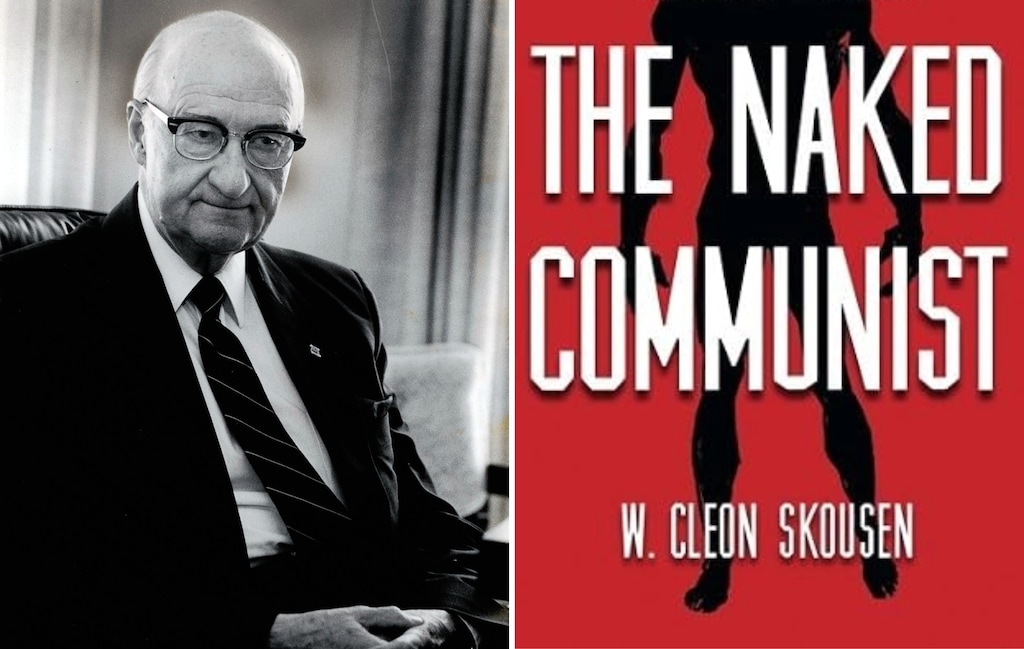
Few voices were as influential in anti-communist cause as W. Cleon Skousen. The charismatic and popular speaker spent decades touring the nation warning citizens of the real yet clandestine threats to national security and social morality. He spoke to thousands in Southern California’s Hollywood Bowl, influenced upstart politicians like Ronald Reagan, and befriended Christian activists like Jerry Falwell. His lectures, pamphlets, workshops and textbooks shaped generations of conservatives, even if his Mormon identity was often hidden — or at least downplayed.
Yet his bestselling work, “The Naked Communist,” a text that sold millions of copies and remains popular six decades after its publication, was deeply Mormon in its origins, content and promotion.
His work for BYU
After working as an FBI agent for more than a decade — back when being a “G-man” meant modeling a combination of law-and-order conservatism and God-fearing Christian nationalism — Skousen was invited to become part of the Brigham Young University staff as President Ernest Wilkinson aimed to transform the school into a premier institution of higher education. Though his primary job was to oversee the alumni office and help raise money, he quickly became known as a popular speaker, especially on the hot issue of communism’s many threats.
Church President David O. McKay, more moderate in politics but a rabid anti-communist, worried the Latter-day Saints were not taking the threats seriously enough. He encouraged Wilkinson to form a committee of faculty, with Skousen as chair, to write a textbook outlining the history, development and dangers of communism. The committee labored for a few years with limited success. The history and political science professors believed Skousen’s connections were outlandish and unsupported; Skousen feared they failed to recognize the depravity and extent of their existential opponent. All agreed that Skousen should probably work on it on his own.
(The Church of Jesus Christ of Latter-day Saints) President David O. McKay, left, with U.S. President John F. Kennedy in the Tabernacle in September 1963. McKay touted Skousen's book and warned against communism.
Skousen continued to chip away at the work, even after he was pulled away from Provo to become Salt Lake City’s police chief. But he struggled to find a publisher once it was complete. The Eastern presses were hesitant to take on the project due to the backlash that followed Joseph McCarthy’s congressional implosion. BYU turned him down when the faculty remained unconvinced of his argument’s merits. And even the church’s Deseret Book said “no.” Was Skousen’s grand work to go unpublished?
McKay, who initially suggested the project, stepped in. He told Skousen to do what he could to publish on his own,and that he’d make sure it was worthwhile.
Skousen, acting on faith, took out a second mortgage on his home, raising just enough money to sell 5,000 copies. “The Naked Communist,” featuring striking art from Arnold Friberg, was printed in early 1958 by Thomas Monson, who would become a Latter-day Saint apostle a few years later. The first year’s sales were meager as Skousen feared its content was “of interest primarily to technical people” and therefore was ignored by general readers.
At that point, McKay once again intervened. When he addressed the global church at a General Conference in 1959, he explicitly praised “The Naked Communist” and read from its flyleaf: “The conflict between communism and freedom,” McKay recited, “is the problem of our time. It overshadows all other problems. This conflict mirrors our age, its toils, its tensions, its troubles and its tasks. On the outcome of this conflict depends the future of mankind.” McKay then “admonish[ed] everybody to read that excellent book of Chief Skousen’s.”
The impact was immediate. Skousen and his book now had the seal of approval from the prophet. Realizing the opportunity, he repurchased his book’s copyright, found a new distributor and inaugurated several more printings. Within two years, “The Naked Communist” went through 10 new editions and sold close to 2 million copies. “The income from this book paid off our home mortgage and all,” Skousen wrote in his 1960 reflective essay, “and provided the foundation for my research and publication from then on.” His faith in prophecy was fulfilled.
Secret combinations
A prophetic endorsement would work only for Latter-day Saint audiences, however. “The Naked Communist” would not have become a bestseller if not for its appeal to nonmembers. But around the same time that Latter-day Saints began buying copies at the recommendation of their ecclesiastical authority, ant-communist circles, like the John Birch Society, also began praising the book for its sobering message.
A key to the book’s success was its ability to mask its Mormon origins. The cabalistic lineage of the nefarious actors seeking to overthrow liberty was evident to those with a Latter-day Saint background: They were merely the latest iteration of the “Gadianton robbers” and other secret combinations in the Book of Mormon and the faith’s Book of Moses. The categorization of human beings as either those who “act” or who are “acted upon” is also directly from restoration scripture. Indeed, the entire ideological framework of “The Naked Communist” fits within the Latter-day Saint plan of salvation, a continuation of Skousen’s popular books on church doctrines.
Yet Skousen presented these ideas within what he called a “sociological” exploration of communism’s history, development and recent encroachments into the U.S. government. The Book of Mormon is not cited, prophetic teachings are merely paraphrased, and the Bible is the only scriptural text invoked. This code-switching won over millions of people who might otherwise have denounced Skousen’s Mormonism as a “cult.”
That impact remains even today. At Charlie Kirk’s funeral last fall, former GOP presidential candidate Ben Carson name-checked Skousen’s “Naked Communist” for warning of Marxism’s secret infiltration. This past summer, culture warrior Jordan Peterson repurposed, without credit, Skousen’s assertion that Marxism is the modern version of a satanic spirit that dates back to Cain.
(Alex Goodlett | Special to The Tribune) U.S. Sen. Mike Lee, shown speaking at a Utah GOP convention this year, alleges that "Democrats prefer communism over capitalism."
And there are other Latter-day Saint figures today who are continuing that legacy. Sen. Mike Lee, R-Utah, has become among the most outspoken voices in denouncing communism, for instance, arguing that “Democrats prefer communism over capitalism,” but merely use “democratic socialism” because it “makes it sound nicer.” (Skousen, too, argued that “social democrats” were merely a front for “Marxist communists.”) And Glenn Beck’s media empire has been similarly primed to support Trump’s assertion that communists were “finally making their move,” an echo of Skousen’s popular appeals back in the 1950s.
(It’s not a coincidence that Beck was responsible for turning Skousen’s “5,000 Year Leap” into a bestseller in 2009, several years after Skousen’s death.)
Mormonism has played a crucial role for the anti-communist movement because several of its loudest voices, including and especially W. Cleon Skousen, have provided a theological matrix through which to view the threat to American liberty. Their arguments are a potent combination of Latter-day Saint scripture, Cold War paranoia, and free-market principles that bear the marks of their era while simultaneously claiming to capture eternal truths.
And in today’s climate, they appear more relevant and popular than ever.
(Benjamin E. Park) Historian Benjamin E. Park is writing a book about W. Cleon Skousen.
Note to readers • Benjamin E. Park is the author of “American Zion: A New History of Mormonism” and the past president of the Mormon History Association. He is currently working on a political biography of W. Cleon Skousen for Signature Books and a history of white Christian nationalism for W.W. Norton. He has a popular YouTube channel, Benjamin Park, Historian.