 Mark Eddington
His name adorns Utah’s redrock city of St. George, where stories about him keep his memory alive even though he never actually lived there.
By all accounts, 19th-century Latter-day Saint apostle George A. Smith was a colonizer, church leader, military commander and polygamist patriarch. He was also, historians say, a bundle of contradictions: warm and witty, yet capable of chilling moral blind spots. And since no definitive biography of him exists, sifting fact from frontier folklore is difficult.
“He was [church founder] Joseph Smith’s first cousin and was called as an apostle at the age of 21,” said Barbara Jones Brown, co-author of “Vengeance Is Mine: The Mountain Meadows Massacre and Its Aftermath.” “He still holds the distinction of being the youngest man to ever be [publicly] called an apostle.”
(Francisco Kjolseth | The Salt Lake Tribune) Emeritus general authority Steven Snow says George A. Smith is “considered the father of the southern Utah settlements.”
Despite his relative youth, the apostle shaped southern Utah. In 1851, Brigham Young sent Smith with the first colonizers to Parowan. According to Steven Snow, an emeritus general authority and former historian for The Church of Jesus Christ of Latter-day Saints, Smith also co-founded Cedar City, New Harmony and the Santa Clara Indian Mission. The settlements paved the way for the October 1861 colonization of St. George, leading Young to instruct apostle Erastus Snow to name the city after Smith.
“He was,” Snow said, “considered the father of the southern Utah settlements.”
(Church History Library) A view of St. George, including its prominent Latter-day Saint temple, from circa 1885 to 1895.
While Smith never resided in St. George, historians say, he helped develop what was then called the Southern or Cotton Mission by choosing the families who would settle there. Independent historian Amy Tanner Thiriot called Smith a “larger-than-life” character.
“He was dedicated to his faith, dedicated to the people, a beautiful writer and orator,” she said. “He really loved the people, and they loved him.”
Smith’s responsibilities didn’t end with colonization. During the Walker and Utah wars in the 1850s, Young appointed him military commander over all militia units in southern Utah. As federal troops advanced toward the territory in August 1857, Smith rode south to prepare Latter-day Saints for what was feared could become a fierce conflict.
“He really whipped the people up to get ready for a possible guerrilla war,” Brown said, unleashing fiery rhetoric to urge settlers to prepare for battle by storing grain and ammunition rather than selling them to California-bound wagon trains. Smith’s incendiary speeches, she added, stoked hostility toward emigrants.
On Sept. 11, 1857, after Smith had departed, Mormon militia members and recruited Paiute allies attacked a California-bound wagon train from Arkansas. They slaughtered men, women and any children old enough to remember the killers in what is known as the Mountain Meadows Massacre, the bloodiest stain in Mormon history.
‘Best-looking men and handsomest women’
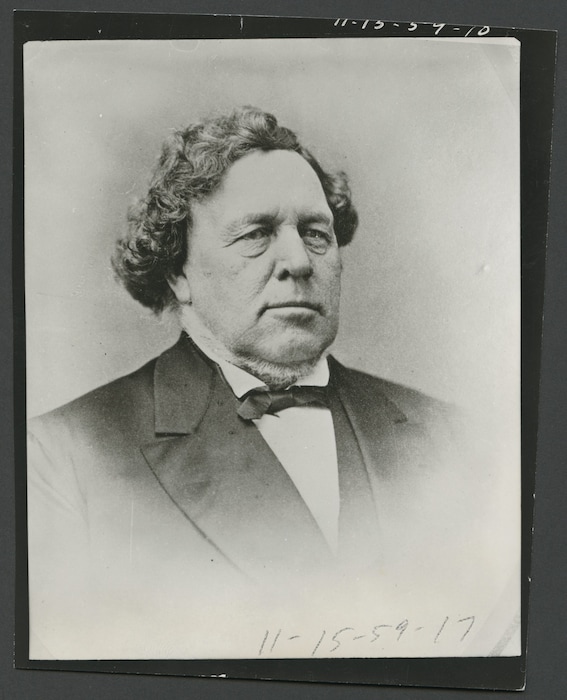
(Church History Library) Apostle George A. Smith, for whom St. George was named.
Beyond his apostolic duties, Smith acted as church historian and was a preferred emissary to non-Latter-day Saint visitors. From 1868 to 1875, he rose to Brigham Young’s first counselor in the church’s governing First Presidency. Moreover, Brown said, he loved books, had a prodigious memory, and was a gifted and colorful speaker.
During an 1855 General Conference address, for example, Smith extolled the merits of polygamy.
“Of all men upon the face of the earth, we are the most favored,” he gushed. “We breathe the free air; we have the best-looking men and handsomest women, and if they envy us our position, well, they may, for they are a poor, narrow-minded, pinch-backed race of men who chain themselves down to the law of monogamy and live all their days under the dominion of one wife.”
Physically, Smith was hard to miss. Heavyset — about 5-foot-10 and purportedly weighing more than 250 pounds — Smith wore a conspicuous wig and false teeth.
When preaching in hot weather, Brown said, he would take off his wig and mop his brow with it “to the delight of his audiences.” At times, he would remove not only his wig but also his teeth and glasses, which led one Paiute observer to nickname him “non-choko-wicher,” which means “takes himself apart.”
Other tales about Smith’s epic exploits sound like whoppers. One story has the portly pioneer propping up a sagging bowery roof while Brigham Young preached, prompting the church president to call him a literal “pillar of the church.”
Fanciful tales speak to his booming voice, which ostensibly could be heard a half-mile away. An additional account describes Smith curing a toothache by yanking out his tooth with a pair of blacksmith tongs.
(Francisco Kjolseth | The Salt Lake Tribune) Amy Tanner Thiriot, speaking at a panel in 2024, calls George A. Smith a "larger-than-life" character.
Another canard, according to Thiriot, is Smith’s reputation as the “potato saint” of St. George. She said that nickname arose earlier at Nebraska’s Winter Quarters, where Smith urged hungry Latter-day Saint refugees to eat potatoes to fight scurvy.
Smith’s darker legacy
(Barbara Jones Brown) Barbara Jones Brown is the co-author of “Vengeance Is Mine: The Mountain Meadows Massacre and Its Aftermath.”
Brown said the absence of a full biography — combined with sparse documentation and a tangle of “legends” and artificial intelligence-generated stories — makes it tricky to know which yarns about Smith to trust. Moreover, while many view Smith with affection and humor, she added, his documented conduct raises concerns.
While researching the book she co-wrote on the Mountain Meadows Massacre, Brown said, she learned Smith, unlike nearly every other observer, left no record of horror or grief after visiting the crime scene. Instead, she noted, he advanced false claims that blamed the victims for the atrocity and attributed the killings entirely to Native Americans.
(Stenhouse) A depiction of the Mountain Meadows Massacre.
Equally disturbing to historians was Smith’s role in the case of George Wood, who confessed in 1862 to slaying Olivia Coombs in Cedar City and nearly killing her daughter. Wood was subsequently convicted and sentenced to life in prison for shooting and beating them with the butt of his pistol.
At a lecture in 2021, Pulitzer Prize-winning historian Laurel Thatcher Ulrich recounted the grisly murder and its aftermath. She said Wood committed the crime after being told his 17-year-old son, Joseph, was involved in an intimate relationship with Coombs’ 13-year-old daughter, Emily.
Wood and his defenders framed the relationship as a deliberate attempt by the mother and daughter to seduce his son. They further alleged that Coombs and her daughter were trying to establish a “house of ill fame,” a baseless accusation Wood used to defend the killings as a way to protect his family and community morals, according to Ulrich.
For his part, Smith urged Wood via personal letter to keep quiet and stay calm, and promised aid would be forthcoming. The apostle simultaneously wrote his cousin, Judge Silas Smith, advocating for him to free the accused on bail.
“The killing of such a whore benefits the community enough to render the case bailable,” Ulrich quotes from Smith’s letter.
Smith subsequently signed a petition, along with 200 other men, that Ulrich said led the territorial governor, James Duane Doty, to pardon Wood.
Smith died in 1875 at age 58, leaving behind seven wives, 20 children and a legacy that resists simple storytelling. He was also the paternal grandfather and namesake of George Albert Smith, the faith’s eighth president.
“Like all human beings,” Brown said, “he was a nuanced individual. He had his good and his bad sides.”
For all his influence, Smith has largely escaped the kind of book-length treatment given to other 19th-century Latter-day Saint leaders.
Snow finds the lack of a comprehensive biography puzzling. “I wish there was a book about him, but there isn’t,” he says. “Someday, I hope there will be.”
(Church History Library) Apostle George A. Smith, for whom St. George was named.
(Church History Library) A view of St. George, including the Latter-day Saint temple, from 1890.
(The Church of Jesus Christ of Latter-day Saints) The St. George Temple on the day of its rededication in 2023.