 Peggy Fletcher Stack
 David Noyce
President Dallin H. Oaks, leader of The Church of Jesus Christ of Latter-day Saints, gave a landmark address recently in a soaring cathedral in the nation’s capital to a packed audience of politicos and insiders.
The former lawyer, law professor and Utah Supreme Court justice schooled his audience on how the U.S. Constitution offers a clear-cut manual for how to deal with profound differences — including political and religious ones — in a pluralistic society.
For Oaks, it seems to be an increasingly urgent message, which he has offered in several diverse venues, including to scholars in Virginia, Catholics in Rome and Latter-day Saints in their General Conferences.
Retired federal Judge Thomas Griffith, a Latter-day Saint, was in the audience at the Washington National Cathedral when Oaks spoke.
(Jacquelyn Martin | AP) Retired U.S. appellate Judge Thomas Griffith, speaking before a Senate committee, says Dallin Oaks is worried about the "toxic polarization" in the nation.
Here are edited excerpts from The Salt Lake Tribune’s “Mormon Land” podcast in which Griffith reviewed the speech, Oaks’ counsel, and why it may be crucial for this time.
Why was the National Cathedral setting important?
(Julia Demaree Nikhinson | AP) The Washington National Cathedral.
I have some real bias here because I am a lifelong Washingtonian. I was raised as an Episcopalian. I’m a Latter-day Saint now, but the cathedral hit all the bases for me. The Washington National Cathedral is, in many ways, the spiritual home of Washington, D.C. It’s an Episcopal cathedral, but it styles itself as a house of prayer for all faiths. Some of the nation’s most significant spiritual moments have taken place there. It’s a place where funerals for heads of state historically have been held.
In the wake of 9/11, President George W. Bush went there and delivered a major address at a time of national calamity. It’s a significant landmark, not just for Washington D.C. but for the nation at large. So the fact that the Episcopal bishop of Washington, D.C., wanted Dallin Oaks to come speak there is a really significant thing that shouldn’t be overlooked.
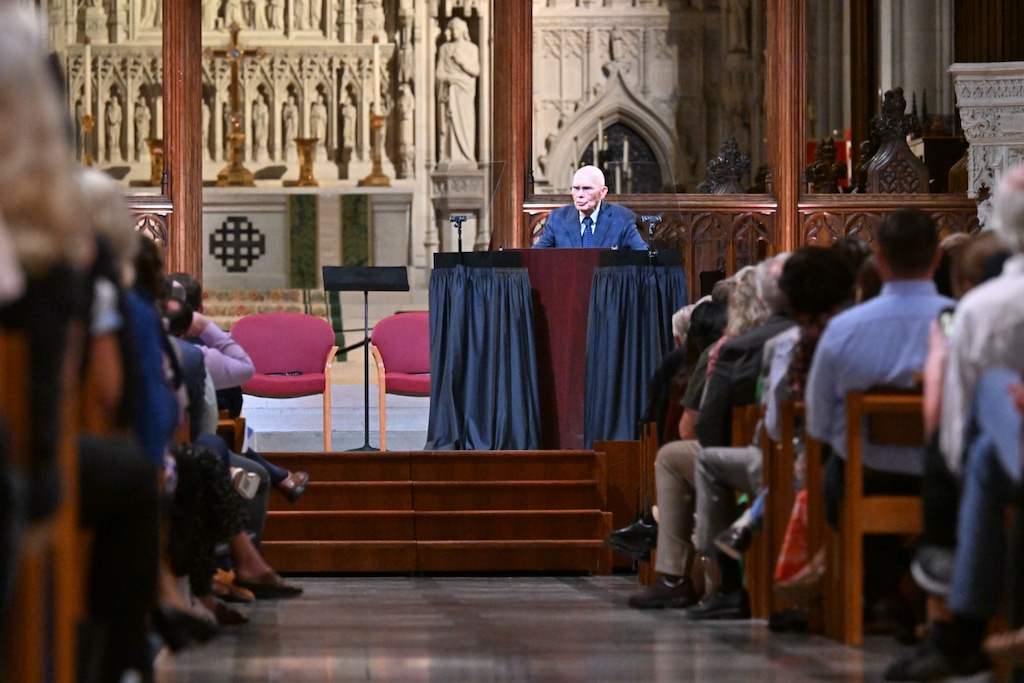
(The Church of Jesus Christ of Latter-day Saints) President Dallin H. Oaks speaks at the Washington National Cathedral, a majestic setting for many significant speeches in the country's history.
What was the essence of Oaks’ message?
There was nothing new in the sense that these are themes that President Dallin Oaks has been speaking about for years. The idea was that there are elements of the United States Constitution that are divinely inspired and that have applicability to all humankind. He reiterated the theme that he made in another landmark address at the University of Virginia that religious liberty has its limits. You just can’t invoke freedom of religion and that trumps everyone else’s interest all the time. This is a really important point he’s been making that not all of my friends have heard or understand.
To me, it wasn’t new, but the emphasis was more pronounced in this talk than in the previous talks. That was stressing peacemaking. You’re not going to resolve [deeply held conflicts] by going to court and battling out there. Courts are not equipped to do that. Those issues need to be resolved by people sitting down at a table, listening to one another, negotiating with one another, and finding imaginative ways to allow the maximum possible freedom for both sides.
(The Church of Jesus Christ of Latter-day Saints) President Dallin H. Oaks speaks at the University of Virginia in 2021.
Is that the way you understood the Constitution?
No. This is new to me. It’s an insight into the Constitution that I and many of us had overlooked for many years. I used to think that the primary purpose of the Constitution was to protect my rights — freedom of religion, freedom of speech, freedom of the press. I’m big on freedom of the press. I still think that’s a critical part of the Constitution. I used to think the critical part of the Constitution was the creative structure of government, separated powers, checks and balances, all that, and I still believe that.
But I’m now with President Oaks. There is something even more important. It creates a system of government that forces me to listen to my neighbor and to understand my neighbor. If you look at the structure of the government that’s created, unless you win a landslide, the only thing you win when you win an election is a seat at the bargaining table. If you want to be successful, you need to learn how to bargain, and the way to bargain, according to President Oaks, is you learn to listen to others.
I was quite moved by his comment that his views on religious liberty, in particular, changed when he learned that his particular views hurt other people. He said that cannot be. We have to move beyond that. That is a powerful sentiment.
Why do you think he keeps returning to it?
Based on what he said in his speech and based on my friendship with him, he cares deeply about the toxic polarization that is besetting our nation and increasingly our church. These are my words, not his. I actually think the Constitution is hanging by a thread. He didn’t say that, by the way, but I think it is, and it’s because of this — not just because of an overly muscular exercise of the executive branch or a supine Congress. The greatest threat to the Constitution right now is this toxic polarization because if you have contempt for one another, you cannot do what President Oaks is saying the Constitution was created to do. Over 70% of Republicans think that Democrats are evil. Over 70% of Democrats think that Republicans are immoral. The republic cannot survive that.
(National Archives via AP and Rick Egan | The Salt Lake Tribune) President Dallin H. Oaks, with the U.S. Constitution.
He didn’t name any particular politician or officeholder in his speech, but he did say citizens should follow the law and the Constitution, not a particular individual or party. Did that stand out to you?
Yeah, it did. But he’s been saying that for years. I heard another senior church leader say too many of our people have traded their religion for their politics. “The idea that my commitment to my party, be it the Democratic Party, Republican Party or whatever, that’s my primary commitment. That’s what I care about most. And then I’ll fit my religion in to sort of gloss over it.”
No, no, no, no, no, no. That’s not how it’s supposed to be. Our primary commitment is supposed to be to help the Lord build his kingdom on Earth, to be peacemakers, and then be politically involved. I’ve been politically involved my whole life, but that’s clearly a secondary or tertiary commitment. When the two come in conflict, there’s no question what you do.
Oaks famously said that Americans should accept the results of elections. Why do some members and Latter-day Saint politicians still seem to struggle with doing that?
(Francisco Kjolseth | The Salt Lake Tribune) Voting signs guide people to the Marmalade Branch Library in Salt Lake City in 2025.
I co-authored a report on the 2020 presidential election. The title of it was “Lost, Not Stolen: The Conservative Case That Biden Won and Trump Lost the 2020 Presidential Election.”
I don’t know why people struggle with it. This is the most studied election in the history of our solar system. We know exactly why President Trump lost. There’s no mystery about it. And there wasn’t fraud that changed the outcome of a single precinct. People who go around making these baseless claims based on anecdotes that aren’t supported by evidence that our election system is rife with fraud, I’m sorry, that’s just wrong.
Why do you, like Oaks, favor legislation over litigation to solve these complex conflicts?
Because judiciaries are faced with binary decisions, a litigant wins or loses. We resolve disputes between parties over discrete issues, somebody wins and somebody loses. We aren’t like Solomon. We don’t split the difference. We read the law and say we understand the law. You win. You lose. That’s it. Legislatures are designed to have people come together with clashing interests and to figure out a way to go forward as best you can in unity, if you can do that.
The Constitution bases its proposals on the presumption that differing parties do so in good faith. But we know there are bad-faith actors out there, and the Constitution has no answer for that.
You’re right. The famous quote from John Adams is: “The Constitution was written for a moral people, and it won’t work without it.”
The norms matter, and if people don’t care about the norms, they’ll ruin it. That’s why I’m worried. What can you do? You just do what President Oaks did. You talk, you act, you reach out, you try and do good, and you just hope that the American people respond.
I grew up watching losing sports teams all my life, so I’m not an optimist. But I am hopeful. And there’s some good news out there. The same social science research that shows us that we’re we’re bitterly divided also shows that 80% of American people hate this. They hate this. And when you drill down on issues, it turns out that the American people agree on a lot more issues than you think.
A culture filled with contempt can change. But there’s got to be people out there doing what President Oaks is doing, urging change and encouraging us to become the better angels of our nature.
Note to readers • To hear the podcast, go to sltrib.com/podcasts/mormonland. To receive ad-free “Mormon Land” episodes, along with our complete newsletter and access to all Tribune religion content, support us at Patreon.com/mormonland.