I first encountered a Latter-day Saint temple when I wandered around a city during an out-of-town high school debate tournament. Churches and cathedrals were already among my favorite tourist sites during family trips, but I learned — gently — that not just anyone can pop into a Latter-day Saint temple for a quick look.
Nothing stokes curiosity more than secrecy, and persistence paid off. I’ve toured several temples of The Church of Jesus Christ of Latter-day Saints, most recently in Washington, D.C. I admire the artwork and architecture of temples, and I’ve appreciated the warm welcome of people who have answered my questions along the way. In 2027, millions of visitors are expected to tour the iconic Salt Lake Temple after seven years of renovations and seismic retrofitting.
Temples are a defining feature of Latter-day Saint Christianity, and they have been from the beginning. The Book of Mormon, the faith’s signature scripture, is replete with references to temples, built by figures like Nephi and serving as places of preaching and teaching.
Church founder Joseph Smith and his followers were thinking about a latter-day temple soon after the faith’s organization. Oliver Cowdery, as he traveled west in October 1830 on his mission to Native tribes, explained that he and his companions would “rear up a pillar as a witness where the temple of God shall be built, in the New Jerusalem.” Joseph’s plans for Zion soon included 24 temples serving as “houses of worship [and] schools.” The Saints did not build a single temple in Independence, Missouri, let alone 24. Anti-Mormons drove church members out of Jackson County.
The Saints and their prophet were resilient when it came to temple building. Joseph consoled the elders who marched from Ohio to Missouri in a failed attempt to redeem Zion with the promise that they would receive “a great endowment” of power in Kirtland. “All who are prepared and are sufficiently pure to abide the presence of the Savior,” he promised as the Kirtland Temple’s completion neared, “will see him in the solemn assembly.” This endowment would send spirit-filled elders out into the mission field.
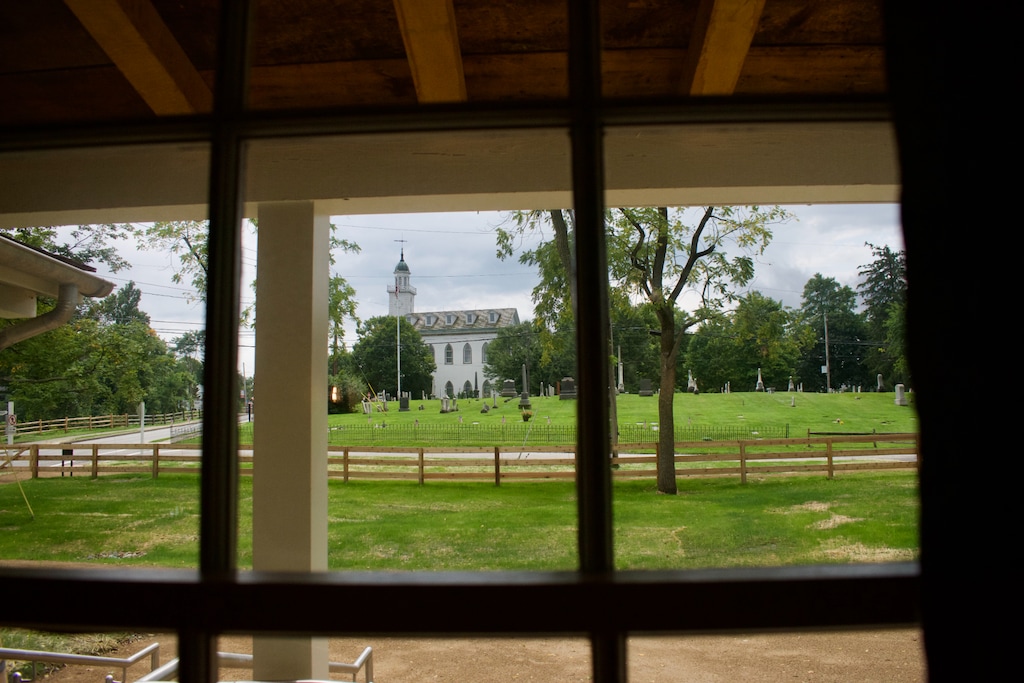
(The Church of Jesus Christ of Latter-day Saints) The Kirtland Temple in Kirtland, Ohio.
Joseph made good on that promise. In March 1836, after last-minute construction, washings and anointings, and late-night meetings filled with prayer and praise, the Kirtland Saints dedicated their temple, and Joseph gathered the elders for a solemn assembly. Men washed one another’s feet, and they partook of the Lord’s Supper. For hours on end, men prophesied, spoke and sang in tongues, shouted hosanna, blessed one another, and cursed their Missouri enemies. Some said they saw Jesus Christ; others reported seeing angels.
“It was a Pentecost and endowment indeed,” Joseph observed.
Mormon Kirtland imploded soon after the temple’s dedication. A failed bank called Joseph’s leadership into question. Fights broke out in the temple. The Latter-day Saint prophet soon had to leave everything behind.
Joseph excelled at starting over. Soon after he fled Kirtland for Missouri, an April 1838 revelation commanded the Saints to break ground on a temple in Far West. Conflict and carnage ensured that it, too, was never built.
The Nauvoo Temple
(Utah Historical Society) The temple looms over Nauvoo, Illinois, in this undated image.
By 1840, Joseph began talking about building a temple on a bluff overlooking the rapidly growing city of Nauvoo, Illinois. Joseph wasn’t just persistent in his emphasis on temple building. He was adaptive. The Nauvoo Temple became a sacred space for new rituals. “Let this house be built unto my name,” instructed an early 1841 revelation, “that I may reveal mine ordinances therein.” Joseph soon told the Saints to cease baptisms for the dead until a font in the temple was built. Another such ordinance was the endowment, which expanded upon the washings and anointings Joseph had introduced in Kirtland but reflected subsequent developments in the prophet’s theology. Joseph almost certainly would have relocated other rituals, including sealings, to the temple upon its completion.
After Joseph’s death, under the leadership of Brigham Young and the other apostles, thousands of church members came to the Nauvoo Temple to receive their endowments. There were many sorts of sealings: of husbands to wives, including plural wives; of parents to children; of church members as adopted children to high-ranking leaders.
“Many wept for joy that were adopted into my family,” Young wrote.
The Nauvoo Temple served other purposes. It was a refuge for Young and other church leaders seeking to avoid arrest and threats on their lives. They sometimes slept on sofas. The temple was also a place for both spiritual ecstasy and recreation. Young and other Saints spoke in tongues in the temple, but there were also more ordinary forms of mirth. Violinists and brass musicians played. Young “danced before the Lord,” and the floor was on one occasion covered with dancers. The Lion of the Lord even led a “French Four,” a dance for two couples, and the Saints sang about erecting “towers and temples … along the Pacific sea.”
Joseph and Brigham: Innovators
(The Church of Jesus Christ of Latter-day Saints) Joseph Smith, left, and Brigham Young, the first two leaders of the Latter-day Saint faith, were unafraid to embrace changes.
The early history of Latter-day Saint temples is characterized by false starts, spiritual peaks, and the promise of more to come. Joseph stated that a vignette among the papyri of the Book of Abraham (part of Mormon scripture) “contains writings that cannot be revealed unto the world; but is to be had in the Holy Temple of God.” Who knows what Joseph would have revealed had he lived to preside over the Nauvoo Temple’s brief period of activity? Both he and Brigham were innovators, unafraid to introduce changes in theology and ritual.
Many of Joseph’s religious innovations stuck. His textual productions remain scripture for Latter-day Saints, the church retains the various quorums of leadership he introduced, and many of his rituals remain integral to the tradition.
There have been further changes. The church has discarded certain ordinances, such as the sealing of couples to high-ranking leaders as adopted children. The endowment has undergone substantial revisions on a number of occasions. Temple architecture, furnishings and clothing have also changed. As far as I know, one doesn’t find “French Fours” or speaking in tongues within Latter-day Saint temples anymore.
Joseph Smith insisted on the centrality of temples and was willing to revise their purpose and content. I imagine he would be pleased that instead of 24 temples in Independence, the church has, as of this writing, 222 dedicated temples around the world today, with another 163 planned.
As for me, I haven’t gotten my fill of temple open houses. I can’t wait until next year.
(Chris Samuels | The Salt Lake Tribune) John Turner, left, and his book "Joseph Smith: The Rise and Fall of an American Prophet."
Note to readers • John G. Turner is the author of “Joseph Smith: The Rise and Fall of an American Prophet.”