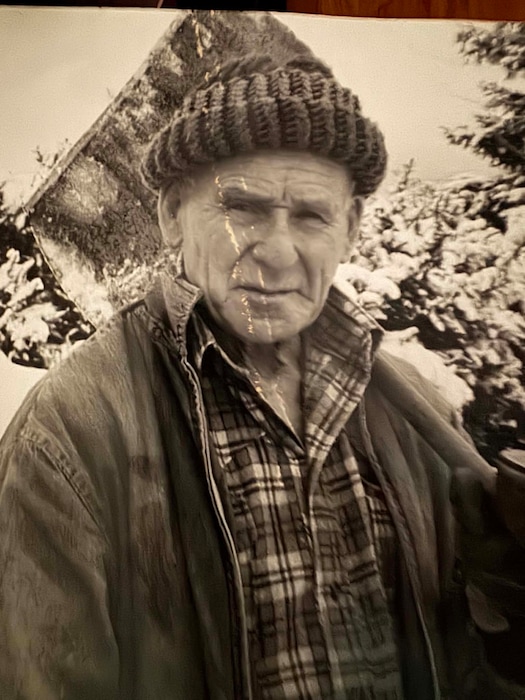
In 2007, I was on a college break and decided to stay at my parents’ house for a few days. They had converted my old bedroom into general storage space for everything they weren’t using but felt weird about discarding for one reason or another.
I have a similar space in my own home, which my husband likes to call “the room of forgotten hobbies” when he wants to hurt my feelings. This is in reference to the piano I don’t play, the guitar I don’t play, the ukulele I don’t play, and the harmonica I never played but bought after returning from a trip to New Orleans, where I had convinced myself I was now going to live a completely different life. But I digress.
Having trouble sleeping one evening, I began to dig through the closet in my old bedroom, uncovering family heirlooms — photo albums, my parents’ yearbooks from the 1970s, my younger sister’s modest-is-hottest prom dress.
Deep in the back of the closet I retrieved a small box of cassette tapes with faded labels that read “Grandpa Hinkle Life History April ’84.” I located a tape recorder and popped in one of them. It began with static, which gave way to a familiar voice I hadn’t heard in more than a decade: my great-grandpa Glenn Lisle Hinkle, who died when I was 14.
He was talking, the way I remember he so often did throughout my childhood, about his past. After a minute or two, a second voice joined in and surprised me. It was my mom’s. She asked him a question, and he answered her with a story. Per the date on the tapes, mom was about eight months pregnant with me when these were recorded.
I stayed up much of the night listening. Grandpa told stories of growing up in poverty around the time of World War I. About the day his stepfather pulled a gun on him. About driving a taxi during the Great Depression and barely managing not to starve. About meeting my great-grandmother shortly thereafter and dating her for some time before she finally disclosed she had two children. He was enamored with her and thrilled to suddenly become a dad.
The stories went on and on. Tape after tape of my mother patiently listening to him and delicately responding to this man who had a tendency toward wild mood swings that probably would be diagnosed and medicated today. (In his final years, he would famously end gatherings in his home by shouting, “What’s it going to take to get you people to leave?”)
‘He was my grandpa right away’
The next morning, I was eager to ask my mom about the tapes. She had married into this family only eight years before recording those stories at age 30.
Her own two grandpas had died long before she ever got a chance to meet them, so when she married into this family, Grandpa Hinkle became the only grandfather she would ever know, and she felt connected to him.
“He was my grandpa right away,” she told me, adding that he instantly treated her like family. “He would hand me 10 yards of denim to make him overalls to wear in his garden, where he’d overgrow barrels of vegetables to give me to can for you kids,” she said. “We took care of each other.”
In 1984, it occurred to mom that grandpa was getting older and his memory was slipping. She knew generally he had had a hard and complicated life, one that was sometimes a mystery to the family, so she asked if he would be willing to let her record his life history.
Grandpa declined, having no interest in sharing the sensitive details of his past. But after giving it more thought, he agreed to do it on one condition: Mom wouldn’t tell anyone about this or share any part of it with anyone else in our large extended family until after he died.
(Cathie McCann) The notes, tapes and book about Grandpa Hinkle.
After grandpa agreed to the recording, mom would go visit him in secret, ushered to his basement to sit on overturned buckets next to an old wood-burning stove, mom’s large pregnant belly hanging in front of her, a recording device perched on a table between the two of them.
Flumes of black smoke seeped out of the stove that warmed them in the dim cellar that always smelled of campfire, dust and, by my memory, a bit of urine. Grandpa would occasionally stand, looking off into the distance as he detailed his life’s traumas and triumphs. Occasionally he would turn to my mother and say, “Cathryn” (he was about the only person who never called her Cathie) “this next part is not to be recorded.” Mom has never told me, or perhaps anyone, what he said during these parts, instead explaining generally, “some memories were so painful he just didn’t want them written down.”
After several long Saturday mornings of recording, grandpa abruptly announced one day, “That’s all.”
And that was that. Mom took the recordings and transcribed them onto onionskin paper with an old black manual typewriter my dad had gotten when he worked for Union Pacific in Salt Lake City.
Grandpa would live another 14 years, descending into Alzheimer’s, forgetting most of us. Mom kept her promise, even after his coherence passed the point in which he would have never been the wiser, not sharing with the family she had done this. She passed out the book of transcribed orations to my dad’s surprised siblings at grandpa’s funeral.
A sacred act
The practice of preserving another person’s history while they’re still able to share it is a sacred act. It appears to be a tradition especially present in Latter-day Saint culture, and perhaps that’s what compelled my Latter-day Saint mother to do this for an in-law. It always seemed to me this must be rooted in a religious and secular desire to learn from those who came before us. That certainly appears to be the purpose of scripture study and pioneer cosplaying. Recording stories is important because these stories will matter to people who come later.
Last week I called mom to ask her some details so I could confirm the accuracy as I prepared to write this. Just as we were ending our hourlong call, mom said to me, “Eli, he had a very hard life — and, for a long time, a very sad life.” Mom paused for a moment and then continued, her voice breaking, “periodically he would tell a small happy story from his past, and I would look at him and say, ‘Grandpa, you are a very good man, and you deserved that happiness.’”
I wondered why she shared this detail with me, but then she inadvertently answered that question.
“I needed him to know he deserved that happiness. I’m glad I got to tell him.”
I’ve certainly benefited from the preservation of family stories, like grandpa’s. But, as a columnist who has been writing my own personal accounts for this publication for four years now, I’m not sure why it took me this long to realize, sometimes recording these memories is especially good for the person who lived them.
(Eli McCann) Tribune guest columnist Eli McCann with his mother, Cathie McCann.
Note to readers • Eli McCann is an attorney, writer and podcaster in Salt Lake City, where he lives with his husband, child and their two naughty (yet worshipped) dogs. He is the author of a new novel, “Stitched,” and a previous collection of his columns, “We’re Thankful for the Moisture: A Gay Guy’s Guide to Mormon Faith, Family, and Fruit Preservation.”