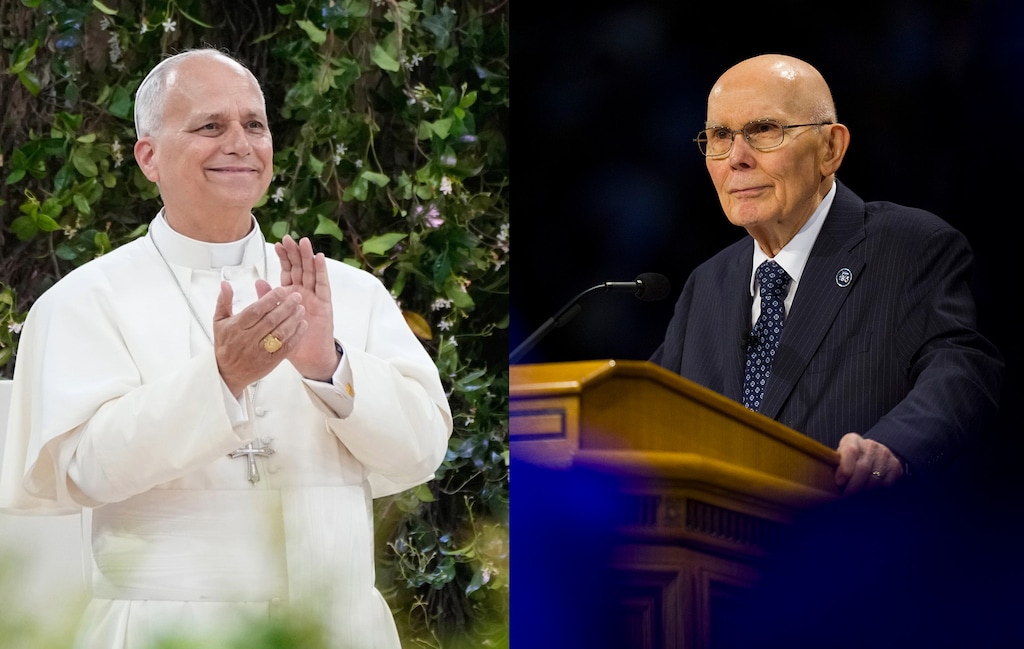
It would be a lie to say that I don’t occasionally fantasize about President Dallin H. Oaks acting a bit more like Pope Leo XIV — or maybe prophets like Nathan and Abinadi if we look within the scriptures of The Church of Jesus Christ of Latter-day Saints. It would be gratifying to hear him state in General Conference that certain views expressed by Latter-day Saints are inconsistent with the gospel — particularly those views that are making my life difficult, strike me as immoral, and keep me up with worry for America. Why call a constitutional law scholar to preside over the church if not for such a time as this?
And, yet, the world needs both Leo’s reminder that some political preferences are not consistent with the gospel and the message Oaks keeps preaching. At least, I do. The Latter-day Saint prophet-president did not call out the other side in his spring General Conference address. He did not call out any side at all. Instead, he called on each of us to remember the Savior’s words: “Love your enemies, bless them that curse you, do good to them that hate you, and pray for them which despitefully use you, and persecute you (Matthew 5:44).” He told the story of a nurse who experienced the Lord’s overwhelming love for a patient in a maximum care facility whom she described as the “most repulsive man she had ever met.”
This is not the talk I wanted, but it was the talk I needed. Oaks gave a talk saying that we need to be peacemakers. Yes, me, too. This can feel like an unfair ask of people experiencing undeserved suffering. It seems to put the responsibility on those facing injustice while doing little to right wrongs. And, yet, Christ said “love your enemies” to a people who were far more oppressed than most of us. He said “love your enemies” to people who were under Roman occupation. He modeled his message, asking forgiveness even on the cross for those who put him to death. He refused to hate.
A taste of self-reflection
It is easy to see what is wrong with everyone else. Every day, we see people in positions of power fail to take principled stands because they are afraid of losing their jobs or falling behind the competition. It is more difficult to confess that I sometimes act similarly as I try to retain the advantages of my own insignificant life, which is nevertheless amongst the most privileged in history. I, too, am full of anxiety, self-interest, elitism, and views that one day may prove misguided, even if my thoughts and actions do not carry much weight.
In my worst moments, I hoard resources because I fear that we will not have enough. I listen to voices that say graduates of elite schools and artificial intelligence companies will amass the lion’s share of the world’s resources while the rest of us lose our jobs. These voices scare me because I worry that they are right. I am occasionally terrified that my children will lose what feels like a fragile hold on the American dream — even while I worry in the same breath that the Earth is burning and that the kids these days are stressed from a rat race that begins at birth. Acknowledging that I am part of the problem, however, helps me humanize everyone else, which is a step toward making peace and loving those who make my life harder.
We cannot unhear the voices that prey upon our fears, but we can reject them. We can confess that we are afraid and still choose the bravery to do the right rather than the selfish thing. We can acknowledge the pain that is motivating some of those with whom we disagree — how we may have wronged or failed to notice them — and seek to address their concerns. We can ask, “Lord, is it I?” and cultivate the mighty change of heart that first requires us to see that we are part of the problem. We can aspire to the courage of Alma and give up our judgment seats — or whatever we may be clinging to — in order to preach and live the gospel.
Do what we can, when we can
We will, of course, repeatedly fail. I fail multiple times a day. Christ said in no uncertain terms that it is hard “for them that trust in riches to enter into the kingdom of God (Mark 10: 24).” We may have more or less than our neighbors, but Americans are collectively the richest people the world has ever known. We are the beneficiaries of a history that has been virtuous and violent, just and unjust — and we are pressured every day to please those persons on whom our continued wealth depends.
We will not succeed in being a fully righteous people. None of us can stand outside the systems in which we live, and those systems are not designed to maximize virtue. The Church of Jesus Christ of Latter-day Saints’ 19th-century effort to build Zion outside of America couldn’t last. Our location within flawed systems, however, should not be an excuse to do nothing. We should recognize in our own spheres of influence when the virtue of compromise becomes the sin of enabling.
We cannot be our best selves or community in a fallen world. But we have a Lord who can make up the difference. When Christ said that “[i]t is easier for a camel to go through the eye of a needle, than for a rich man to enter into the kingdom of God,” his disciples logically wondered, “Who then can be saved?” No one can pass this test because we are all, in our own ways, rich men. Jesus replied: “With men it is impossible, but not with God: for with God all things are possible (Mark 10: 25–27).” He’s only asking us to try.
(Natalie Brown and Greg Kofford Books) "After Happiness: Living with Faith in a Time of Crisis" is the new book by Salt Lake Tribune guest columnist Natalie Brown.
Note to readers • Natalie Brown is a Latter-day Saint based in Colorado, the author of “After Happiness: Living with Faith in a Time of Crisis” and the proud graduate of a Catholic high school. She is speaking in her personal capacity. Her views do not necessarily reflect those of the church or any other organization.