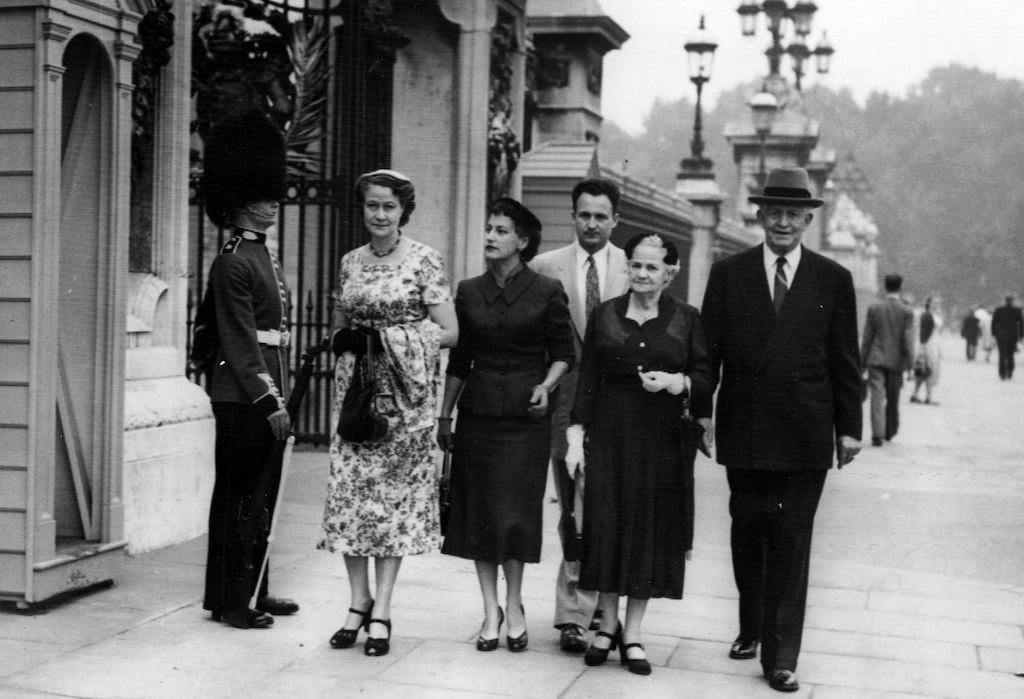
Clare Middlemiss is a forgotten voice in The Church of Jesus Christ of Latter-day Saints, yet she was a force to be reckoned with for more than 35 years at church headquarters.
As church President David O. McKay’s long-standing secretary, she was brusque and no-nonsense and ran McKay’s office with efficiency and exactness. General authority Seventy Paul Dunn said she was “a very stately woman, quite tall, very brisk and to the point. You knew she was in charge.” William Wright, Middlemiss’ nephew, stated, “She was very smart. She was very, very savvy.”
In 1935, she became McKay’s personal secretary while he was in the faith’s governing First Presidency and stayed in that position when he became the prophet-president in 1951 — a position she held until his death in 1970.
She was, however, more than a personal secretary; she functioned as McKay’s chief of staff, even employing several of her own secretaries. Her duties were vast and varied. She supervised the other secretaries in the First Presidency’s office, kept meticulous records of meetings, transcribed McKay’s office journals, compiled his scrapbooks and even spoke with his physician confidentially about his health.
Most importantly, she was McKay’s gatekeeper. No one saw the Latter-day Saint prophet without Middlemiss’ permission.
Fiercely loyal, she devoted her entire life to serving him, even forgoing marriage and children. “Clare was absolutely devoted to that man,” fellow secretary Elaine Reiser astutely observed. “I wondered how Emma Ray [McKay’s wife] ever stood that relationship.”
Whether Emma Ray knew about Middlemiss’ affection for her husband remains a mystery, but those within McKay’s orbit speculated that she desired to be his plural wife in the eternities. Lola Timmins, a secretary in the First Presidency’s office who worked closely with Middlemiss, bluntly noted: “I had heard rumors from other people ... that Clare was secretly in love with President McKay and that she wanted to be sealed to him.”
There is no evidence, to be clear, that McKay, who was 28 years older than Middlemiss, ever acted improperly toward her. But he was keenly aware that she wasn’t married. Church policy at the time forbade married women from being employed by the church, and McKay knew the strain that it put on Middlemiss as she weighed her church employment against marriage and family.
This difficult choice caused Middlemiss tremendous grief. She told the church president that “she’d never gotten married because she had been so devoted to him.” McKay, who shuddered at hearing this, snapped, “I never asked you to give up your life for me.”
(Gregory Prince) Clare Middlemiss, shown in February 1965, with some of the volumes of office diaries she prepared for President David O. McKay. Those journals would ultimately amount to 40,000 pages.
The decider
In truth, while Middlemiss’ devotion to the church leader was genuine, she also craved power and wielded it over the apostles like a cudgel, often angering them. She provoked their ire by acting as an aggressive gatekeeper, deciding who gained access to McKay and who was turned away.
Apostle Matthew Cowley experienced this the hard way when he tried to see McKay. After several unsuccessful attempts to secure an appointment, he told Middlemiss that McKay had phoned him and called him to his office, and she had no choice but to comply. This wasn’t true; there was no call.
Simply put, Cowley had to lie to see the president.
Apostle Marion G. Romney shared a similarly frustrating moment. “Is President McKay in?” he asked Middlemiss, and she said, “I’m sorry, he’s not in.” Romney replied, “That’s funny. He just called me and asked me to come down.” Caught in a fib, Middlemiss responded, “Oh, in that case, you can go in.”
Apostle Hugh B. Brown, McKay’s liberal counselor, was also denied access. Middlemiss resented his clashes with conservative apostle Ezra Taft Benson, her friend and ally. As a conservative Republican and John Birch Society sympathizer, she deeply resented Brown’s efforts to curtail Benson’s far-right advocacy and retaliated by denying Brown access to McKay. Brown simply went around her by reaching out through Lawrence McKay, the president’s son.
(The Salt Lake Tribune) Ezra Taft Benson and Clare Middlemiss shared an affinity for conservative politics.
Brown’s son Charles reflected his father’s disdain for the outspoken secretary in a little ditty:
Little Miss Middlemiss was never sustained,
Little Miss Middlemiss was never ordained.
But of all of the brethren, there’s none can compare
With the line of authority of Little Miss Clare.
Power plays
Many of the apostles complained to McKay about Middlemiss, but he brushed off their concerns insisting that she was a loyal and effective secretary. Her influence was further amplified by McKay’s health in the 1960s. Close observers noted that the nonagenarian leader showed cognitive decline, creating a power vacuum that Middlemiss readily exploited. According to family members, McKay suffered from “geriatric paranoia” in the last decade of his life, an affliction that impaired his judgment and deepened his suspicion of close associates.
Middlemiss convinced the elderly leader that his counselors were driven by personal agendas and couldn’t be trusted. “They need to learn their place in the church,” she huffed to fellow secretary Lola Timmins, upon which Timmins responded, “And who decides what their place is, Clare? You?”
Brown didn’t take Middlemiss’ outspokenness lightly and accused her of taking advantage of McKay’s dotage and “conspiring to run the church.” Whether this was her intention is an open question, but the strong-willed secretary clearly inserted her influence in appointing McKay’s counselors in the First Presidency, one of whom was her cousin.
In 1963, when counselor Henry D. Moyle died, Middlemiss lobbied the church prophet to replace him with Ezra Taft Benson. Upon learning of this effort, Brown vigorously protested, prompting McKay to reject Benson and instead call Brown’s nephew, N. Eldon Tanner. Angry at failing to get Benson into the faith’s governing body, Middlemiss fumed to McKay that “some insidious influence” had swayed his decision — a not-so-subtle jab at Brown.
Middlemiss had better luck getting others into the First Presidency. In 1965, she persuaded McKay to put Thorpe Isaacson of the Presiding Bishopric into the First Presidency despite the absence of a vacancy. She told McKay that because Brigham Young added supplemental counselors during his tenure as church president there was a precedent for it. The highly ambitious Isaacson had long sought this position. Recognizing Middlemiss’ immense influence over the frail McKay, Isaacson flattered her with a gift of a mink jacket to secure her influence.
It worked.
Isaacson’s tenure in the First Presidency, however, proved short-lived. Within a few months of his elevation, he had a stroke that left him unable to fulfill his duties. Middlemiss again intervened, persuading McKay to call her cousin, Alvin R. Dyer, into the First Presidency in 1968. This appointment angered counselors Brown and Tanner, as well as senior apostles Joseph Fielding Smith and Harold B. Lee, who remained upset over Isaacson’s call. As an assistant to the Quorum of the Twelve Apostles, Dyer had suddenly vaulted into the church’s highest governing body — an appointment all the more surprising given that he barely knew the prophet.
The post-McKay years
(The Church of Jesus Christ of Latter-day Saints) President David O. McKay, center, with two of his First Presidency counselors, N. Eldon Tanner, left, and Hugh B. Brown.
By 1969, the apostles had grown weary of Middlemiss’ strong-arm tactics and decided to act. When McKay lapsed into a coma at age 96, they collaborated with the Latter-day Saint prophet’s physician to have him declared non compos mentis, transferring all of his administrative duties to the counselors. Now in a position to rein in Middlemiss, Brown and Tanner acted swiftly, stripping her of her essential duties, including handling McKay’s mail.
After McKay’s death in 1970, Joseph Fielding Smith, the new church president, promptly informed Middlemiss that she would not be retained as his personal secretary — a position she had sought. Devastated by the rejection, she suffered another blow at McKay’s funeral when Brown and other speakers failed to acknowledge her after years of devoted service to McKay.
This public slight deeply hurt Middlemiss. “After all I did for all those years,” she told a friend, “and they never even mentioned me at the funeral.”
Middlemiss suffered a final setback when the new First Presidency (Joseph Fielding Smith, Harold B. Lee and N. Eldon Tanner) refused to honor the full-salary pension that McKay had promised her. This shattered her trust in the new leadership and she lapsed into inactivity, unable and unwilling to attend church.
Middlemiss died in 1983 at age 82, resentful and estranged from the global church she loved and had served so devoutly.
In the final analysis, no other church president has had a secretary who acted so assertively and aggressively to protect his interests or influence the selection of his counselors. Indeed, her extensive reach was widely felt among the church’s presiding patriarchy. It is no exaggeration to say that for more than three decades, Clare Middlemiss was the most powerful Latter-day Saint woman.
(Matthew Harris) Historian Matthew Harris is the author of an acclaimed book about the former priesthood/temple ban against Black Latter-day Saints.
(Gregory Prince) Gregory A. Prince is a biomedical researcher and author whose books include “Power from on High: The Development of Mormon Priesthood”; “David O. McKay and the Rise of Modern Mormonism”; “Leonard Arrington and the Writing of Mormon History”; and “Gay Rights and the Mormon Church: Intended Actions, Unintended Consequences.”
Note to readers • Matthew L. Harris is the author of “Second-Class Saints: Black Mormons and the Struggle for Racial Equality”; “Watchman on the Tower: Ezra Taft Benson and the Making of the Mormon Right”; and many other books in Mormon history. His biography “Hugh: The Life and Times of Hugh B. Brown, Mormonism’s Maverick Apostle” will be published next year. Gregory A. Prince is a biomedical researcher and author whose books include “Power from on High: The Development of Mormon Priesthood”; “David O. McKay and the Rise of Modern Mormonism”; “Leonard Arrington and the Writing of Mormon History”; and “Gay Rights and the Mormon Church: Intended Actions, Unintended Consequences.”