 Peggy Fletcher Stack
Yom Kippur, the holiest day in the Jewish calendar, is a time for fasting, prayer, and self-reflection about the mistakes of the past year and how to do better in the future.
Utah’s Jewish community will flock to their respective synagogues for services that will help them, they believe, purify their souls.
Hollis Robbins will not be joining any of them.
Instead, the Jewish professor will, she says, be “davening” [repeating ritual prayers] alone in her Salt Lake City apartment.
“For me, it is the time where you ask for forgiveness,” Robbins says. “Weeping, weeping.”
Since her 2022 arrival in the Beehive State, Robbins, an English professor at the University of Utah, has not found a Jewish community that matches her practice of Judaism.
She says some are too pro-Israel for her, while others are too rigid, too exclusive, too loose in observance or too divided by gender.
“There is nothing in Utah,” the professor says, “that delivers that community for me.”
But New York City’s Central Synagogue and its rabbi, Angela Buchdahl does. Robbins has been joining that congregation virtually since the COVID-19 pandemic and never stopped.
Her resistance is, well, very Jewish. To explain, she recounts an old joke.
A Jewish man is rescued after being alone for years on a deserted island. There, he had built two synagogues. “One is where I go to pray,” he explains, “and the other is one I would never set foot in if my life depended on it.”
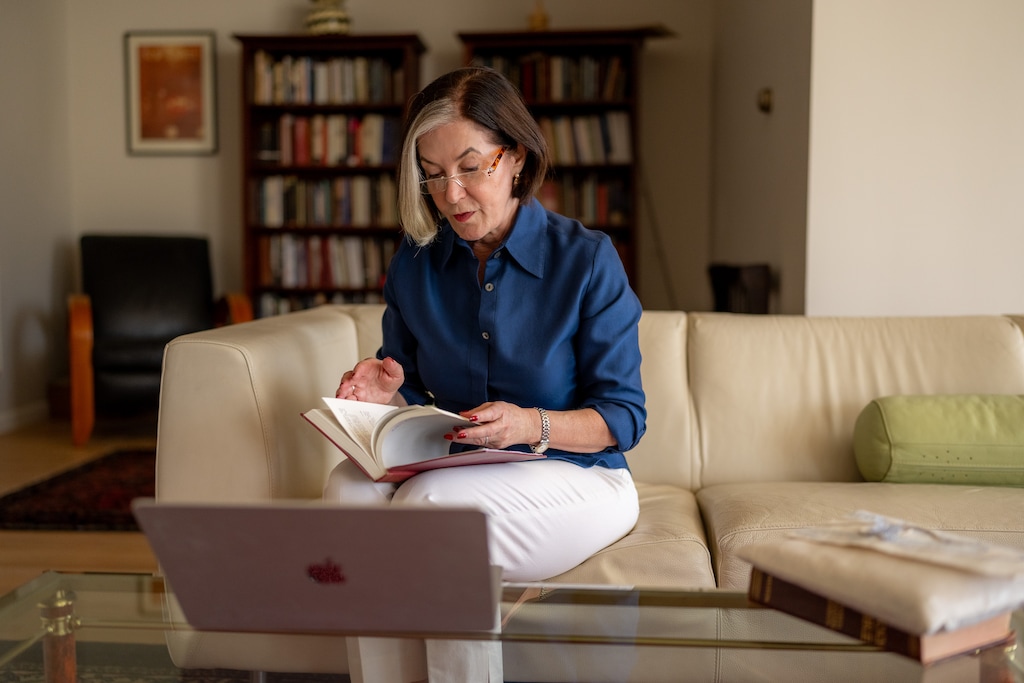
So, on this sacred day, Robbins will open her laptop that is sitting on her coffee table, and sign into the site. She will sit and stand with her online fellow Jewish worshippers and recite the prayer book along with them.
It is, she acknowledges, not unlike the book “Bowling Alone: The Collapse and Revival of American Community.”
Being Jewish ‘intentionally’
(Trent Nelson | The Salt Lake Tribune) Hollis Robbins will observe Yom Kippur virtually with fellow Jewish adherents in New York.
The future English professor was raised as an atheist in New Hampshire.
Her mother was not Jewish, but her father was. His family emigrated to America from Latvia and Lithuania before the Holocaust.
In her home, they didn’t talk about religion, Robbins says, “but I always felt very Jewish.”
She then discovered Reconstructionist Judaism.
Started by Mordechai Kaplan in the 1920s, it taught that Judaism was “a ‘religious civilization’ emerging from the history and culture of the Jewish people,” according to an official website. “[It] was constantly evolving, and it was the goal of Jewish thinkers at any given time to interpret Judaism in the light of contemporary life and thought without abandoning its traditional values.”
The Reconstructionist tradition, for example, recognized patrilineal descent in 1968, she says, not just the matrilineal line.
Many Reconstructionist Jews had come from Europe or the Middle East but asked the question: “How do we reconstruct Judaism in America?”
Robbins liked how that movement wove elements of individual choice into community and its emphasis on responding to the contemporary environment.
Most of all, she liked its “intentionality.”
Robbins, in short, chose her Jewishness, rather than inherited it.
The point is to observe Jewish laws “as best you can,” she says, “which is different from as best you want.”
Finding a home — online
Robbins began looking for an online Jewish home when she lived in California during the pandemic.
She was “shopping” for a synagogue but once she heard the Central Synagogue’s music, she “was hooked,” she says. It left her “awestruck.” And she was really drawn to Rabbi Buchdahl’s sermons and approach.
Even though the rabbi is not Reconstructionist, “she represents for me the inclusivity of Reconstruction Judaism, welcoming those who want to be Jewish and who want to be observant,” Robbins says. “Mordecai Kaplan would have been thrilled to know her and know of her leadership.”
Because of the music and the rabbi, “I feel like I am being an inclusive Reconstructionist,” Robbins says, “by attending her services virtually.”
So instead of being in the pews, she will be ruminating from her living room — listening to music, watching the screen, seeking forgiveness and “weeping, weeping.”