 Peggy Fletcher Stack
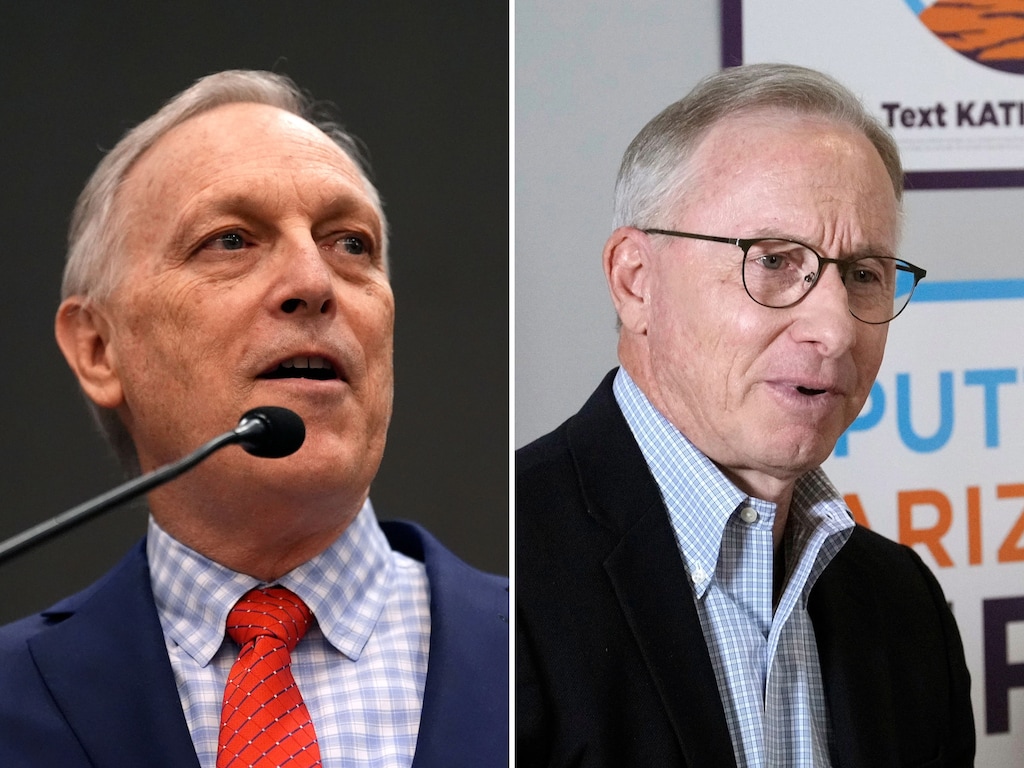
Two prominent Latter-day Saints are facing off in Arizona’s closely watched gubernatorial race, prompting fellow church members to reflect on who better expresses their shared faith.
• Andy Biggs, the Republican nominee for governor, is a Donald Trump-endorsed U.S. House member who has questioned the 2020 presidential election results and has represented the battleground state in Congress since 2017.
• John Giles, incumbent Democratic Gov. Katie Hobbs’ running mate for lieutenant governor, is an independent and a former Mesa mayor who launched a support organization for Democrat Kamala Harris.
Here are excerpts — edited for length and clarity — from the two candidates’ interviews for a recent Salt Lake Tribune story:
Andy Biggs
(Ross D. Franklin | AP) Rep. Andy Biggs, speaking earlier this year, praises the church's teachings about the Constitution.
What does Mormonism mean to you? What role does it play in your politics?
Biggs • The church is foundational to my beliefs on freedom and agency and the Constitution and its importance in the history of this nation, and the preeminent place that we put on this nation and its purpose. The church teachings on that are pretty important.
Have you always been a member?
Biggs • My parents joined the church when I was very young, probably 4 or 5 years old.
What issues do you support that go along with church positions?
Biggs • The very notion of the freedom to worship, the Bill of Rights, those are critical. The church teaches, as did the founders of this nation, that those are inherent rights. Protecting those rights is paramount. The main purpose of government is to protect the rights of its citizens.
The church supports immigration reform broadly and opposes separating families. What is your position on that?
Biggs • My position is that that is not generally a state issue. The state is obligated to enforce the federal law because the Constitution indicates pretty clearly that the federal law has primacy, so that’s the statement I would make on that.
I understand Arizona has quite a few DACA (Deferred Action for Childhood Arrivals) recipients. What’s your position on that?
Biggs • Again, that’s a federal issue. The federal courts have said that DACA is not legal, but the practice has been to acknowledge it at least on the federal level.
The church has said there are good people in both parties. Do you think members should vote for Democrats?
Biggs • They do vote for Democrats, and I do think that there are good people in both parties.
You don’t think Democrats are evil?
Biggs • Some of them are, but I think some Republicans are evil, too [laughs]. The bottom line is that you find good people wherever you go — if you look for the good in people.
Church President Dallin Oaks has said a hallmark of democracy is the peaceful transfer of power. Yet you supported all the efforts to overturn the 2020 election?
Biggs • That’s a gross, hideous mischaracterization.
I did not try to overturn the election. What I did is try to do the same thing that Democrats have done in every presidential election this century, and that is I joined a motion to decertify. My purpose, if you go back and watch what I said, is that there were questions that should be resolved, and we should delay certification until those issues have been resolved. That’s very different from trying to overturn an election.
Do you now accept the results of the conclusion that Democrat Joe Biden won that election?
Biggs • Why are you litigating something that took place six years ago? I mean, seriously, why are you? I’m going to tell you, most Arizonans are like I am. We’re going forward. We want the best elections we can possibly get. We hope that they’ll always be good and fair and transparent, and that’s what we want. And the only people who are driving the narrative that you’re driving seems to be the media and some of the hardest left people in Arizona.
Your campaign has the potential to divide the church membership between Katie Hobbs and John Giles and you, knowing that Giles is a Latter-day Saint, too. What are you going to do to bridge that divide?
Biggs • In Utah and Arizona, where there’s a large number of Latter-day Saints, it is not unusual to have one Latter-day Saint run against another. The notion that we’re going to cause some massive schism because I’m running against John Giles seems to me a zany idea.
Do you see any more hostility among members toward one of you than the other, or anything?
Biggs • Not particularly, at least I haven’t run into it. I have my supporters. He has his supporters.
Does it come up at church?
Biggs • Not really. It’s a big state. There are people who agree with me and my politics, and I’m sure that there are a few, very few, of course, who don’t necessarily agree with my policies. But we tend to view each other as part of a ward family. So even if we have policy differences, we get along pretty well in my ward.
John Giles
(Ruth Fremson | The New York Times) John Giles, speaking at the Democratic National Convention in 2024, says his Latter-day Saint faith plays a "significant" role in his politics.
What role does your faith play in your politics?
Giles • It’s significant. A lot of us can relate back to growing up in the church in the 1960s and the ’70s, when they used to announce from the pulpit whenever there was an election, that [the church] encouraged members to vote, but to also be actively involved in the community and service. So the seed of doing something like this was planted back in my childhood when I heard those admonitions read from the pulpit.
Is there anything specific in church teachings that pushed you toward one issue or another?
Giles • Just the general Christian belief — commandment — to love our fellow man and to serve them is probably the most compelling thing I bring from my faith. But I don’t think being a Latter-day Saint has teed up specific issues that I’m more concerned about than other people.
What about immigration?
Giles • That has been an issue that has motivated me in the past. As mayor of Mesa, which is the 35th largest city in the United States, but we’re in the top 20 when it comes to DACA recipients, I always felt like I needed to represent everyone in my community and advocate for them. So I was involved at a national level in immigration reform movement at the U.S. Conference of Mayors.
Has this campaign divided church members?
Giles • I can’t speak for Andy, but speaking for myself, the last thing I want is to have this be a divisive issue in the Latter-day Saint community, or to put the church on the spot. I think it’s great that there are two Latter-day Saint candidates in the election. One of the things I like about that is it shows that there’s some diversity of thought [in the church]. For a long time people assumed what the political priorities were in the church, and painted Latter-day Saints with a broad brush. I’m glad that that’s clearly not always the case. Maybe that’ll be freeing for members of the church to realize that they can have political views that maybe traditionally people didn’t think were strongly held by members of the church.
Many Latter-day Saints still think voting for a Democrat is a sin or, at least, misguided. Even some who were anti-President Trump still won’t vote for a Democrat. How do you overcome that?
Giles • We do still have a ways to go in the church to really believe what church President Dallin Oaks taught about not being overly loyal to political parties and realizing that we kind of need to zig and zag among candidates and parties, and not have the mentality that we’re going to find all the truth in one place.
How do you feel when people say a candidate is a Latter-day Saint, so he must espouse Latter-day Saint values — by which they mean Republican?
Giles • I hope it is true that I espouse Latter-day Saint values and that people understand those aren’t exclusively Republican or Democratic values. For the last several years, we’ve had this increased political polarization and this very toxic environment, where people just go further and further to the left and further and further to the right. Those of us who feel like we’re in the middle are left more and more politically homeless. I don’t mean to attack him, but Andy is very politically extreme. He’s from the far right of the party, and he sees things very much through a partisan lens. The fact that Governor Hobbs is reaching across the aisle — though I’m not a Republican any longer. I am an independent, but still am very similar to a lot of Republicans — is pretty historic. This is the first thing I’ve seen in a long time where someone is trying to come into the middle and to be inclusive and collaborative, and say, “Hey, let’s lower the temperature. Let’s be less concerned about whether the ideas come from a Republican or a Democrat, and let’s focus on delivering results and solving problems in a nonpartisan way like transportation and affordability, medical treatments, education and water.” Why do these things need to be so partisan? They shouldn’t. And so that’s what I think is exciting about this campaign.
Do you expect to have a fair amount of support among Latter-day Saints?
Giles • There’s a lot of people who heard what President Oaks said about giving members the freedom to pick and choose candidates and to acknowledge that there’s good in more than one political party. The church is evolving politically, no question about it. There are a lot of Latter-day Saints in Arizona who are really excited about this campaign.