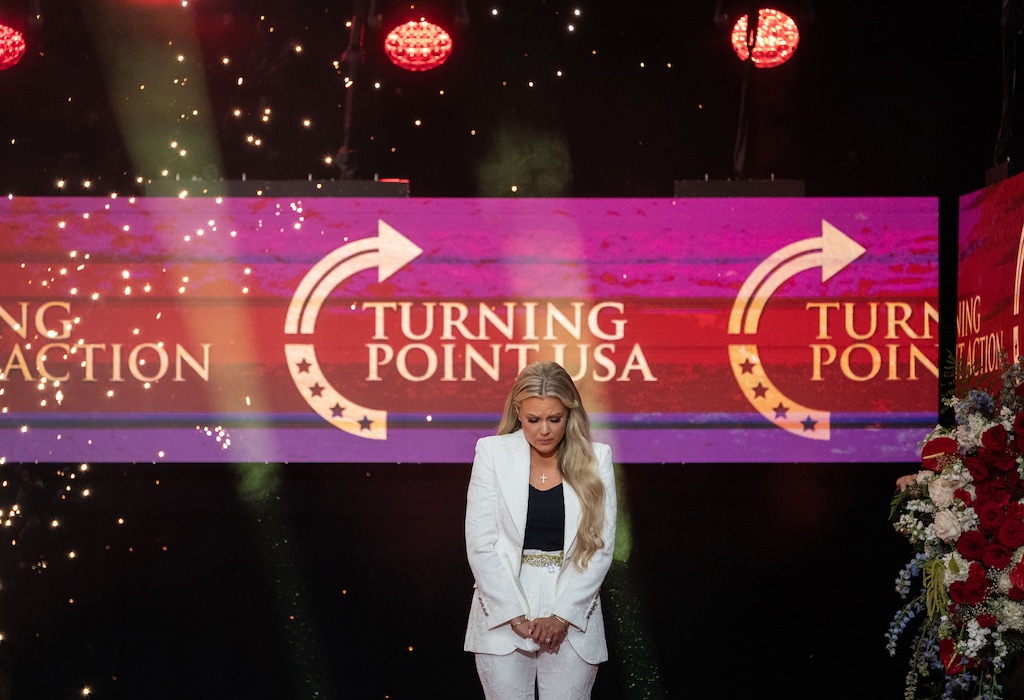
In the days after Charlie Kirk was shot and killed at Utah Valley University on Sept. 10, 2025, Leona Salinas, Turning Point chapter president at Texas State University in San Marcos, Texas, fielded dozens of urgent inquiries from peers eager to join the political organization, she said.
That surge was part of a larger wave, according to Turning Point USA, which in December announced that 140,000 students requested to get involved after Kirk’s assassination — an awakening leaders described as political and spiritual.
“I’ve never seen anything like it. It was a revival,” said Kristan Hawkins, Students for Life president, about the response to Kirk’s death.
A year later, it’s hard to know if that uptick in engagement had staying power. In recent fundraising appeals, Turning Point, now under the leadership of Kirk’s widow, Erika Kirk, who took over as CEO after her husband’s death, cites more than 1,500 college chapters, 3,500 high school chapters and 11,000 church partnerships. But some students said the enthusiasm they encountered last fall has waned. According to Salinas, initial interest in her campus Turning Point chapter dwindled amid the spread of conspiracies from conservative influencer Candace Owens, a former Turning Point employee who has insinuated to her millions of followers that Israel and others close to Charlie Kirk were involved in his killing.
“It’s created this ginormous divide amongst students,” said Salinas. “‘What do you think of Erika? What do you think really happened to Charlie? Do you think Israel had anything to do with this?’ I’m telling you, every single chapter when tabling gets asked that question several times a day.”
During the past year, Turning Point has responded to Charlie Kirk’s death and the growing fissures in the conservative movement by aiming to build on the religious and political zeal that surfaced after his assassination. In speeches and through its faith-focused programming, the organization has described its founder as a martyr and its political efforts as part of a spiritual battle between the godly and demonic. That message extended Charlie Kirk’s own argument that to “reclaim the country for Christ” requires political action. By continuing to cast political alignment as a biblical mandate, Turning Point is testing whether that strategy can unite a splintering movement and sustain the organization’s mission, even without its founder.
“All of you in this room are those people who I am so proud to have in my army as I go through this battle against Satan,” Erika Kirk told student Turning Point leaders at the Chapter Leadership Summit in July.
In the beginning
Religious language wasn’t always a mainstay of Turning Point. When Charlie Kirk first founded the organization in 2012, it focused on fiscal responsibility, free markets and limited government. By 2015, the group had become known for its campus organizing and watch list of professors they said were anti-conservative. Then, in 2021, the group launched TPUSA Faith, which offered programming that addressed conservative Christian faith and culture war issues at monthly megachurch events, pastors’ summits and in online curricula.
Meanwhile, Charlie Kirk, who was raised Presbyterian, was speaking more publicly about his evangelical faith and on topics like abortion, transgender rights and diversity, equity and inclusion. In the run-up to the 2024 election, he threw the full weight of TPUSA’s organizing power and evangelical clout behind Donald Trump, describing Trump as part of God’s plan to defeat evil. “Finally we have a president that understands the seven mountains of cultural influence,” Charlie Kirk said in 2020, invoking what scholar Matthew Boedy describes as the Seven Mountains Mandate — a charismatic Christian ideology that envisions Christian leadership over seven “mountains” of society.
Though Kirk amassed millions of followers in his lifetime, in death, he reached millions more, especially after Erika Kirk’s tearful declaration that she forgave her husband’s alleged killer.
“You really saw the gospel preached at that memorial,” said Christina Littlefield, associate professor of communication and religion at Pepperdine University, referring to Erika Kirk’s forgiveness. “I think that earned her respect from a lot of Christians who would otherwise not agree with anything TPUSA is doing.”
To build on that momentum, in January 2026, TPUSA Faith launched its “Make Heaven Crowded Tour,” a series of nearly 30 evangelistic gatherings hosted at churches across the U.S. At the first stop in Riverside, California, Erika Kirk described the tour as a way to bring a “slice of heaven from that memorial for my husband” to “everyone around this country.”
The free two-hour events featured worship led by a praise team, speeches from pastors and thought leaders — including evangelical Pastor Greg Laurie, conservative activist Riley Gaines, Duck Dynasty star Willie Robertson and content creator Bryce Crawford — and concluded with an altar call.
“A lot of the people coming to these are people that have been caught in that moment where they saw the horror of what happened, and then they saw, I think, the response of Erika’s forgiveness,” said Pastor Lucas Miles, an evangelical pastor based in Indiana who was chosen by Charlie Kirk to head TPUSA Faith in 2024.
He added that during the tour, the focus was meeting people’s need for Jesus — but he also heard attendees share their top political concerns, including their desire for hard-line immigration policies and objections to the “contagion of transgender ideology” and the “rise of Islamists in America.”
‘Charlie understood that’
Though Turning Point’s political lobbying efforts fall under the separate 501(c)(4) entity Turning Point Action, “everything is downstream of theology,” said Miles, including people’s decisions about their families and their politics. The message that conservative political views are a natural outgrowth of Christianity is ubiquitous at Turning Point, as is the idea that winning the culture wars involves winning votes and souls.
“The only worldview you’re going to get God-given moral rights from … is the Christian worldview,” said Frank Turek, a Christian apologist and friend of Charlie Kirk who was featured on tour. “Charlie understood that, and that was the basis for everything he did.”
At Turning Point events throughout the year, newcomers were often met with strong religious messaging that built on the spiritual language Charlie Kirk was using before his death. Erika Kirk’s speeches reinforced the idea that those who joined the organization had entered a spiritual war.
“He will never win,” said Erika Kirk, referring to Satan, in December during her opening speech at TPUSA’s annual America Fest. “We know we’re on the winning side. God is so good.”
The spiritual war against Satan, according to Erika Kirk, is waged in the home, on college campuses and in the voting booth. At a Turning Point Action political rally in April when Trump was the headliner, she noted that building a movement requires both “getting out the vote” and “spiritual revival.”
At June’s Women’s Leadership Summit in San Antonio, Erika Kirk contrasted feminism with the “divine” callings of marriage and motherhood — and, when she was interrupted by a heckler, reminded the attendees to “pray for your enemies,” noting that the real enemy was Satan.
And at the TPUSA’s Chapter Leadership Summit for student leaders in July, Erika Kirk encouraged attendees to appeal to the Holy Spirit for courage when they face backlash on their campuses, instructing them to be a “happy warrior,” even if a “Muslim” or “gender-confused person” is “spitting on you” or “cussing at you.”
“We are on enemy-occupied territory,” Erika Kir said, “and the devil would love nothing more than to be in the middle of your head to dictate your fear, to dictate whether or not you continue forward having a chapter.”
In Littlefield’s view, this messaging is “70% typical evangelical messaging” that then frames political talking points as part of the Christian gospel.
“The real mission is the conservative ideology,” she said, “but they’re now using Christianity as the vehicle to really deliver that ideology.”
Gaines, a Gen Z Turning Point influencer and host of The Riley Gaines Show, told Religion News Service that thinking about politics within the broader context of spiritual warfare can provide clarity for a generation that’s seeking direction.
“You see young kids who are desperate not only for objective truth and how to win in these policy debates,” she said, “but I think more importantly, you see young kids now who are desperate for spiritual truth and biblical truth.”
The impact of conspiracy theories
Even when TPUSA programming offers a political and religious blueprint, some students say they feel ill-equipped as they face the pressure to defend their ties to the group amid the rise of conspiracy theories.
Salinas, age 21, has been involved in Turning Point since 2024. Her chapter has roughly 15 to 20 members, including five who joined and stuck around after Kirk’s death. But lately, she said, her chapter has been inundated with students echoing the theories of Owens, who has become an outspoken critic of Turning Point and the state of Israel and has claimed that Tyler Robinson, who is charged in Kirk’s killing, was framed.
Salinas believes her peers are adopting these theories as they wrestle with grief triggered by the assassination.
“Conspiracy theories are just inherently more seductive,” she said. “It gives you a clear answer to why (that) happened, because it’s really hard to rationalize why someone would just kill Charlie Kirk because they disagreed with him.”
Lindsay Cameron, a 19-year-old who has attended Turning Point events since 2021, said she remembers the days when figures like Owens and The Daily Wire co-founder Ben Shapiro got along at Turning Point events. But Owens hasn’t been a guest at a Turning Point event since 2024, and Ben Shapiro made headlines for swiping at fellow speakers Tucker Carlson and Megyn Kelly at America Fest in December.
Cameron said the dividing line in the conservative movement is support for Israel — and said, before his death, Charlie Kirk had been the “glue” that “held the organization together.” Cameron believes Erika Kirk was thrust into an impossible position as CEO, and, because people don’t respect her the way they did her husband, Cameron believes the new energy around Turning Point “will putter out.”
Leaders in the Turning Point orbit say that, internally, the organization has never been more united. They view critiques of Erika Kirk and conspiracies about the organization as further evidence of persecution.
“That’s what’s going on with some of these people trying to tear down Charlie, trying to tear down his legacy, trying to tear down his organization, trying to even attack a widow,” said Turek. “It’s demonic.”
Amid divisions, Turning Point leaders continue to appeal to religion as a unifying force. In speeches, they call on students to model the strength of their founder and contend that he died not just for political views but Christian convictions.
“I believe he died as a martyr,” said Miles. “He gave his life for a cause that is now bigger than he could ever imagine.”
Note to readers • Religion News Service’s Jack Jenkins contributed to this reporting.