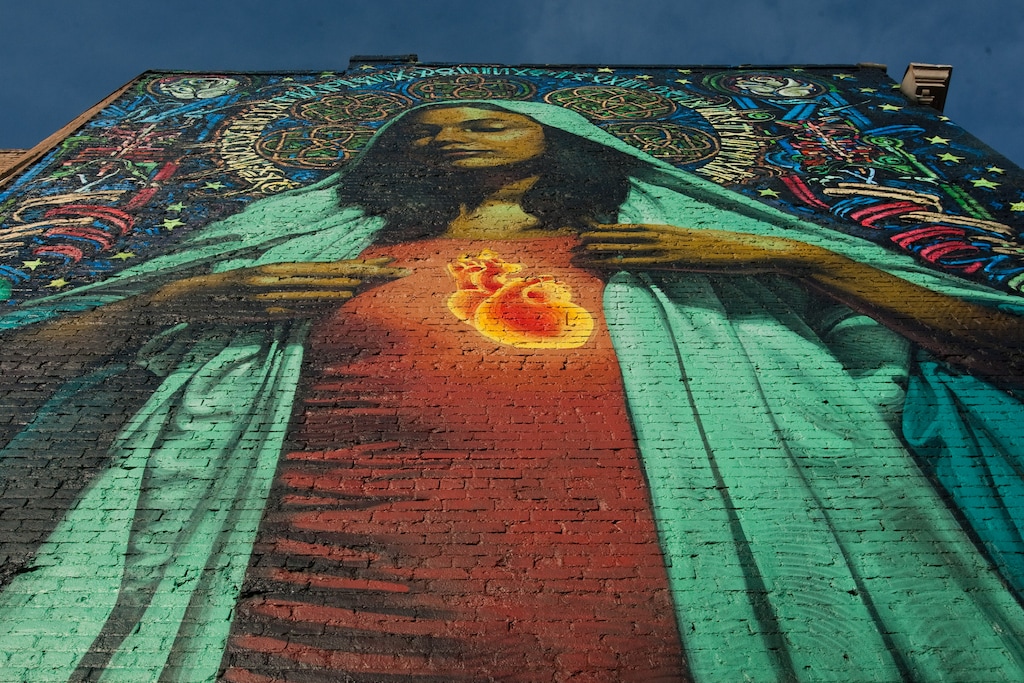
Ask an evangelical what separates them from Rome, and they’ll likely mention Mary. Ask a Catholic convert why she crossed over, and she might say the same thing. Nothing divides evangelical Protestants from Catholics quite so visibly as Mary.
But beneath that divide lies deeper questions about authority, tradition, worship and what it means to belong to the church.
Over the past year as a writer and podcast host, I’ve spoken extensively with Protestant women who converted to Catholicism, as well as academics and those studying the forces behind this shift.
The conversion pattern is real: Catholic dioceses across the country have reported striking increases in converts, with some seeing their numbers rise by 70% to nearly 90% in a single year.
Eastern Orthodoxy — another liturgically “thick” tradition — has seen a similar surge, with 65% of its converts coming from Protestant backgrounds, according to the Orthodox Studies Institute.
For many women converting to Catholicism, the Mary factor indeed looms large.
“Catholicism is one of the few religions that respect and revere women,” Genileigh Wentworth, a 37-year-old convert, told me.
She had cycled through a variety of evangelical churches, then New Age spirituality, before Catholicism brought her back to Christ.
“Mary was never acknowledged or talked about in any Protestant church I went to,” she said, “and I went to many.”
What drew Wentworth back, she said, wasn’t a doctrine so much as a feeling she had been chasing since childhood. She remembers being taken to Washington National Cathedral on a middle school trip and feeling “so emotionally moved by the history, the stained glass, the overwhelming peace I felt” that she didn’t have language for it at the time.
Though marriage to a Catholic spouse is still the single largest driver of conversion, women like Wentworth are growing in number. This smaller, harder-to-quantify group — educated, theologically literate women converting on conviction rather than circumstance — is the most interesting conversion story I’ve seen. While American women are leaving organized religion at faster rates than men, some women are instead entering.
After months of research, here’s my read on what appears to be driving the Catholic conversion trend for women:
1. Sacramental hunger
The Eucharist runs through nearly every conversion story I collected, more than any other single factor. Heather Howard, a 42-year-old mother of two from Bloomington, Indiana, started with Father Mike Schmitz’s “Catechism in a Year” podcast and found herself, to her own surprise, “longing for the Eucharist” in a way weekly Communion-free Protestant services couldn’t satisfy.
Phylicia Masonheimer, an evangelical Bible teacher who isn’t Catholic, put her finger on why: Protestant Communion practice varies wildly by congregation — weekly here, monthly there, quarterly somewhere else — and “a lot of people are very dissatisfied with something that feels like it should be so important.”
Brad Littlejohn and Chris Castaldo make the same point in “Why Do Protestants Convert,” saying that Protestantism treats the sacred as primarily verbal, “secondary to the Word” — while Catholicism roots it in “oil, water, shrines, relics, chapels.” For women converting in midlife, many who are simply tired of abstractions, this distinction is critical.
(Bethany Baker | The Salt Lake Tribune) A parishioner takes communion during the service for Ash Wednesday at St. Ann Catholic Church in South Salt Lake in February.
2. Exhaustion with the endless arguments over women’s roles
For decades, Mary has often been Exhibit A in Protestant teaching about what’s wrong with Catholicism. She’s seen as a distraction from Christ, if not outright idolized, depending on whom you ask.
Several converts told me they inherited real suspicion of her in their evangelical youth. What changed for them was learning more about Catholicism and realizing what they’d been taught about her was inaccurate and that she was a respected female inside a religious leadership that sometimes felt not so open to women.
Masonheimer argues that years of Protestant infighting over women’s roles — a fight the Southern Baptist Convention recently took public again — leaves a “void” that Mary fills for some. “Womanhood becomes something that God sees as worthy … a necessary part of the picture of the gospel,” said Masonheimer.
For some converts, the closure and perceived simplicity is comforting. They see Mary as symbolizing a soft equality to men even as she inhabits a different role.
3. A theology of the body that takes womanhood seriously
Notre Dame professor and author Abigail Favale, who writes on Catholic feminism and stopped supporting abortion or birth control, told me evangelicalism’s suspicion of embodiment “hits women differently than it does men.” This is because, she said, “what’s unique about the female experience is that it’s more intensely bodily.”
Catholic sexual ethics, she argues, isn’t the anti-woman position she once assumed. It “takes the reality of pregnancy seriously” instead of treating fertility as a problem to be managed.
Rachel Aldhizer, an evangelical writer and an Ethics and Public Policy Center fellow who works in heavily Catholic circles, put it more bluntly: “I feel like Catholics understand that I want a career and more kids, and there’s zero comparison for Protestants.” She’s not converting, but Aldhizer hit on something others I spoke with have also felt.
4. Fatigue with pulpit politics — across the board
Krystle Gabele said she left evangelicalism partly because sermons had become “politically charged” and thin on substance. The evangelical label is certainly tied to Republican politics, whether congregants like it or not. Mass, by contrast, offered “intellectually stimulating homilies” she could actually apply to her life.
Catholicism’s appeal isn’t that it’s apolitical. Catholics have their own conservative and progressive activists, and priests sometimes engage in political preaching from the pulpit. But Catholicism seems less entangled with the politics of the moment than Protestantism, projecting an identity rooted more in historical continuity and catechesis. Many converts appreciate that the church’s core teaching doesn’t tend to move with election cycles. Change does happen, but slowly, through a hierarchy designed to make it so.
Most Protestant churches don’t operate this way, but their structures allow for greater theological volatility: A single pastor, for example, can shift a church’s theology with a change in leadership and relatively little oversight. Even when that doesn’t happen, the possibility can create its own kind of instability.
5. Intellectual and cultural respectability
Several academics I spoke with noted that — good or bad — Catholicism carries more weight in elite and intellectual spaces.
“In elite circles in Washington, D.C., the fruits of evangelicalism’s anti-intellectualism are more apparent,” said the Rev. Barton Gingerich, an Anglican rector in Richmond, Virginia.
Converts skew toward higher education and income than the general population, and researchers consistently find those factors predict religious engagement broadly.
What conversions mean
What I’ve seen across my interviews isn’t primarily a rejection of Protestant doctrine. It’s a rejection of what many see as Protestant instability institutionally, liturgically and culturally. In many spheres of evangelicalism over the past decade, we’ve seen a relitigation of many things: women’s roles, sexuality, politics and more.
But reassessing things isn’t always bad. Fallible humans — even those ordained by God — can get things wrong, and Protestants and Catholics have. Protestants are freer to revisit old practices and reform them when they believe correction is warranted.
That can feel unstable when it’s used too freely or too often. Depending on their denomination or church, some converts told me they felt Protestantism was like building a spiritual life on shaky ground. Notably, none of these women said she converted after resolving every difficult Catholic doctrine. Most still wrestle with questions around transubstantiation, purgatory and the impossibility of certain assurance of salvation. In fact, several told me they’ve simply decided those questions matter less to them than the stability of the institution they’ve chosen to trust. Doctrine seems to be beside the point.
The conversion excitement could also be credited to “the honeymoon effect.” Pew finds 38% of converts attend Mass weekly, versus 28% of cradle Catholics; CARA estimates 84% of adult converts stay active in the faith long-term. But weekly Catholic Mass attendance overall has collapsed from 34% of the cradle Catholic population in 1973 to 11% today. Along with immigration, the Catholic Church is, in some sense, being sustained by the very people it’s receiving from evangelicalism, even as it loses 9 in 10 of its own.
Carl Trueman has called this trend “a triumph of aesthetics and consumer taste over doctrinal confession.” John Piper has said he won’t let a desire for “certain forms or styles or richness” trump doctrine.
Littlejohn and Castaldo, despite documenting the trend sympathetically, end their book urging Protestants not to convert at all. In fact, they call it “spiritually dangerous” and worry that converts are looking for a tradition to resolve doubts that no tradition can fully answer. Some, they say, may be chasing a purer Protestantism, in Catholic clothing, rather than Catholicism itself.
Early Protestants deeply valued the Eucharist and the sermon, but that emphasis dissolved over time — something Martin Luther himself would not have supported. In the 1530 Augsburg Confession, Luther wrote: “Falsely are our churches accused of abolishing the Mass, for the Mass is retained by us and celebrated with the highest reverence.”
As Gavin Ortlund writes, “the Protestant effort was to reclaim the Eucharist, not replace it.” So an evangelical who becomes attracted to weekly Eucharist, liturgy, reverence, presence and historical rootedness isn’t necessarily discovering things foreign to Protestantism. In many cases, they may be rediscovering things modern evangelical Protestantism simply lost along the way.
The desire for a church that more clearly values the sacraments, honors a theology of the body, and appreciates liturgy and tradition is a beautiful thing. It’s not just aesthetics but a deep, spiritual desire for a more tangible faith.
At a time when women are leaving the church at unprecedented rates — a phenomenon I explored at length in my book, “Reason to Return: Why Women Need the Church and the Church Needs Women” — it’s vital for Protestants to take a hard look at what they’ve lost or overlooked in the modern era. If they don’t, they may continue losing women — to Catholicism, or out of the faith altogether.
Note to readers • Ericka Andersen is a freelance writer and the author of “Freely Sober: Rethinking Alcohol Through the Lens of Faith.” The views expressed in this commentary do not necessarily reflect those of Religion News Service.