 Tamarra Kemsley
This week, Utahns will line the streets for parades featuring handcarts accompanied by women in bonnets and men in suspenders, a celebration of the day Brigham Young and his band of believers entered the Salt Lake Valley.
Pioneer Day, a new book argues, is just one of many examples of the anti-Indigenous racism woven into the DNA of The Church of Jesus Christ of Latter-day Saints.
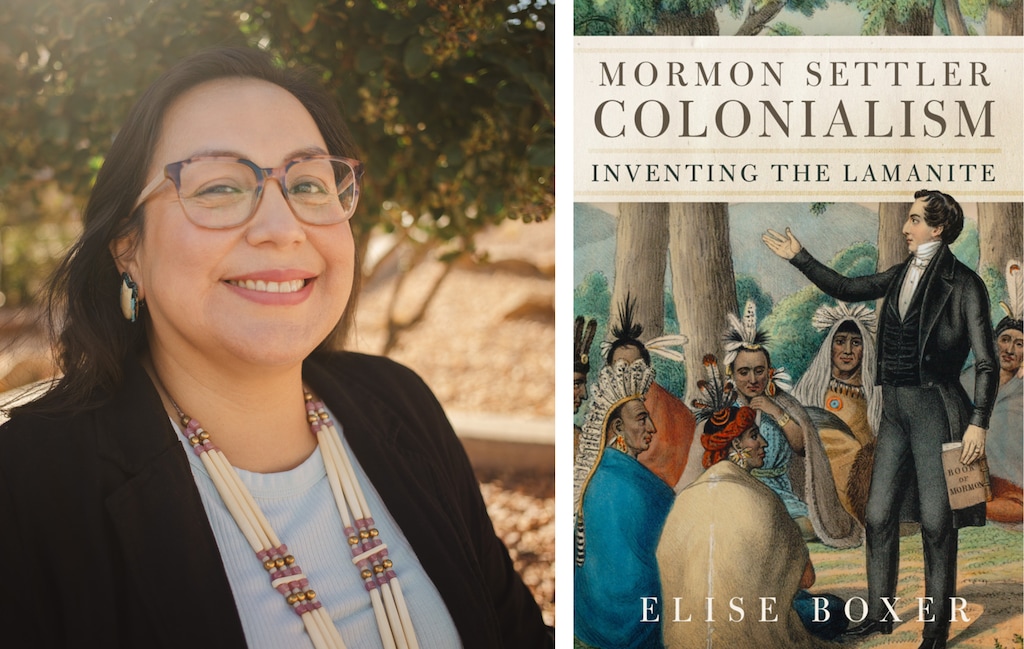
So, too, the book “Mormon Settler Colonialism: Inventing the Lamanite” maintains, is Salt Lake City’s This Is the Place Heritage Park, a mock 19th-century village that centers on the arrival and stories of Mormon pioneers.
The book’s author, Elise Boxer, makes the same case about the popular Latter-day Saint children’s song, “Book of Mormon Stories,” with its melody meant to mimic drums and lyrics that cast Native Americans’ claims to their homelands as hinged upon their “righteousness.” Also: the church’s now-ended practice of encouraging families to host Indigenous children and teens during the school year, known as the Indian Student Placement Program.
(Rick Egan | The Salt Lake Tribune) Kids learn to do the Virginia Reel at This Is the Place Heritage State Park on Pioneer Day last year.
The list goes on in the book, which recently won the Mormon History Association’s 2026 award for best Indigenous studies.
“Indigenous peoples,” the University of South Dakota associate professor posits, “have been uniquely othered within the LDS Church.”
Providing the framework for this othering, she contends, is the faith’s founding scripture, the Book of Mormon, and specifically a group within it known as the Lamanites, which the text asserts are “among the ancestors of the American Indians” (previously “principal ancestors”). Cursed with dark skin by God for their wickedness, the group is left awaiting redemption at the end of the sacred text.
These teachings, plus cultural practices both present and past, point to an uncomfortable reality, the author concludes.
“American Indians will never fully become Mormon,” she writes. “Indigenous peoples will always be relegated to the Lamanite” identity.
‘Willing to call out racism’
Boxer’s book comes amid an upswell of interest in the overlap between Mormon and Native American history, explained Montana State University associate professor Amanda Hendrix-Komoto. What makes this new publication different, she said, is the author’s background.
Boxer is Dakota from the Sisseton and Wahpeton bands. She was also raised in the church.
Because of this, Hendrix-Komoto said, the author “emphasizes the importance of Indigenous nations being able to define their own histories and cultures” and “is more willing to call out racism within the church and name things as colonialism.”
That is not to say all Indigenous current and former Latter-day Saints share Boxer’s critiques — a point she acknowledges in her book.
Nevertheless, Boxer argues that regardless of how individuals feel, the church, as a system, is rooted in the marginalization of Native people.
Faith founder Joseph Smith was, she writes, a “quintessential American settler” whose teachings that God had called him to build Zion “drove Mormon settler desires tied to the land.”
What, then, were he and his followers to make of the people already residing in the territory where early church members wished to build their “Mormon empire”?
(Francisco Kjolseth | The Salt Lake Tribune) The statue at This Is the Place Heritage Park is one of many examples Elise Boxer cites of the centering of white Mormon pioneers over the region's original inhabitants.
The answer, Boxer explains, came in the form of a “uniquely racialized identity and category of race: Lamanite.”
According to the Book of Mormon, the Lamanites were descendants of Israelite immigrants who rejected God and deviated from his commandments.
Within this paradigm, she writes, “American Indians floundered in a state of savagery because they lost their original teachings recorded in the Book of Mormon.”
The text also teaches that God preserved the “promised land” — interpreted by many early and current church members as North America — for the righteous.
Together, Boxer argues, these ideas contributed then and now to a worldview in which the “removal and disappearance” of Indigenous people who failed to convert was, and remains, “justified.”
Ongoing erasure and discrimination
The results, she writes, have been devastating.
“Mormon settlers,” Boxer explains toward the end of her book, “continue to live on stolen lands,” asserting their assumed right to it in the form of great, granite temples, monuments and even murals.
Take, for example, the 2021 controversy that erupted after news broke that the church planned to remove the historic Manti Temple’s hand-painted murals, including one by revered Latter-day Saint artist Minerva Teichert.
Outcry ensued, and the church backed down, Boxer notes, despite its “racist depictions of Indigenous peoples” as side characters to the artwork’s heroes: white Mormon pioneers.
(The Church of Jesus Christ of Latter-day Saints) Ordinance room in the Manti Temple displays the brightened Minerva Teichert murals.
This is just one example the author points to when building her case that the effort to “erase Indigenous peoples from their lands, history and identity” remains alive and well.
Meanwhile, Indigenous members of the church face ongoing discrimination and stereotyping by others in the faith, she says, citing some of her own negative encounters.
Those include watching as a child in silent protest as her peers “play[ed] Indian” while singing “Book of Mormon Stories,” an experience that is “seared” into her memory.
Another occurred when she was an adult speaking with a fellow Latter-day Saint, someone she describes as educated. Boxer does not detail the exchange, only its lasting effect, which was a realization “that while I grew up in the LDS Church and considered myself to be a faithful member, others did not see me as fully Mormon because I am seen first as Indigenous, or Dakota.”
‘Derogatory’
Thomas Murphy, an anthropologist of religion and the author of the newly published “Unsettling Scripture: The Book of Mormon and the Iroquois,” called Boxer’s publication “the most important book written by a Native American about the Book of Mormon.”
Among the reasons he cited is the fact that Boxer is not alone when it comes to the Indigenous members and former members of the church who feel the Lamanite term “constrains and misrepresents” Native people.
Her book, he said, “is creating a space” for those individuals “to articulate that discomfort.”
That includes Angelo Baca, a Diné (Navajo) and Hopi filmmaker who grew up attending church in San Juan County.
(Bethany Baker | The Salt Lake Tribune) Angelo Baca, a cultural activist, scholar and filmmaker.
Baca, assistant professor at the Rhode Island School of Design, called the term Lamanite a “textual and verbal marker for something that is less than human and therefore is acceptable to treat less than human.”
By demonstrating the way the term has been weaponized against Indigenous groups, Baca said, Boxer’s book “gives a set of knowledge to a new generation that does not have to subscribe to the old ideas of the derogatory nature of that label upon Native people.”
Reframing ‘Lamanite’
Zander Sturgill is a Diné Latter-day Saint who grew up in Provo “not really thinking about” how the church treated Indigenous people and issues.
“I would hear terms like Lamanite now and then, people referencing me that way,” he said, explaining it always seemed to be older members who did so.
Today, Sturgill, who believes the Book of Mormon is scripture and an ancient record, works as a videographer for the Ancient America Foundation, a nonprofit aimed at building a scholarly case for the text as a historical document.
(Francisco Kjolseth | The Salt Lake Tribune) Zander Sturgill, a Latter-day Saint and Diné, poses for a portrait at Civic Center Park in Springville. Sturgill tries to hold space for criticism of the church while still believing the Book of Mormon to be what it claims — a historical record about former inhabitants of the Western Hemisphere.
The Springville resident recently has started untangling the term “Lamanite” in earnest, a process that led him to Boxer’s book.
He said that while she is right to point out that Latter-day Saints have a blind spot for Indigenous people and history, he wished the scholar did more to engage with the shift in Latter-day Saint thinking in recent decades away from viewing all Native people as descended from Lamanites — to Lamanites as being one of many groups who inhabited the continent before the arrival of Western colonizers.
“That,” he said, “changes everything.”
Within this framing, he said, Lamanite ceases to be a matter of genetics and instead becomes a “covenantal term,” he said, comparing it to the label “gentile.”
Reclaiming the term
This reframing is one Shane Manning, a citizen of the Muscogee Creek Nation of Oklahoma who has lived in Arizona her whole life, has witnessed within the wider Indigenous Latter-day Saint community.
(Annie Ellsworth) Shane Manning lives in Arizona, where she works as the director of operations for the nonprofit Gathering the Tribes.
Along with Cindy Quinney, a Cree member of the church living in Canada, Manning runs Gathering of Tribes, a nonprofit creating community among Native members of the church.
“If you come to a Gathering event,” Manning said, “people will talk about how we are the Lamanites.”
For some, the term carries a meaning that is “biological,” she explained, for others strictly one that is “spiritual.” Regardless, Manning said, it’s always “positive.”
(Cindy Quinney) As executive director for Gathering of Tribes, Cindy Quinney works to build community among Indigenous Latter-day Saints.
“They’re talking about the promises and responsibilities,” she said, that come with the term.
Quinney concurred, saying that, for her, the term represents the notion that “I’ve been through the fire, and I’m still standing.”
This is all in stark contrast, Manning argued, to what Boxer describes in her scholarship, which is outsiders “projecting” a “fallen identity” onto Indigenous members.
Still ‘living in the periphery’
In her book and in an interview, Boxer recognized there’s a “spectrum” to how Indigenous people with ties to the church relate to the term.
“What I’m really interested in is the structure in which people are making those decisions,” she told The Salt Lake Tribune. “I want to acknowledge that they’re making these decisions really within a settler-colonial framework.”
She’s adamant that this argument does not make her “anti-Mormon,” a term she said some scholars have attached to her.
Rather, as she writes at the end of her book, “there must also be room for the voices and experiences of those who do not readily accept, reject or have a complicated relationship with” the church’s framing and treatment of Indigenous people.
For too long, she states, the institution and scholars of Mormon history have either ignored Native voices or elevated “good Indians” supportive of the church’s teachings and aims.
All the while, Indigenous people continue to “live in the periphery of Mormon settler society.”
It is for them, she concludes, “that I write this book.”