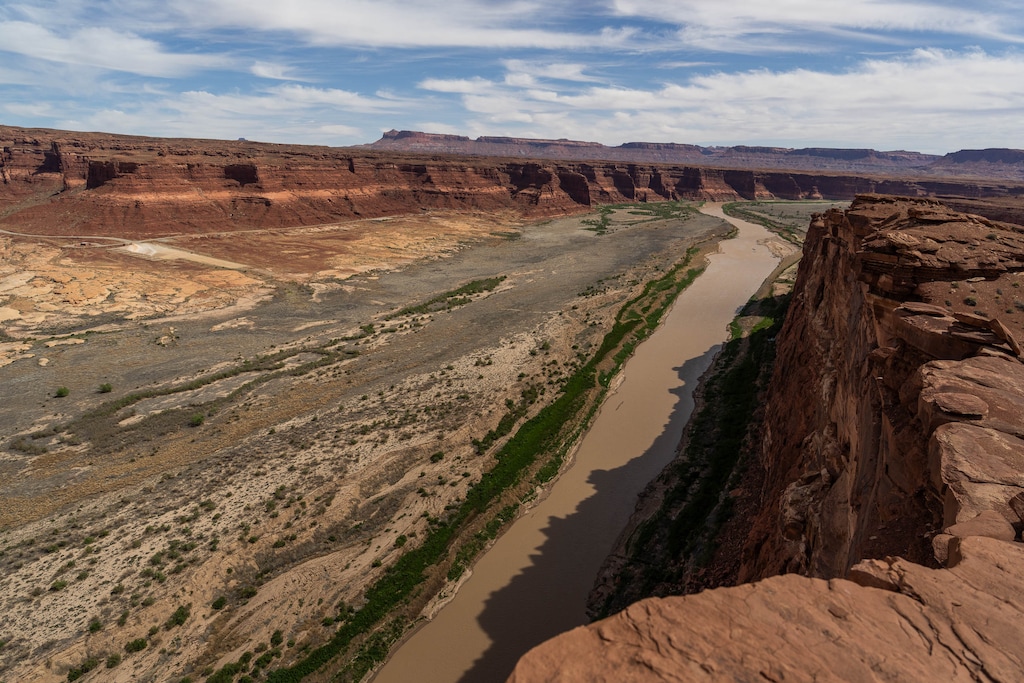
There is a big problem with the current allocation of the Colorado River water as we see in the news reports. The problem is that more water is allocated than actually exists. Thus, as each state takes the water they are allocated, our reservoirs are being depleted to record low levels.
The 1922 Colorado River Compact gave the upper basin states 7.5 million acre feet and the lower basin states 7.5 million acre feet (MAF), for a total of 15 MAF. (Later changes added Mexico, which gets 1.5 MAF.)
But instead of allocations based on a fixed amount, why not allocate the water based on what actually exists? Since the upper and lower basin states each are allocated half of the 15 MAF, why not divide the existing amount by that half? Say in a dry year, only 10 MAF flows into the basin, then the upper basin states get 50% of that or 5 MAF, and the lower basin states also get 50% or 5 MAF. In a wet year, perhaps 20 MAF will flow into the basin, then the upper basin states get 10 MAF, and the lower basin states get 10 MAF.
You could also subdivide between the states in each basin. There are four states in the upper basin (Colorado, Utah, Wyoming and New Mexico) so each would get 1/4 of the upper basin 50% allocation or 12.5% each. And for the lower basin states (Arizona, California,and Nevada), each would get 1/3 of the 50% allocation or 16.67% of the total.
You could also hold back a small amount for contingencies and store for the future in the reservoirs, say 5% to 10%.
That way, each basin and each state would share equally in the amount of water that actually exists — more in wet years, and less in dry years.
Frank Heath, Ogden