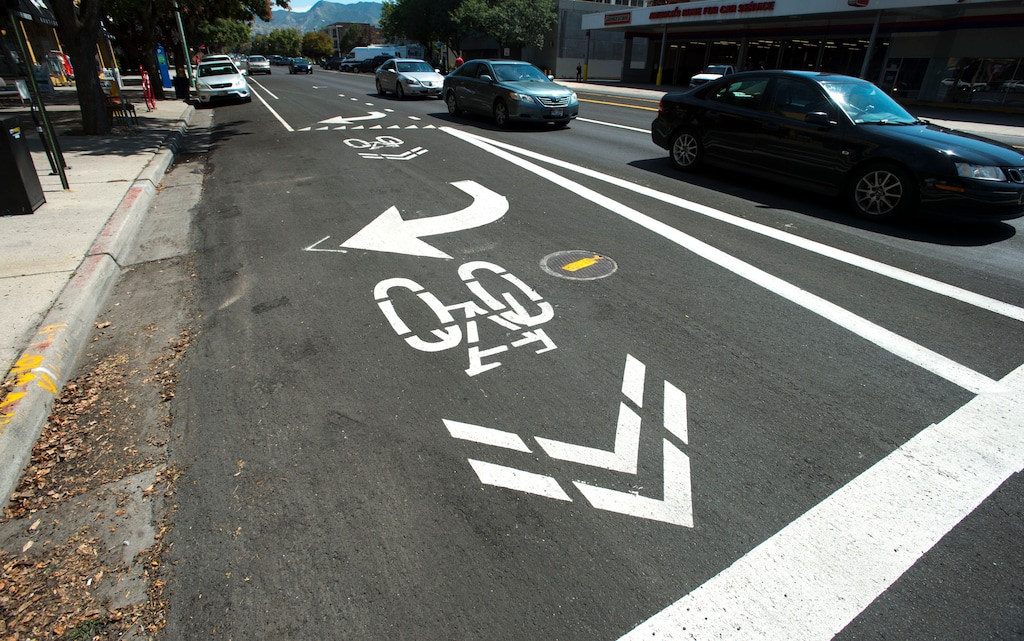
A car killed my father while he was riding a bicycle back home. The car smashed his body and his bike in Provo, on the intersection of Lakeview Parkway and the University Avenue off-ramp from I-15.
I say a car and not a driver because I believe the car to be the real culprit. Not just that individual car, but the American, and Utahn, fixation on cars.
Despite significant strides over the past 10 years, such as the Utah Valley Express and additional bike lanes, there are still countless places in Utah that are built only for privately-owned motor vehicles, leaving danger behind for anyone on foot or riding a bike.
Deaths like my father’s are not statistical anomalies, caused only by reckless drivers or careless bikers. They are the bloody cost of our car-obsessed world.
For one, any encounter between a bike and car is weighted towards the car. It can move faster and more suddenly. It is harder to maneuver quickly. A bike colliding with a pedestrian will certainly cause scraped knees, or even broken bones, but is far less likely to seriously injure or kill either rider or walker.
When it comes to the road, cars have all the power.
Those are all common sense or intuitive truths. Let’s look at the numbers. According to the National Highway Traffic Safety Administration, 39,345 people died in car crashes in 2024. Of that number, approximately 1,166 were cyclists. For a long time, cyclist fatalities were going down — they reached a record low of 685 in 2010 — they have since shot up, with 2024’s number representing a record high.
The fact is, while cycling’s affordability and low-environmental impact have made it more popular than ever, biking infrastructure has not caught up with demand.
But now I shall address the obvious objection. Are these deaths not a matter of individual responsibility? Surely if bikers and drivers were careful enough, no one would die. It is only because of human weakness this happens. Do we need to build more bike lanes or plant more stop signs when we could merely train people better?
First of all, in this case, we have no reason to believe that either biker or driver was careless. My father, Vincent Stanley Benfell III, was a lifelong cyclist. He would bike to his job as a professor at BYU daily. He rode recreationally to keep up his health and for personal enjoyment. He loved to mountain bike, braving the White Rim Trail in Canyonlands National Park every year with several of his closest friends. By every account I have ever received, he was a careful and circumspect rider, and not a fast or reckless one. In fact, he warned friends about the exact intersection where he met his fate.
The driver too was not under the influence, nor was he speeding. Even if he were directly at fault, convicting him would not prevent another death like my father’s. The exact circumstances will forever be a mystery. But I believe that more dedicated bike lanes, cheaper and more expansive public transit, and rigorous legal protections for bikers could have saved his life. His death underlines the urgency of this work. Organizations like Bike Walk Provo have advocated for more restrictive speed limits, an end to parking minimums, and zoning reform. These are changes that reach beyond any human weakness. All of us have moments of blankness. Such a moment should not cause death.
For decades, artists and activists have placed “ghost bikes” at the sites of cyclists’ ultimate fate. One such bike is now at the intersection where my father collided with that car that Monday morning. The bike’s haunting color, bone white, reminds us of the bodies’ fragility. We are all one car crash away from the end of our days. We should not have to wait for this monument to protect bikers. We can, we must, take action now, before some new senseless death proves the need for change all over again.
(Grace Benfell) Grace Benfell was born and raised in Provo and currently resides in Chicago.
Grace Benfell was born and raised in Provo and currently resides in Chicago. She is a freelance writer and journalist who covers technology, the environment, video games and gender.
The Salt Lake Tribune is committed to creating a space where Utahns can share ideas, perspectives and solutions that move our state forward. We rely on your insight to do this. Find out how to share your opinion here, and email us at voices@sltrib.com.