“If you aren’t doing anything wrong, what are you worried about?”
I hear that question whenever I raise concerns about the surveillance cameras appearing across Utah. My answer is simple: Free people should not live under constant warrantless surveillance.
The better question is: Why should innocent Utahns be subjected to surveillance when they haven’t done anything wrong?
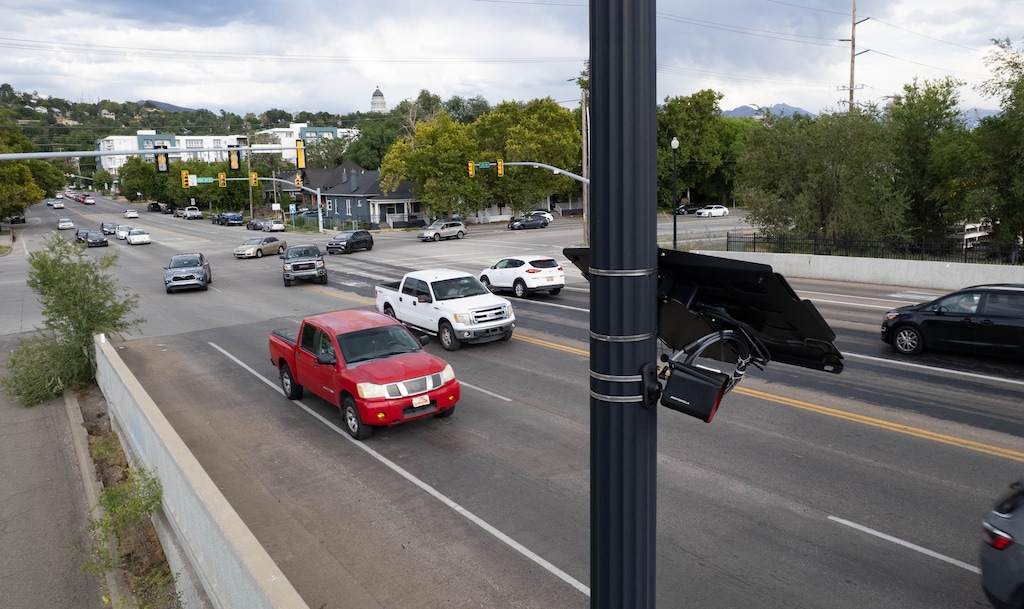
Police protected our communities for generations without building searchable databases of everyone’s movements. Today, automatic license plate readers (ALPRs) can photograph vehicles traveling our streets and feed that information into powerful computer networks capable of reconstructing everywhere a person has been.
A government program can be useful and still be unconstitutional. In my reasoned legal opinion as an attorney, Utah law already prohibits government from turning this technology into a mass-surveillance system.
Utah Code § 41-6a-2003 begins with a remarkably clear rule: Except for specifically enumerated exceptions, “a governmental entity may not use an automatic license plate reader system.”
Enumerated exceptions permit legitimate law-enforcement uses, including locating stolen vehicles, missing people and wanted suspects. Police may also access license-plate data as part of an “active criminal investigation,” but Utah law requires documented reasonable suspicion of a crime and a reason to connect that activity to a particular vehicle, owner or occupant.
That is targeted investigation. Recording everyone so police can search through their movements later is something fundamentally different.
Utah’s own Office of Data Privacy recently reviewed two law-enforcement ALPR programs. They noted that Utah law prohibits ALPR use, except as specifically authorized, and concluded: “Nothing in the Act states that a LEA may use ALPR for homeland security or electronic surveillance.”
Utah’s Constitution provides another warning. In State v. DeBooy, the Utah Supreme Court considered indiscriminate highway checkpoints under both the Utah and U.S. Constitutions. Its language could hardly be more relevant:
“Multi-purpose, general warrant-like intrusions on the privacy of persons using the highways are unacceptable.”
That case involved checkpoints, not artificial intelligence and camera networks. But the constitutional principle should apply with even greater force to an electronic dragnet. A checkpoint eventually disappears. A database never sleeps.
I represent a Utah mother who had one of these cameras installed in front of her home against her wishes. It watches where her children board their school bus. It photographs her vehicle when she leaves and returns home.
She has previously been the victim of abuse. She isn’t worried because she has something to hide. She is worried because information revealing where she lives, when she leaves home and the patterns of her family’s daily life can make her less safe.
Those concerns are not hypothetical. The Institute for Justice has documented more than 150 incidents of ALPR abuse, including wrongful stops and officials using surveillance systems to track women.
The surveillance debate recently came home to Salt Lake County. Millcreek officials discovered a Flock camera sitting on city property that neither the city nor its police could initially explain. City crews removed it after officials determined that no city department knew who had put it there or why.
Observation is not the same thing as surveillance.
Seeing my car drive down State Street is one thing. Building an interconnected database that records everywhere I go and preserves that information makes my entire life electronically searchable. That is something else entirely.
These cameras can feed privately operated AI-powered networks extending far beyond the Utah agencies using them. Once information about Utahns enters an interconnected surveillance network, local governments may never even know who can access it, how it is shared, what artificial intelligence may infer from it or if it will ever be deleted.
None of this requires distrust of police. Police should have powerful investigative tools when they are investigating crimes. But the constitutional order runs in one legal direction: crime, suspicion, investigation. Mass surveillance reverses it: collect information about everyone first and search for reasons to use it later.
Utahns never voted for that.
We never repealed Article I, Section 14 of the Utah Constitution or the Fourth Amendment. And our Legislature did not give local governments unlimited authority to monitor everyone merely because technology made it possible.
In my reasoned legal opinion, public-private mass-surveillance partnerships using systems like Flock camera networks, Palantir databases and Axon systems are illegal in Utah when they exceed the narrow exceptions authorized by law. Government entities participating in unlawful surveillance also risk costly litigation at taxpayers’ expense.
Our constitutional rights keep us safe. Elected officials should follow the law. Indiscriminate surveillance of innocent Utahns must stop.
If the government wants the extraordinary power to build a surveillance state, it should first have to convince the people of Utah to give it that power.
Until then, the cameras should come down.
(Benjamin Shaffer) Benjamin Shaffer is a Utah attorney.
Benjamin Shaffer is a Utah attorney. He practices law in the areas of civil rights litigation, constitutional advocacy and monetary reform. He lives with his wife and five children in Spanish Fork.
The Salt Lake Tribune is committed to creating a space where Utahns can share ideas, perspectives and solutions that move our state forward. We rely on your insight to do this. Find out how to share your opinion here, and email us at voices@sltrib.com.