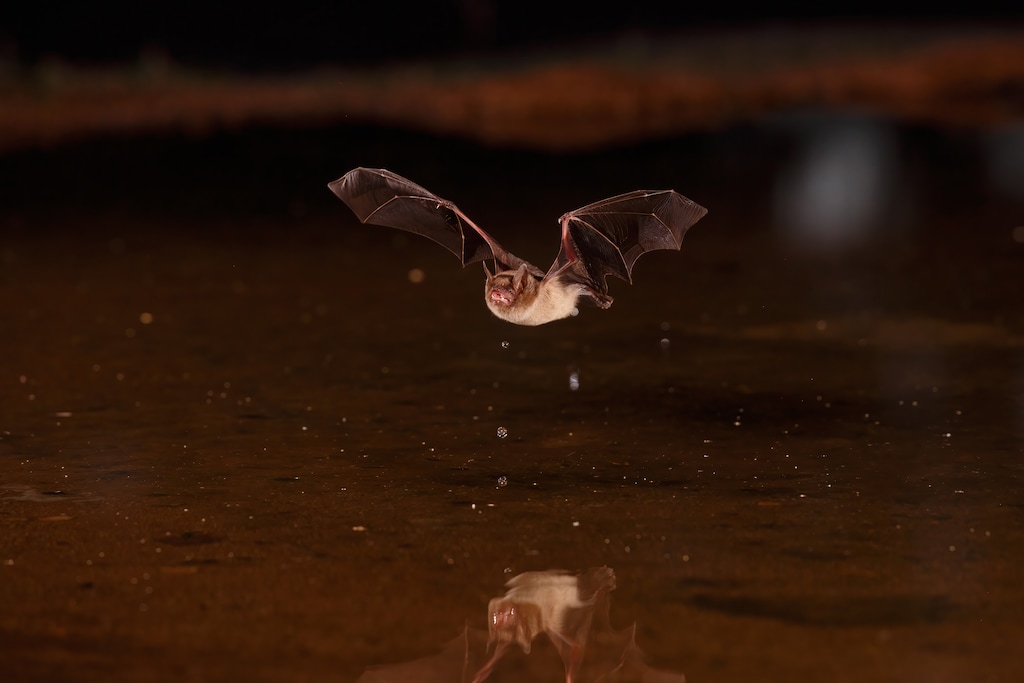
“Um, honey … I think there’s a bat in the kitchen sink.”
Our dinner guests watched, stunned, as my husband and I trapped the tiny bat in a piece of Tupperware and released it outside. I remember thinking the bat was actually sort of cute, fuzzy and curled over itself.
Sixty days later, “cute” wasn’t on my list of words for what that bat cost my family. Over the following week, more bats turned up inside our Park City home, one flying erratically through a hallway, another swooping through our bedroom while we slept.
A few days later, a friend sent me a video explaining that many bat bites are painless, often go unnoticed, and that spending even a single night in a room with a bat is enough to put a family at high risk of rabies exposure. Unsure and naive, I called our pediatrician to ask if we could wait and see.
“If a single symptom appears, you will be dead within a year,” she replied.
Our children, then 3, 4 and 5, could have been bitten in their sleep without knowing it. All five of us needed post-exposure prophylaxis (PEP) immediately. After a few calls, she sent us to the emergency room at Park City Hospital for the first of four shots, spaced two weeks apart, a series that would save us from a terrifying rabid death.
A month after our last dose, a stack of bills arrived from our insurer. I assumed a doctor-ordered, life-saving vaccine would cost us a few hundred dollars at most. Eight bills, totaling $10,670.06, after insurance coverage, stared back at me. My heart rate soared, and I felt hot in my cheeks as I checked every line, hoping, and failing, to find an error.
We aren’t a family in financial crisis, and I’m not writing this looking for sympathy. I share these details because what happened to our family happens to thousands of insured families every year. We’re not a cautionary tale; we’re a predictable result of how U.S. health policy treats this one vaccine.
State insurance regulators, including here in Utah, should require insurers to cover rabies PEP the same way they already cover routine vaccines: with zero cost-sharing for patients who need it to survive.
Journalist Sarah Kliff, writes for Vox: “The price of rabies treatment in America reveals unique failures of our country’s health care system ... pharmaceutical companies can set sky-high prices for lifesaving medication.” The Centers for Disease Control and Prevention estimates roughly 100,000 Americans receive post-exposure prophylaxis every year. I imagine the hot cheeks of parents across the country, 100,000 times a year, staring at a bill for treatment to avoid certain death.
Congress has taken notice of part of this problem. Legislation introduced in a recent session, the Affordable Rabies Treatment for All Act, would reimburse providers who treat uninsured PEP patients. While that is certainly worth supporting, it does nothing for families like ours, insured and still billed five figures.
The Affordable Care Act requires insurers to cover routine, recommended vaccines — measles, flu, HPV — with zero cost-sharing, on the logic that preventing disease is cheaper and safer than treating it later. Rabies PEP doesn’t qualify, because it isn’t “routine.” It’s given only after an exposure, billed as emergency care. So insurers apply standard deductibles, copays and coinsurance, leaving families holding the bag. The reasoning that makes a flu shot free doesn’t extend to a treatment that stands between a family and a disease with no cure once it sets in.
Failures like this don’t just cost families money; they erode public trust in a health care system that’s supposed to protect them. This is a failure of policy, not medicine, and a fixable one: State and federal regulators could classify physician-confirmed rabies PEP as a no-cost-sharing service, the way several states already cap what patients pay for insulin and EpiPens.
No family should have to weigh a four-figure bill against treatment for a disease that is, without exception, fatal. If health policy exists to protect people, not to offer opportunities to bolster a line item in a P&L, this case is as clear as it gets.
Our family received treatment, and the bats moved on from our home. The medical debt did not. It has been three years since our immunizations, and we are still paying down the debt on a zero-interest payment plan. Until insurers and regulators close this gap, the next family that finds a bat in the kitchen sink will open the same stack of letters we did, and wonder why saving their own lives cost them $10,670.06.
(Kayti Sullivan) Kayti Sullivan is a mother, a Park City resident and the founder of Threshold Consulting, a boutique consultancy focused on the complexities of midlife.
Kayti Sullivan is a mother, a Park City resident and the founder of Threshold Consulting, a boutique consultancy focused on the complexities of midlife. A seasoned senior executive and business operator, she helped scale the consumer internet company Yelp, ultimately managing a nearly one-billion-dollar P&L and a 3,500-person team. She later served as Chief Revenue Officer at The RealReal and Flyhomes, and is currently studying at the University of Utah to earn her Master’s in Social Work.
The Salt Lake Tribune is committed to creating a space where Utahns can share ideas, perspectives and solutions that move our state forward. We rely on your insight to do this. Find out how to share your opinion here, and email us at voices@sltrib.com.