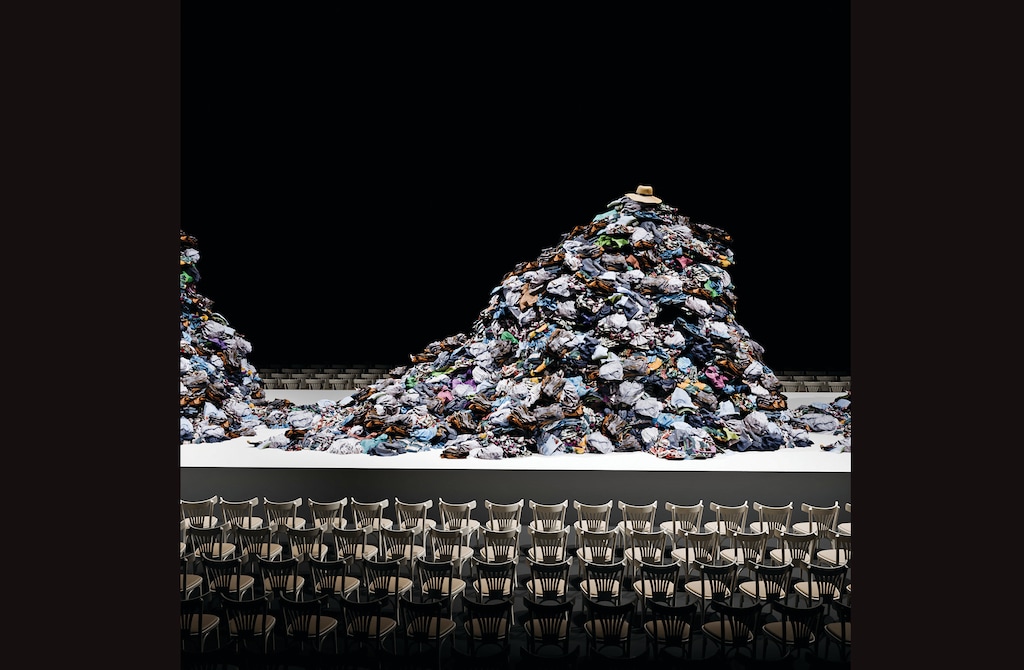
On Thursday New York Fashion Week kicks off the spring-summer 2027 season, with brands presenting their latest offerings on runways and in showrooms. As part of a monthlong fashionpalooza, designers will then travel to London, Milan and Paris for more of the same, all to feed the $1.9 trillion industry that produces an estimated 100 billion garments and accessories a year. Rough estimates are that only about 80 billion of them actually sell.
What happens to the other 20 billion? Some wind up in outlets and on flash sale sites. Some get dumped in far-off places, like the once majestic Atacama Desert in Chile, where in 2021 Agence France-Press reported that 39,000 tons of unsold fast fashion apparel were dumped, creating dunes of clothes. Much of that unworn apparel, often with price tags still attached, is burned, the synthetic fabrics and dyes generating a toxic black smoke that drifts into local villages. A court case in Hong Kong revealed that Chanel had until a few years ago engaged in what the industry euphemistically calls “inventory management.” Burberry says it no longer destroys leftover products, but the company revealed in its 2018 annual report that it had incinerated or otherwise destroyed 28.6 million pounds’ worth of unsold clothes, accessories and perfume the previous fiscal year ($37 million), bringing its five-year total to about £100 million ($130 million).
In her newsletter, Back Row, in 2022, Amy Odell quoted someone she described as a Saks marketing department employee who had worked in two different stores in the 2010s. The source said that retail staff members filled one to two dumpsters a day with unsold luxury products. Sometimes the employees were instructed to slash the items, presumably to ensure no one scavenged them. “I always wanted to bring them to a homeless shelter or Dress for Success,” Odell’s source said. “That was just absolutely wholly dismissed because there was no way a luxury brand was going to allow that to happen unless they decided to do it on their own terms.” (Ms. Odell reached out to Saks for comment at the time but did not receive a response.)
Fashion is one of the least regulated global businesses. Unlike the automobile, aviation or agricultural industries, fashion has remarkably few requirements to track, disclose or limit its environmental impact. That 100 billion figure I cited earlier is an estimate because no one knows exactly how many items the industry churns out; fashion companies don’t have to tell us. And because most production is outsourced to independent contractors, brands are not responsible for the wages or labor conditions of many of the people who make their clothes.
It’s time for American lawmakers to bring this free-for-all to an end. Overproduction is the obvious place to start. We need to know how much the industry is producing, and at what cost to the environment. Consumers should be able to buy clothes without contributing to the reckless degradation of the planet and the exploitation of their fellow humans. Fashion doesn’t need to be such an ugly business.
As I have witnessed in a decade of reporting on fashion’s impact on the environment and humanity, overproduction isn’t an accident or an occasional forecasting error. It’s built into the business model. Fast fashion and luxury brands alike need constant novelty to lure customers into stores more often. The Spanish fast fashion retailer Zara releases new items every week; next month, those offerings will include pieces by John Galliano, the British designer whose exhibition at the Metropolitan Museum of Art was canceled shortly after it was announced. Fashion weeks feed the machine: more collections, more seasons, more reasons to buy. In 1980, the average American purchased 12 to 14 clothing items a year; by 2018, that number was 68.
One big reason is that in the age of globalization and offshoring, apparel and accessories have become extraordinarily inexpensive to manufacture. A majority of production is outsourced, primarily to developing nations where safety and labor oversight is weak and wages are at or below poverty level. Today only about 3 percent of the clothes sold in the United States are made domestically. Lower production costs mean lower retail prices, which is why a new T-shirt can cost as little as a few dollars. According to the Bureau of Labor Statistics, clothing accounted for 10.4 percent of the American household budget in the 1960s; today, consumers spend 2.5 percent of their budgets on apparel and related services such as dry cleaning, even though they buy five times as many items.
The same economics make excess inventory disposable. For brands, destroying or dumping items is cheaper and easier than storing, sorting, transporting, recycling or reselling them.
Some companies gesture toward reducing waste. You can deposit discards from any brand at H&M stores, and the company has partnered with organizations that sort the collected clothing for reuse or recycling. But such initiatives often seem to be more about buffing up a company’s public image than truly doing good. In 2023, the Dutch sustainability nonprofit Changing Markets Foundation stashed Apple AirTags inside 21 items that it donated to clothing chains across Europe or posted on resale sites to see where the clothes actually went. It determined that 16 of the items were destroyed, abandoned in warehouses or exported to Africa. Only five were reused or resold within Europe. Overall, according to data from the sustainable fashion nonprofit Textile Exchange, less than 1 percent of clothing is recycled into new fiber each year.
Meanwhile, fashion’s greenhouse gas emissions are rising, driven in part by the global production of polyester, an inexpensive petroleum-based synthetic that does not biodegrade. The industry’s annual greenhouse gas emissions have now reached an estimated gigaton — about the same as the entire climate footprint of Japan.
Governments are trying to rectify that by making brands financially responsible for the entire lives of their garments. In 2024 Gov. Gavin Newsom of California signed the Responsible Textile Recovery Act, a law that requires apparel and textile companies to pay for the collection and recycling of their products. Producers had to enroll in the state program by July 2026, and it must be fully operational by 2030. Congress should pass a similar law nationwide.
Also in 2024, the European Union introduced a sweeping new framework to make products more durable and recyclable, and introduced digital labeling that shows an item’s provenance and environmental footprint. The European Union has since adopted separate rules that hold producers financially responsible for the textile waste they generate. This summer, one piece of that framework went into effect in the 27-country bloc: Large companies are now prohibited from destroying unsold clothing, accessories and footwear. The goal is to curb overproduction, reduce waste and keep valuable materials in circulation longer.
France is going further. As of Sept. 1, ultra-fast-fashion companies such as Shein and Temu, which flood the market with enormous amounts of inexpensive clothes, have to pay a fee on every item they sell. The tax can reach $14 per item now and $23 by 2030, though it cannot exceed half the item’s pretax price. Refashion, a nonprofit organization that runs France’s textile producer responsibility program, will manage the collection of the new charges.
All of this is a good start. But each action targets only one part of a systemic problem. Governments should require all fashion brands to disclose publicly how much they produce, penalize them for what they fail to sell and hold them accountable for environmental and labor abuses throughout their supply chains. Only then will the new clothes coming down the runways each season be worth wanting.
Dana Thomas is the author of “Fashionopolis: Why What We Wear Matters,” and writes the newsletter The Style Files. This article originally appeared in The New York Times.