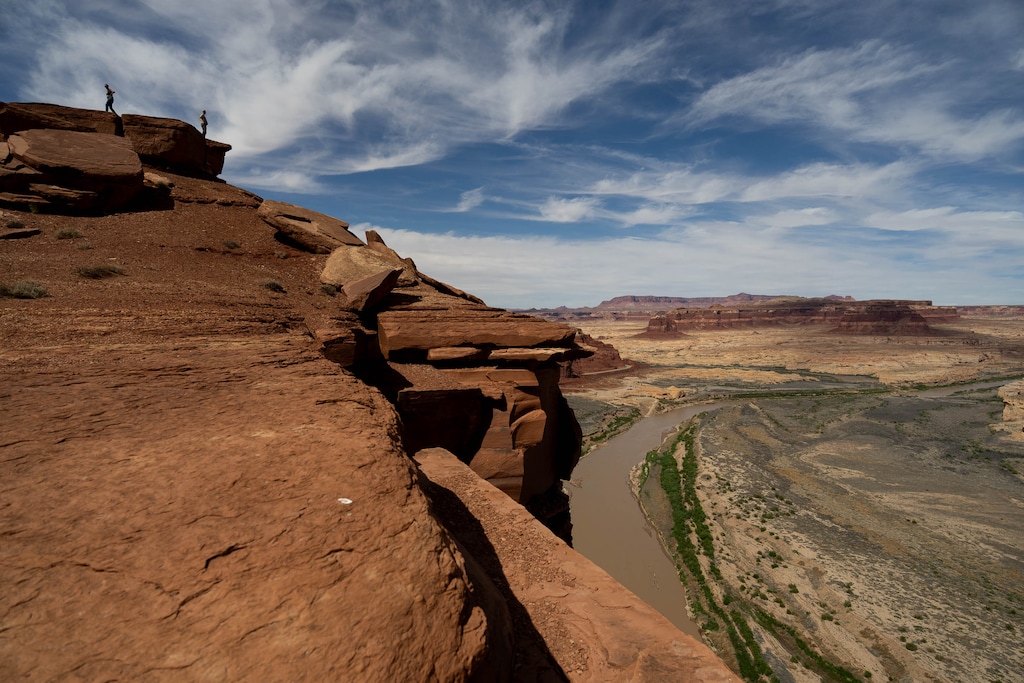
After months of negotiations, the Upper and Lower Basin states recently failed to agree on a plan for sharing the Colorado River through 2036. This was and is a difficult assignment.
My Ph.D. dissertation in mechanical engineering involved fluid mechanics. Later, for years as a consultant, I worked with other experts, attorneys and designers on difficult tasks. I learned how people with differing backgrounds can work well together. The same strategies I learned then are needed for this project: individual research, plus group creative involvement and insights. For example, we should ask why four states agreed to export water for free 100 years ago and whether that should continue indefinitely.
Realistically, I believe the long term solution is to take salt out of ocean water and flow more water where it’s needed.
Water flowing in the Colorado River is over-allocated. The 1922 Colorado River Compact divided the river into “Upper” and “Lower” basins, each allotted half of the assumed flow of 15 Million Acre-Feet per year (MAF/yr). The Upper Basin is where it snows. The Lower Basin is where it goes. Then what’s left empties into the Gulf of California.
Ignored were treaty obligations half a century earlier granting 3.4 MAF/yr to tribes. Mexico received 1.5 MAF/yr by treaty in 1944, leaving the total obligation to 19.9 MAF/yr.
Data show that a more realistic expectation for flow, absent drought, is 11 or 12 MAF/yr. The Lower Basin plus Mexico used their full allocation until 2022, well into the drought. The Upper Basin, lacking infrastructure, used an average of 57% of allocation between 2021 and 2024. Lake Mead and Lake Powell reservoirs were added to stabilize flow rate. However, a prolonged drought has drained reservoirs to levels threatening power production.
The water law that justifies this strange legal practice of claiming rivers began in the California gold rush of 1849. Miners piled rocks to identify gold mining claims, diverted rivers to wash away gravel and defended their claims with threats of violence. They formed districts to keep others away. Districts devised rules to determine who could keep a claim, like “use it or lose it”.
These rules were later canonized into law after California became a state in 1850. Prior Appropriation law for Western Water is just to claim and use the water. Riparian Rights for Eastern Water are tied to the land near the river.
Veins of gold, however, are eventually mined out. The claimed river of water renews every spring. The Colorado River is a renewable gold mine.
The seven basin states in 1922 signed the Compact for the purpose of equitable division and apportionment of the river. Cities in Southern California pooled funds to build the Colorado River Aqueduct to LA, thus obtaining senior water rights, forever claiming the biggest share of water by being the first to follow the Doctrine of Beneficial Use.
To become equitable, more water is necessary.
Ocean water is available from the Gulf of California. San Diego operates a membrane desalination plant that cost $1 billion dollars to build. Two of these would produce 100,000 acre-ft/yr of fresh water and require one 77-MW Small Modular Reactor to supply power, adding $1 Billion. Thus, $3 billion dollars would be needed to produce that amount of irrigation water for use in the imperial valley by delivering it into the All-American Canal near Yuma, just 100 miles away at 200 foot elevation.
The result: additional fresh water from the ocean traded for snow and rain where it already exists upstream.
It would be a large, very expensive project, comparable to Hoover Dam construction in 1935. But if we could do it then, why not now? What is needed is generation of public interest and creative planning.
We now know that water has value. Utah is leasing water from irrigators for $390 for each acre-ft. Others have paid much more to grow the flow. Suppose a fee of $400/acre-ft was charged for diversion of Colorado River Water by states, irrigation districts and Mexico. Everybody except tribes. In the first year just 10 MAF/yr would generate $4 billion dollars. Enough to begin a sustainable long term program of growth when coupled with conservation. Another facility added each year. More than a million acre-feet added in year 10.
What’s the chance that a long term solution like this can be implemented? One-in-a-million?
To quote the movie, Dumb and Dumber, “So yer sayin there’s a chance!”
(Ronald Lee Woolley) Ronald Lee Woolley is the founder of Woolley Engineering Research in Provo.
Ronald Lee Woolley is the founder of Woolley Engineering Research in Provo. He is a retired mechanical engineer who consults and is an expert witness in accident reconstruction. He holds degrees from BYU and Stanford University. Woolley and his wife, Ann, are the parents of five children and the grandparents of 17 children.
The Salt Lake Tribune is committed to creating a space where Utahns can share ideas, perspectives and solutions that move our state forward. We rely on your insight to do this. Find out how to share your opinion here, and email us at voices@sltrib.com.