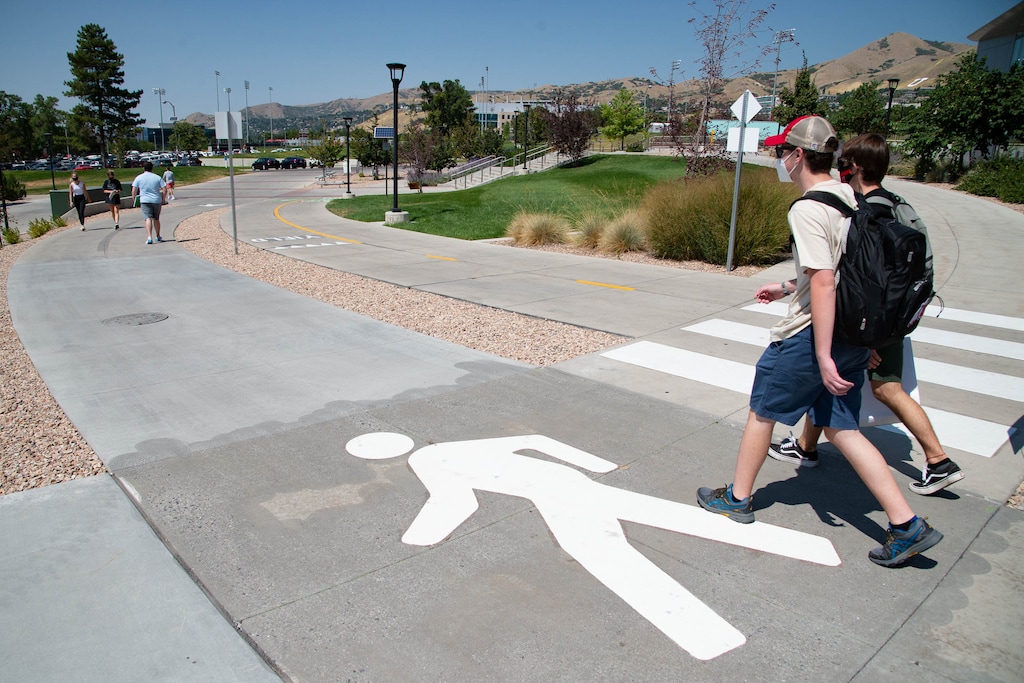
On a recent Sunday, I wanted to meet a friend for coffee and to read books together.
First, I texted different friends to see who is available. Then, I had to see what was open — it’s a Sunday in Salt Lake City, after all. Then I had to decide: Do we drive separately or bike separately? Will there be a freight train across the bike path — again?
Each step between wanting to see a friend and actually seeing one created friction. And these moments of friction are when I start thinking about college, where my commute, my work, my meals and my home were all within 15-minute walk of each other.
In an epidemic of loneliness, we can — and we should — design our cities and communities with this same attention to scale, where proximity rules and the friction for interactions is low.
For myself and many Americans, college was the last time we lived in a neighborhood designed for connection and friendship, and at 36, I still miss my college experience. I miss bumping into friends at the dining hall during breakfast. I miss how seeing people I know was a convenient and structurally reinforced part of my life, not an onerous task for a Sunday morning.
In psychology, this is called propinquity. Simply put, tight bonds and friendships form among people who are in proximity to each other. Living in college co-housing where you see the same people in the mornings, during the day, and in the evenings is a prime example. Many adults who attended college cite their friends from that time as their longest lived and deepest friendships. As a student, I knew when I left my dorm room in the morning that I didn’t need to make plans to see friends because I would just see them, through the course of a day.
We have other models for this success, and it comes in surprising places: retirement homes and rural America. Retirement homes serve as a mirror on the opposite end of life to a freshman dorm experience. In a similar vein, rural Americans know their neighbors thanks to the informal, repeated encounters of your neighbors at the single store town or post office are exactly the kind of social environment that car driven suburbs engineer out.
In many American cities, it is effectively illegal to build multi-unit, mixed-use communities that foster closeness. Zoning laws limit the types of housing available, and in many cases, most cities are largely zoned for single-use, single-family home neighborhoods. Moreover, laws written to separate us by race (redlining) still separate us — only now the dividing lines run between all of us.
There are some solid policy proposals that would support a more communal urban environment. Salt Lake City is considering a tweak of urban zoning laws allowing larger lots to be split into more single family homes, which has been successful in Durham, North Carolina, and in Houston, Texas. Cities could remove barriers to construction of formerly common duplexes, tri- and fourplexes, and smaller scale homes that were commonly built in the past but rare or outright banned in today’s American cities. Cities could allow and encourage cottage court style housing, where single family homes face a shared greenspace courtyard.
Moreover, proposals that allow for greater infill in a city do not require tear down of existing homes and no moving into dorm style living.
Cities could also remove exclusion for businesses so residential areas include third places: restaurants, coffee shops and bars.
The changes happen in local governments where residents have input, and they don’t require a challenging legislative push. And they could start a transition to an environment where friendships can form by accident, not appointment.
I’ve joined a local housing group, Wasatch Advocates for Livable Communities, not because I have strong feelings about lot sizes, but because the rules keeping my friends priced off my block are the same rules keeping all of us apart. I would call on readers to contact their City Council Representatives and ask them to support the Expanding Housing Options initiative; join pro-housing, pro-neighbor groups like WALC, and show up at the Salt Lake City Planning Commission hearing covering Expanding Housing Options on Sept. 9 at 5:30 p.m. to speak up in support.
It turns out no one was available for coffee on that recent Sunday. I biked home to find a quarterly college magazine in my mailbox. I open it and see an article for the new dorms built on campus celebrating a “home in the village” for students: the en suite set up for upperclassmen, the in-building dining facility, and proximity to both classroom and campus activities.
All I want in my neighborhood is a walkable grocery store and friends nearby. Having accessible social spaces would make it easier to develop more friendships with the people who already live close to me. Otherwise, maybe I have to go back to college to find this type of built environment.
(Matthew Morriss) Matthew Morriss, Ph.D., is a resident of Salt Lake City's West Side, an avid bike commuter and a housing and transit advocate.
Matthew Morriss, Ph.D., is a resident of Salt Lake City’s West Side, an avid bike commuter and a housing and transit advocate.
The Salt Lake Tribune is committed to creating a space where Utahns can share ideas, perspectives and solutions that move our state forward. We rely on your insight to do this. Find out how to share your opinion here, and email us at voices@sltrib.com.