In recent years, residents of the western United States have watched helplessly as wildfire after wildfire tears through communities once thought immune.
Los Angeles, once associated primarily with palm trees and Hollywood glamour, now finds itself infamous for orange skies, air thick with ash and urban neighborhoods turned to charred ruins.
The threat is no longer confined to remote forests. It has reached into city limits. And Salt Lake City, nestled against the Wasatch Front, may be next.
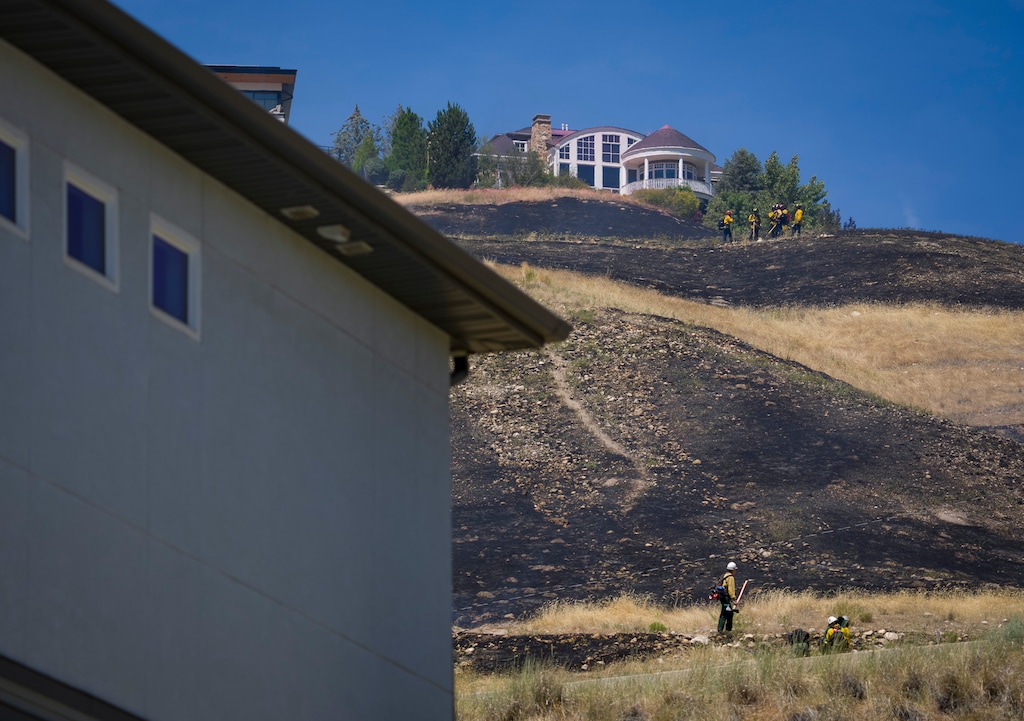
As residents of our city, we live at the wildland urban interface, have experienced several wildfires firsthand and have spent a decade trying to prevent wildfires from destroying our neighborhood.
This possibility that Salt Lake City could become the next LA isn’t hypothetical. Our region, long regarded for its stunning natural beauty and access to the outdoors, is becoming a textbook case of wildfire vulnerability due to a convergence of climate change, urban expansion, drought and aging electric utility infrastructure. Yet, our collective awareness and political will remain dangerously out of step with the risks we face.
The wildland urban interface (WUI) — where residential neighborhoods meet undeveloped wildland — is growing rapidly across Utah, especially along the Wasatch Front. Neighborhoods in foothill areas like Emigration Canyon, the Avenues and even the east bench of Salt Lake City are increasingly interwoven with dry vegetation, creating dangerous conditions for fast-moving urban fires. As more housing developments push into these fringe areas, we are creating corridors for wildfire to leap from the wilderness into the heart of our city.
In Los Angeles, fires such as the Eaton Canyon and Palisades Fires demonstrated how quickly this can happen. Salt Lake City’s terrain, with steep slopes, canyons funneling wind and years of dried-out underbrush, has produced similar fire risk — only without the same level of public readiness or emergency infrastructure.
Climate scientists have long warned that Utah will be among the states hardest hit by rising temperatures and declining snowpack. According to the National Integrated Drought Information System, most of Utah, including Salt Lake County, has recently experienced severe to extreme drought conditions. Drier winters and hotter summers mean that the vegetation around us is not only drier — it’s effectively kindling. Combine this with stronger wind events — like those that knocked down hundreds of trees along the Wasatch Front in 2020 — and you have a recipe for a catastrophic firestorm. Santa Ana-style winds that stoke fires in California have analogues here.
Aging electrical infrastructure has been linked to several of California’s most destructive fires. Pacific Gas & Electric (PG&E) was found liablefor many reasons, including the devastating Camp Fire in 2018. The most recent Altadena fire in Los Angeles has been found to have been caused by Southern California Edison utility transmission wires. In Utah, Rocky Mountain Power (RMP) has moved very slowly to harden its aging infrastructure. Power lines in high-fire-risk zones — especially near foothills — are vulnerable during windstorms. Indeed, last year RMP’s poorly maintained equipment started a fire on Ensign Peak that threatened several neighborhoods. Rather than bury lines in high-risk zones, this past year, RMP was planning to merely replace above-ground poles in a foothill’s wildfire interface neighborhood with a helicopter on a red flag day. It gave homeowners mandatory home evacuation notices. Despite numerous requests over 10 years by homeowners to bury the power lines in this foothills area due to its wildfire designation, RMP has steadfastly refused to do so.
We call on the city and state government to act urgently in the following areas:
Hazard mapping and public communication: Clearly define fire risk zones within Salt Lake City, and disseminate information to residents through every available channel.
Fire-safe building codes: Mandate fire-resistant materials for new construction in high-risk areas, and incentivize retrofitting older structures.
Vegetation management: Expand defensible space programs, require vegetation clearing near structures and increase prescribed burns or targeted thinning.
Infrastructure upgrades: Evaluate all transmission and distribution lines in WUI areas, and call on RMP to immediately begin undergrounding wires in the highest risk areas and update its dangerously outdated infrastructure.
Evacuation planning: Conduct evacuation drills and install fire warning sirens or automated alert systems across vulnerable neighborhoods.
If Salt Lake City waits for its version of California’s wildfire tragedy before acting, it will already be too late. We must not mistake our mountains for permanent protections. The same topography that defines our beauty can also be our greatest threat.
Our city administration must act prudently on wildfire mitigation and accept the fact that a lot of WUI zones are high risk due to the poorly managed public lands that the city owns.
Urban fire is not a distant risk — it is a growing certainty. Let’s choose prevention over regret.
(David Classen) David Classen, M.D., M.S., is a faculty member at the University of Utah School of Medicine and a former board member of Red Butte Garden for 10 years.
David Classen, M.D., M.S., is a faculty member at the University of Utah School of Medicine and a former board member of Red Butte Garden for 10 years.
(Ian McCubbin) Ian McCubbin serves as a prominent leader within the evolving space economy, specializing in wildfire technology, Earth observing systems and commercial weather applications.
Ian McCubbin serves as a prominent leader within the evolving space economy, specializing in wildfire technology, Earth observing systems and commercial weather applications. He focuses on the intersection of emerging startups and venture funding, particularly analyzing how the capital stack integrates across government, philanthropic, and private investment sectors to advance wildland innovation.
(David Goldsmith) David Goldsmith is a fourth-generation resident of Utah and the chief operating officer of a telehealth company dedicated to cancer care.
David Goldsmith is a fourth-generation resident of Utah and the chief operating officer of a telehealth company dedicated to cancer care.
(Laurie Hofmann) Laurie Hofmann lives in Salt Lake City at the Wildland Urban Interface.
Laurie Hofmann is a community volunteer and a concerned citizen.
All four authors have homes in Salt Lake City at the Wildland Urban Interface.
The Salt Lake Tribune is committed to creating a space where Utahns can share ideas, perspectives and solutions that move our state forward. We rely on your insight to do this. Find out how to share your opinion here, and email us at voices@sltrib.com.