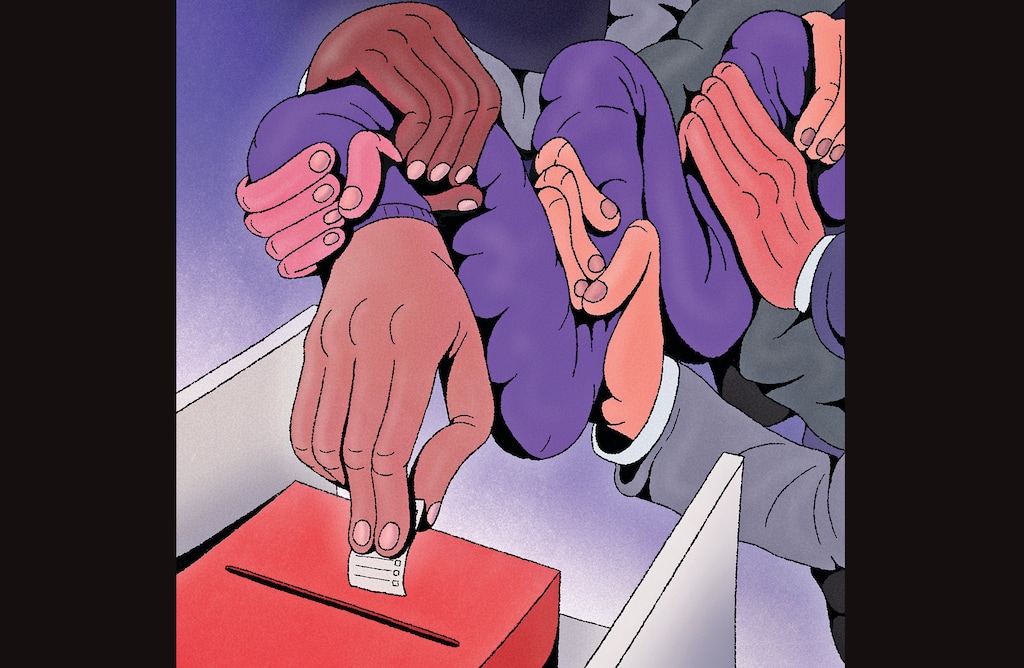
When America lowered the voting age from 21 to 18, the move had broad bipartisan support, starting with college students and civil rights groups and running right up through Congress and state legislatures. At the 26th Amendment’s signing ceremony, 55 years ago last month, President Richard Nixon declared that “America’s new voters, America’s young generation,” would bring “moral courage” and “a spirit of high idealism” to the country.
Today, however, America’s current “young generation” — and in particular, college students — stand at the intersection of two of the Trump administration’s favorite targets: voting rights and higher education. Through a range of measures, the administration has sought to make it more difficult for students to vote and for colleges and universities to assist student voters.
The connection between education and democracy has been core to American ideals since the nation’s founding. Thomas Jefferson, who went on to found the University of Virginia, wrote, “No other sure foundation can be devised, for the preservation of freedom and happiness.” For this historical reason — and more practically, because college students may live away from home — institutions of higher learning have traditionally made an effort to facilitate registration and voting.
The Trump administration’s new regulations are aimed right at those efforts. If universities do not fight to maintain the vital work they have done to promote democracy in its most literal form, they will lose that foundational purpose, and the nation will lose the vital contributions of countless young adults.
Last August, just as the academic year was beginning, the Department of Education sent a “Dear Colleague” letter to college administrators informing them that their institutions could no longer use federal work-study funds to support nonpartisan civic activities such as voter registration, voter hotlines and voter assistance at polling places. These are activities that groups such as the ALL IN Campus Democracy Challenge and the Students Learn Students Vote Coalition have shown demonstrably increase student voter turnout.
The message in the latest edition of the Federal Student Aid Handbook appears to set a somewhat less restrictive standard. So what exactly is permissible? The American Council on Education encourages institutions to “assess from their own risk vantage point.”
Helping students vote should not require nerves of steel.
New regulations that could go into effect as early as Oct. 1, just over a month before the 2026 midterms, would place even greater restrictions on this activity. The Office of Management and Budget has proposed to classify voter registration efforts by colleges and other nonprofit organizations, even if nonpartisan, as “lobbying,” and therefore to ban the use of any federal grant dollars for that purpose or “related activities.” We can only speculate about the rationale for this change, because the O.M.B. failed to provide the justification that is required by law.
The attacks on college-based voter registration efforts don’t just limit healthy democratic engagement; they violate the spirit of our existing federal law. The 1998 reauthorization of the Higher Education Act requires colleges and universities to make a “good faith” effort to provide their students with voter registration materials.
In addition, laws in states such as California, Maryland, Minnesota and Michigan require proactive measures to encourage student voting. Depending on how these new federal regulations are interpreted, they might come into conflict with the state laws, too.
In February, Secretary of Education Linda McMahon declared that “American colleges and universities should be focused on teaching, learning and research — not influencing elections.” Her statement was made in a news release about a federal investigation into the National Study of Learning, Voting and Engagement, a nonpartisan research project that for 13 years has helped educators understand and promote civic participation at more than 1,000 colleges and universities.
Neither the study nor Tufts, the study’s home, has been accused of any wrongdoing, but the threat of sanctions — against both the National Student Clearinghouse, the source of essential data for the study, and the schools that participate in the project — appears to have been enough to halt research for the foreseeable future.
The paradox is that Ms. McMahon, along with many other members of the Trump administration and a growing number of voices on both sides of the political divide, champions a return to civics education. But the purpose of that education does not end at the classroom door.
Its value is in its ability to get people involved in civic life and the democratic process. That’s precisely the goal of these college activities and organizations, yet they are coming under relentless attack.
American colleges and universities must not be neutral on the issues of democracy and civic participation. Institutions should do what they have been doing since before the Declaration of Independence: educate students and help shape them as informed and engaged citizens.
In the 2022 midterms, only 31.3 percent of college students voted. We should all view this as unacceptable. College leaders should articulate their opposition to the proposed rule changes and find resources to promote and defend the most foundational of democratic rights. This is not a question of partisanship but of citizenship.
This month, when first-year students arrived at Bard College, where for 15 years I have directed the Center for Civic Engagement, they all had to visit a voter registration booth even before they received their room keys. No one was required to register, but several hundred did, and those who were already registered and planning to vote from home received help with the often complex absentee ballot process.
Instead of shying away from this legitimate activity, colleges should redouble their efforts to reach young people, educate them and assist them as they navigate the registration and voting process. They should not just teach students about their democratic rights; they should help students realize them. There is no truer way to fulfill their educational mission.
Jonathan Becker is the acting president of Bard College and an editor of “Youth Voting Rights: Civil Rights, the Twenty-Sixth Amendment, and the Fight for American Democracy on College Campuses.” This article originally appeared in The New York Times.