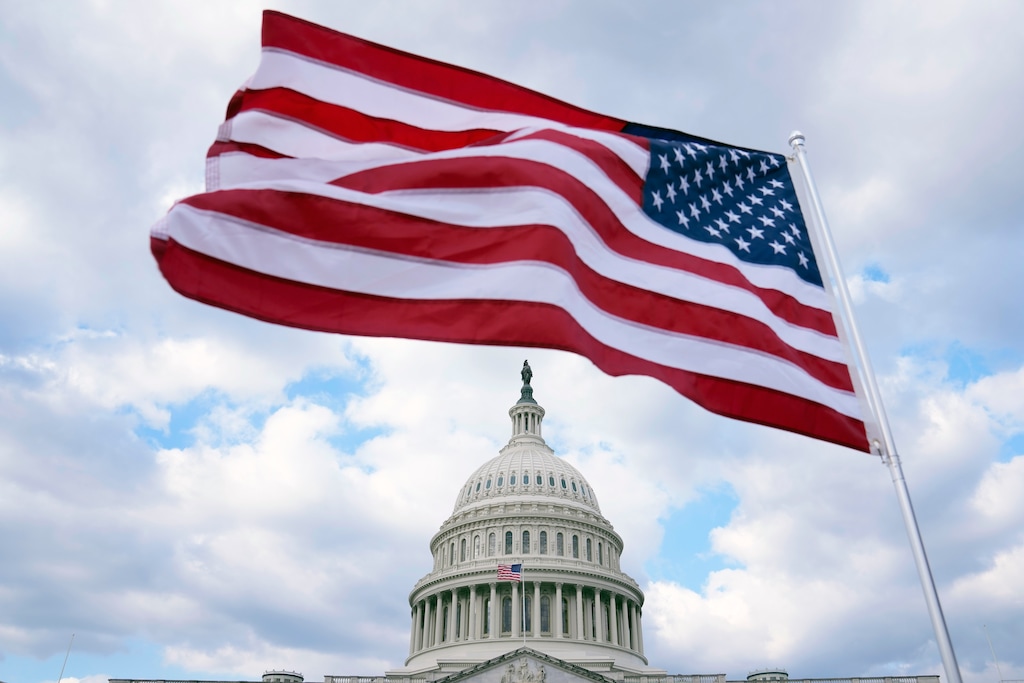
Exactly 250 years ago this very month, a small group of men made the most radical, earth-shattering and beautiful assertion in the history of our species. They claimed that “all men are created equal.” Then they doubled down: These equally created men, they wrote, “are endowed by their Creator with certain unalienable Rights,” among them “Life, Liberty and the pursuit of Happiness.” And most audaciously of all, they claimed this without proof or argument. Brushing all need to justify aside, they boldly declared “these truths to be self-evident.”
On that basis, they listed grievances against their British sovereign, then pledged to each other “our Lives, our Fortunes and our sacred Honor” to create such a society or — implicitly — to die trying. Thus began the American experiment.
For nearly a decade now, I’ve told that story in podcast form. Millions of Americans have tuned in and, in more recent years, I’ve carried it from one packed theater to the next, in so-called “blue” and “red” states alike. In a time when headlines speak of a “divided” nation on the brink of implosion, I’ve met thousands of Americans hungry to hear their story. Not a flattering version, not their chosen partisan one, but the complicated, messy, imperfect and beautiful truth of this experiment. The highs and lows alike. I know first-hand that Americans care about their past, their present and each other.
But I also know why America250 has come not with a bang but a whimper. I hear it in the questions crowds ask me after the show: How much longer will we endure? Are we headed toward another civil war?
The love and patriotism are there. But they’re overshadowed by despondency. A despondency fed by partisan grinding that erodes trust in our institutions. And it’s all fanned by the algorithms that aren’t about keeping us informed but scrolling. Nothing keeps us scrolling like fear.
Yet, I have never been more hopeful.
Telling America’s story has taken me to the darkest places in our nation’s annals. That 250-year-old promise has been waylaid again and again by factionalism and failure; our own state’s founding is the story of a group fleeing exactly that kind of failure. But in this long history, I’ve seen, again and again, how our shaken, cracked and at times circumvented institutions have held just long enough for our better angels to rise and fight for them. It’s the same instinct that drove a golden spike into the ground here, at Utah’s Promontory Summit, only years after the Civil War: the belief that this country is worth binding together, even as — perhaps especially as — it strains at the seams.
Not that those angels won every fight. Frederick Douglass saw slavery abolished only to watch Jim Crow rise in its place. Susan B. Anthony was arrested for voting, and never did so legally. Standing Bear won legal recognition of Native personhood in court, but not citizenship. Failures and imperfect victories, and yet, we’re closer to the promise today because such angels, including Utah’s own vote-casting suffragist Seraph Young, never gave in to hopelessness.
Truly, Abraham Lincoln was right: “As a nation of freemen, we must live through all time, or die by suicide.”
I don’t see a nation ready for suicide. That would not only contradict our long historical pattern, but ignore the angels I’ve met teaching at UVU — from my students in National Security Studies who are so visibly eager to serve, to our diverse student body filled with young angels who are eager to learn, to ask questions in good faith, to have a dialogue and, yes, on occasion, to exercise their First Amendment right to protest.
Nonetheless, we can’t leave the problem solving to the next generation. We have to serve. Volunteer on local committees or commissions. We have to vote, and I don’t just mean in November. That’s like getting a gym membership in January and claiming you exercise. Be the contrarian, if need be, who expands your party’s tent. And rather than bemoaning the misinformation online, let’s recognize what’s unprecedented in our day isn’t the “fake news;” it’s the unparalleled access to good information. Finally, let’s not give into othering. I cherish the email I got just last week from a mother with a self-professed extreme position who’s decided she can be a better listener to her moderate daughter. Not bend her views. But listen and love. Despondency doesn’t survive dialogue.
So now, as Utah marks 179 years since the arrival of its pioneers and their chapter in America’s complicated and contradictory story, let this nation’s 250th anniversary fill us with wonder instead of dread. May we all renew that 250-year-old, impossible, but worthy and unfinished pledge: to wear out our lives building the society our founders dared to imagine, even knowing that we’ll die trying.
Greg Jackson, a Utah Valley University history professor and creator of the "History That Doesn't Suck" podcast has written a new book, "Been There, Done That," exploring periods of conflict and in American history to point out political turmoil is not new and the nation is resilient.
Greg Jackson hosts the podcasts “History That Doesn’t Suck” and “Government That Doesn’t Suck”, is streaming on PBS with “The Unlikely Union,” the author of “Been There, Done That: How Our History Shows What We Can Overcome,” and the America250 Professor in Constitutional Studies and Senior Fellow in National Security Studies at Utah Valley University.
The Salt Lake Tribune is committed to creating a space where Utahns can share ideas, perspectives and solutions that move our state forward. We rely on your insight to do this. Find out how to share your opinion here, and email us at voices@sltrib.com.