 Carmen Nesbitt
The defeat of more than a dozen Republican incumbents in last week’s elections sent a clear message to Utah lawmakers, Gov. Spencer Cox said this week: Utahns are tired of being ignored by their elected representatives.
“Definitely, the national political environment played an enormous role in the outcomes here in Utah — but I think it would be a mistake to stop there,” Cox said Monday at a news conference aired on PBS Utah.
He then pointed to multiple instances where lawmakers ignored their constituents on important issues — including a 2025 bill that gutted bargaining rights for public employee unions.
Despite mass opposition from nearly every public labor union in Utah, lawmakers passed the measure. The Legislature ultimately repealed the law after labor organizers collected more than a quarter of a million signatures to call a referendum to undo it.
Still, both of the bill’s original sponsors felt the consequences on Election Day.
Rep. Jordan Teuscher, R-South Jordan, lost to Democrat challenger Jess Birtcher, who received 52.62% of the vote as of late Wednesday. Teuscher has held the House District 44 seat since 2021.
“I want to congratulate Jess Birtcher on his victory,” Teuscher announced on Facebook this week. “While we disagree on many political issues, we share a deep love for our community and a commitment to serving Utahns. I’m grateful for the respectful campaign he ran, and I sincerely wish him the best.”
Teuscher’s bill, HB267, would have eliminated collective bargaining for government workers, including in public education, law enforcement, fire departments and public transportation.
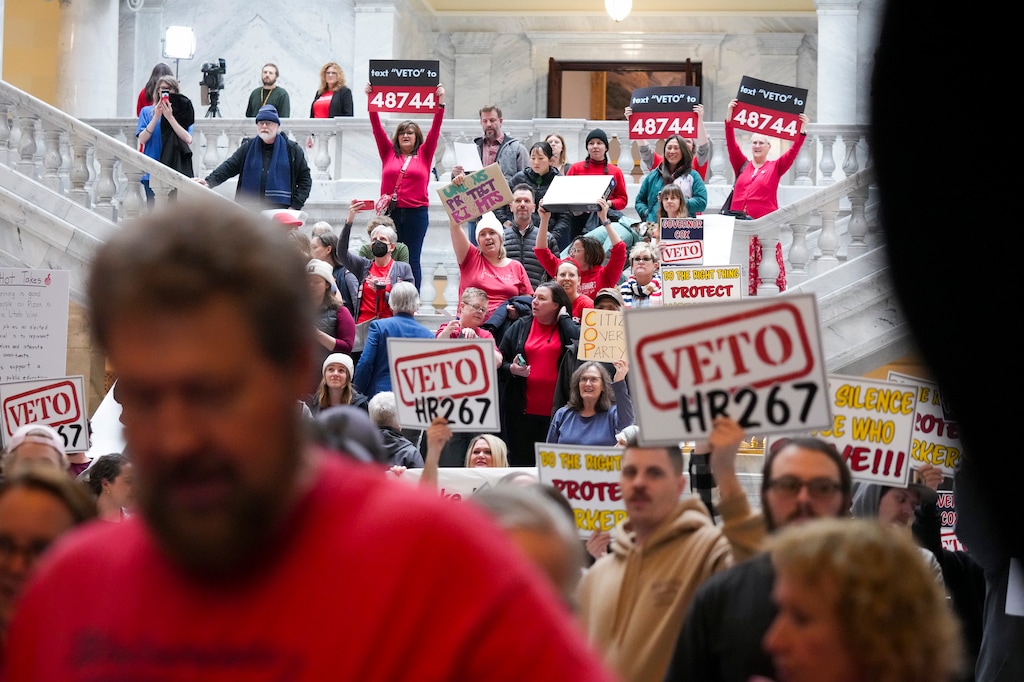
Over the course of about two weeks between late January and early February 2025, labor representatives and employees from all those sectors showed up to the Utah Capitol to oppose the bill.
Firefighters, teachers and police officers all delivered the same message: HB267 would hurt and silence them.
(Trent Nelson | The Salt Lake Tribune) Firefighters look on as the Senate votes on HB267, a bill aimed at banning collective bargaining for public labor unions in Utah, at the Utah Capitol in Salt Lake City on Thursday, Jan. 30, 2025.
Teuscher argued the bill did the opposite by “bringing more voices to the table,” especially for public education.
“I know how hard teachers work, and if I didn’t believe that this bill was really going to, in the end, help that environment to be better for students, I wouldn’t be running this bill,” he said at the time. “But I strongly believe that this path will actually get to a place where all voices are heard.”
Renée Pinkney, president of the Utah Education Association, the state’s largest teachers union, repeatedly and publicly pushed back on that. She argued student outcomes rely on healthy working conditions for educators — which unions play a crucial role in.
The bill’s Senate sponsor, Kirk Cullimore, R-Sandy, reduced the widespread backlash to “unfounded” fear that was being “promulgated” by education unions that were “recognizing” they don’t offer the services they are meant to provide.
“[It] is because of legislative action that teacher pay is where it is today, and not from union representation over the last few years,” Cullimore argued.
(Trent Nelson | The Salt Lake Tribune) Senate Majority Leader Kirk Cullimore, R-Sandy, speaks during media availability after the Senate voted on HB267, a bill aimed at banning collective bargaining for public labor unions in Utah, on Thursday, Jan. 30, 2025. At left is Senate Minority Leader Luz Escamilla, D-Salt Lake City.
He lost his reelection bid to Democrat Shana Anderson, who received 53.83% of the vote as of Wednesday evening. Cullimore conceded last week, KSL reported.
After the bill passed, Teuscher doubled down on the Legislature’s actions. In a Wall Street Journal opinion piece, he asserted that lawmakers had tried to compromise on HB267, but unions refused.
“The blame lies with the unions,” Teuscher wrote. “No one worked harder than I did to achieve a compromise. Still, I’m proud of the final law.”
He argued that the various unions involved in the short-lived negotiations had agreed to remain neutral on a proposed rewrite, but they didn’t keep their word.
“Their strategy was clear: stall, delay and hope lawmakers ran out of time to pass anything — including the compromise they said they supported,” Teuscher wrote.
In the end, Teuscher wrote, “They miscalculated.”
(Francisco Kjolseth | The Salt Lake Tribune) People pack the Senate Revenue and Taxation Committee hearing at the Capitol, in addition to several overflow rooms, to discuss HB267, sponsored by Rep. Jordan Teuscher, R-South Jordan, center right, in Salt Lake City on Wednesday, Jan 29, 2025.
By May, labor groups received 251,590 valid signatures to put a referendum on the ballot asking Utah voters if they want to repeal the law.
It was the most successful signature-gathering effort in state history, according to the lieutenant governor’s office, racking up nearly 100,000 more names than the previous record set by the 2018 medical marijuana initiative.
Rather than have the referendum appear on the ballot, lawmakers repealed it last December.