 Robert Gehrke
 Samantha Moilanen
 Brooke Larsen
 Mark Eddington
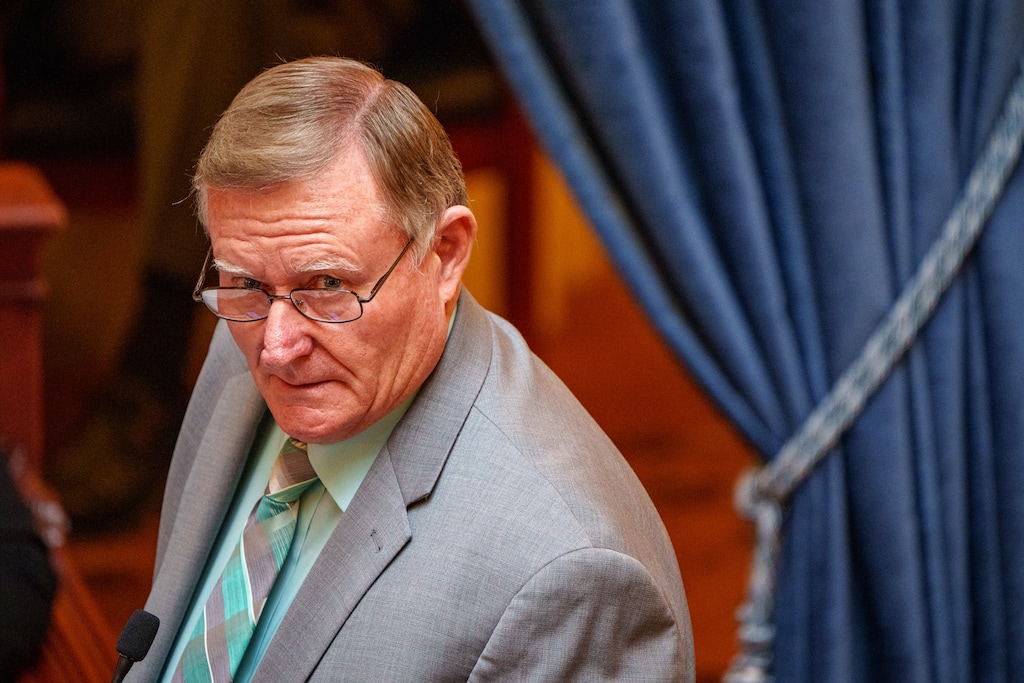
Sen. Evan Vickers will succeed Sen. J. Stuart Adams as Utah Senate President, becoming the first president from southern Utah in seven decades — and local leaders are bullish about what it means for the region.
The only other contender for the position was Senate Majority Leader Kirk Cullimore, who appears certain to be upset in his reelection bid after the latest vote totals. While results are not final, Cullimore trailed Democrat Shana Anderson by 13.3 percentage points.
Adams, who has been president since 2019, lost his Republican primary to Sen.-elect Stephanie Hollist in June, creating the opening. It was a surprising downfall for one of the state’s most powerful politicians, as Adams was dragged down by his role in approving a controversial Box Elder County data center project.
While other senators considered getting into the race, Sen. Don Ipson, R-St. George, whose district borders Vickers’, said nobody else filed to run.
Ipson called Vickers an inclusive leader who brings people across the Senate together.
“He not only brings everybody in the caucus along, but everybody in the Senate. He lets the minority party have a voice,” said Ipson, calling Vickers’ rise, “the best thing for the state [and] certainly the best thing for southern Utah.”
The formal election for the leadership positions is scheduled for Friday evening.
(Trent Nelson | The Salt Lake Tribune) Sen. Evan Vickers, R-Cedar City, and Senate Minority Leader Luz Escamilla, D-Salt Lake City, as the Senate discusses HB267, a bill aimed at banning collective bargaining for public labor unions in Utah, at the Utah Capitol in Salt Lake City on Thursday, Jan. 30, 2025.
Vickers is a pharmacist who owns Bulloch Drug, Township Pharmacy and four other stores in Cedar City. He was elected to the House in 2008, serving two terms before running for the Senate in 2012.
He was chosen by his Republican colleagues as Senate Majority Leader under Adams in 2019 and held the position until he lost a leadership election to Cullimore in 2025. He won 76% of the vote in his election this week.
With his background in medicine, Vickers has been a leader on legislation dealing with medical cannabis, pharmacy issues, professional licensing and wildfire mitigation.
The last southern Utah senator to serve as president was Orval Hafen in 1957. Rep. Dave Clark, from Santa Clara, was the House Speaker from 2008 to 2011.
Elected officials in southern Utah are exuberant at the prospect of having one of their own bringing the region’s perspective to the powerful position.
Southern Utah is “a different world” from the Wasatch Front, said Beaver County Commissioner Tammy Pearson, with smaller populations, a high density of public lands and tourism-based economies. That creates unique funding and resource challenges, which Vickers understands, she said.
“We look up to him as a leader,” she said, “and he’s always taken good care of us and represented us well.”
(Trent Nelson | The Salt Lake Tribune) Sen. Evan Vickers, R-Cedar City, as the Senate Business and Labor Committee discusses SB 330, Cosmetology Modifications, at the Utah Capitol in Salt Lake City on Wednesday, Feb. 26, 2025.
“What we’re most looking forward to is being able to have a seat at the table,” said St. George Mayor Jimmie Hughes, “and not having to say, ‘Hey, wait, remember us down here.’”
In past years, Hughes said, state funding for issues such as homelessness and infrastructure has often gone to the Wasatch Front first. Southern Utah faces many of the same challenges, he said, even if they are not always on the same scale. And as tourism brings more visitors, smaller communities across the region are growing, too.
Hughes said state leaders farther north have paid more attention to southern Utah in recent years, so “we’re not as forgotten.”
Still, having someone “closer to home” who understands the region’s needs, particularly when it comes to water and infrastructure, would be “crucial,” he said.
Washington County Commissioner Adam Snow echoed Hughes. “Any time that we can get our concerns, our needs, in front of the Legislature is important for us,” he said, “and there’s no better way to do that than with leadership.”
With Vickers in leadership, Snow said he hopes the Legislature prioritizes funding for water projects in southwest Utah and statewide support for the county’s rights in the Virgin River, including potential legal help from the attorney general’s office.
Snow said he also wants to see the Legislature’s eyes on transportation and economic development issues in Washington County.
(Jud Burkett | Special to The Tribune) Historic buildings, including the St. George Tabernacle, stand in downtown St. George as the sun sets on the red hills north of town, Monday, Dec. 1, 2025.
“We’re rural because we’re off the Wasatch Front, but we’re not really rural because we’ve got a substantial population,” Snow said. “We’re the hub of the southern half of the state, so we have different needs sometimes than other counties and cities do.”
Washington City Mayor Kress Staheli called Vickers an experienced, thoughtful leader who can work across party lines. Staheli said Vickers is well-liked and trusted by his colleagues and could provide a steady hand as new senators take office.
Staheli also said Vickers’ leadership could help ensure southern Utah’s interests are heard despite the region’s smaller share of the state’s legislative seats. He said Vickers would represent the whole state while keeping Southern Utah in mind.
“Sometimes southern Utah needs can be overlooked because we don’t have the numbers in the Senate or the House,” Staheli said. “He’s a guy that’s going to work to represent the entire state.”