 Robert Gehrke
Most years, John Colaizzi would get on his motorcycle and head north for a summer trip to Montana or Yellowstone.
The retired Army veteran didn’t make that trip this year. He hasn’t for the last several years, as he tries to cut back on travel to make ends meet amid high prices for gas and groceries.
Colaizzi, 72, has rented out three of the rooms in his four-bedroom Centerville home to defray his mortgage payments. He said he’s also cut out buying that occasional McDonald’s breakfast sandwich.
“Everything is getting more expensive,” he said. “It’s like, I go to the grocery store now and I spend, like, $100 on something that might have cost me, you know, $50, $55 or $60 even a year ago.”
(Francisco Kjolseth | The Salt Lake Tribune) John Colaizzi, right, a disabled veteran, and Steven Carter join the “Let Our Voices Be Heard" rally at the Salt Lake City Veterans Affairs Medical Center on April 26, 2025.
Colaizzi’s story is not unique. Across the state, Utahns are coping with adjusting their habits and cutting back in the face of record-high gas prices, higher housing prices and other expenses.
For many, it is front of mind as they vote in the 2026 election.
When The Salt Lake Tribune asked readers earlier this year what issues were going to most profoundly influence their votes, affordability was near the top.
Readers said they were eating out less, eliminating vacations, cutting back on groceries, looking for extra work, gardening more, relying more on credit cards and squeezing a family of five into their two-bedroom home instead of buying a bigger one.
Housing the top priority
Logan Rowley wanted to get out of his parents’ home in San Diego, where he said he “didn’t vibe with the culture,” so at age 22 he went wandering, looking for somewhere to land.
“I stumbled on Provo and just really liked it,” he said. While he still likes the city, he said, “the most salient [issue] to me is housing.”
Now, at 28, he’s renting a one-bedroom apartment in the city’s center.
“I would love to buy, but I think that’s going to be out of my budget for a while,” he said. Even a somewhat bigger two-bedroom would run him upwards of $2,000, before utilities.
He has adjusted his grocery shopping and is eating more fruits and vegetables, which are cheaper than processed foods. He’s also cutting back on beef, buying less expensive chicken or pork. He has also cut back on other occasional extravagances.
Rowley said his girlfriend lost her job earlier this year in an industry where artificial intelligence is gobbling up work and, while he feels secure, it remains a looming concern for the future job market.
When he fills out his ballot, he said, he is planning to vote for Democrats, “largely because of a lot of the price increases we’re facing recently all tie to fuel, which I blame Trump’s war with Iran for.”
Additionally, he said he believes corporations are buying up housing stock, making it unaffordable, “and I would trust Democrats to stop that more than I would Republicans.” Rowley added he doesn’t really trust either party very much.
‘Would rather see Europe on my retirement dollars’
After moving around the West for about 40 years, Shane Reeder and his wife, Michele, returned to Utah and settled in Cache Valley, where he’s trying to get a nonprofit apprenticeship program off the ground. His wife recently lost her job in a management shakeup, the 66-year-old said.
With that change, they’ve had to tap their retirement savings, grow more of their own food and stay in campgrounds when they travel.
Food prices in the region rose 3% in the past year, according to the U.S. Bureau of Labor Statistics, while gas has climbed to nearly $5 a gallon, as Utahns pay the eighth-highest gas price in the nation.
Reeder said he has emailed candidates, asking what they plan to do to address affordability and other issues, but has been disappointed with their unwillingness to respond.
In September, 46% of Utah voters said the top issues in the upcoming election were the economy, jobs and inflation. according to a poll by The Hinckley Institute of Politics and the Deseret News.
The figure reflects the national trend as well. A recent Associated Press poll found that five out of six voters consider the economy and cost of living to be among the top issues this election cycle.
Reeder recently put out squash and other produce he grew to help neighbors who, he said, might be struggling to make ends meet.
“I will weather it OK enough. … I would rather go see Europe on my retirement dollars than go to the grocery store,” he said. “But there are [neighbors who] are just eking out an existence, trying to get by on Social Security, and that doesn’t stretch very far anymore.”
‘We’d have to pay double for a house anywhere’
Lisa Hurtado McDonnell, 65, worked as an attorney for the state in different capacities and has a state pension. Recently, she had been working for the U.S. Census Bureau, until her contract ended in September.
Her husband is collecting Social Security, but Hurtado McDonnell can’t start collecting her checks for about two years without being penalized.
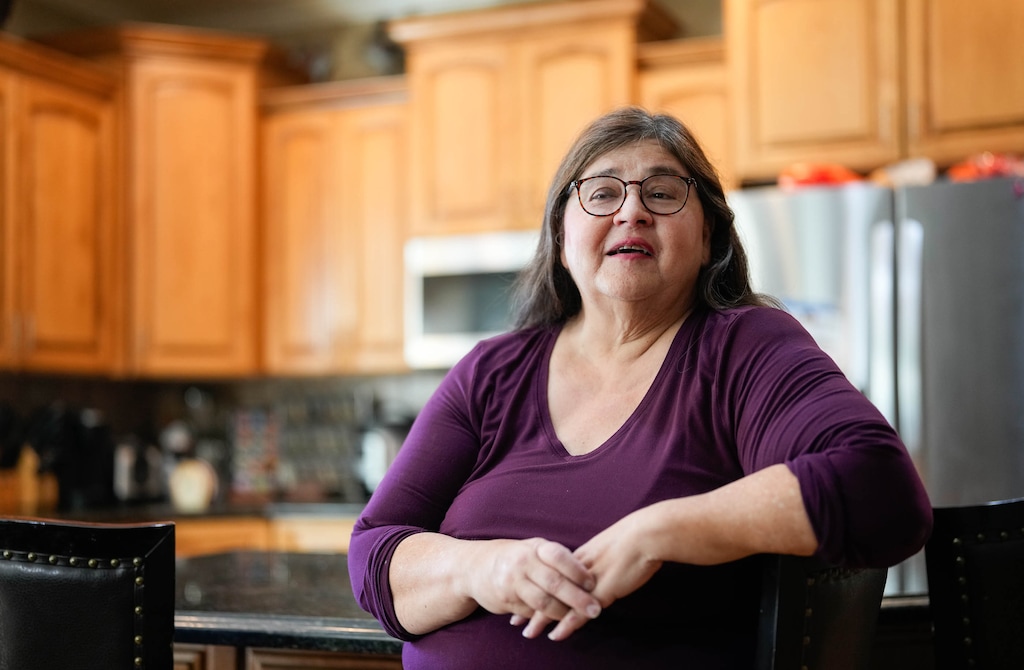
(Francisco Kjolseth | The Salt Lake Tribune) Lisa Hurtado McDonnell, who recently spoke on affordability, is pictured at her home in Fruit Heights on Friday, Oct. 16, 2026.
Her two kids both recently graduated from college and they have talked about downsizing their Fruit Heights home, “but houses are more,” she said. “I mean, we’d have to pay double [the price] for a house anywhere, even if we downsized.”
According to a recent report from the Kem C. Gardner Policy Institute, the typical Utah home costs $544,000, and buyers need an annual income of close to $150,000 to afford one. Nine out of 10 renters are priced out of buying a typical home.
When Trump was reelected, Hurtado McDonnell said, she thought prices were going to go up, so she sold her small SUV and bought a hybrid to save money on gas. “Even that is still expensive,” she said, with prices up nearly $2 per gallon since the start of Trump’s term.
Hurtado McDonnell said she wants to “stop paying for the war” with Iran and sending money to support Israel. But “as long as Trump’s in there, things are going to be the same,” she said. “He’s given all the money to the top one percenters. They’re making out like bandits and he’s cutting off services.”
She helps her kids with some of their expenses, she said — like sharing a phone plan and helping pay for car insurance and student loans. But she can’t help them with everything.
Her daughter has been living at home while she decides where she wants to earn her physician assistant degree. She had been on an Affordable Care Act plan, but her premiums nearly doubled when the Republican-led Congress terminated enhanced COVID-era subsidies, Hurtado McDonnell said.
“My son, he’s still on our insurance, but he’s going to get kicked off in a couple of days,” she said, “so I don’t know what he’s going to do.”
‘Are you going to support the people?’
Utahns earlier this year rated the state’s quality of life at 63 out of 100 — the lowest level since measurements began in 2011, the Gardner Institute and Utah Foundation said in a recent report.
Nearly half of Utahns said addressing housing and growth was the most important issue to improve quality of life in the state, and 21% said the economy and cost of living were the top issues.
In addition, those surveyed expressed concerns about dwindling job opportunities, said Shawn Tiegen, president of the Utah Foundation.
“The economy plays a big role in everyone’s lives, and a lot of voters two years ago were expecting some big change and everything to be rosy,” Tiegen said.
“When you look at the quality of life of Utahns compared to four years ago, it’s kind of the same, but maybe the same isn’t quite good enough,” he said, “and that will affect some voters.”
As Colaizzi decides who he will vote for, he said he wants to hear that candidates are sincerely interested in putting the needs of their constituents first and foremost.
“Are you going to do more for the citizens or for your donors? Are you going to support the people or the corporations?” he said. “I think that somehow along the way, our political system has gotten off track.”