 Julie Jag
Note to readers • Click here to find an interactive map where you can enter your address to see all the races on your ballot that have a voter guide from The Salt Lake Tribune.
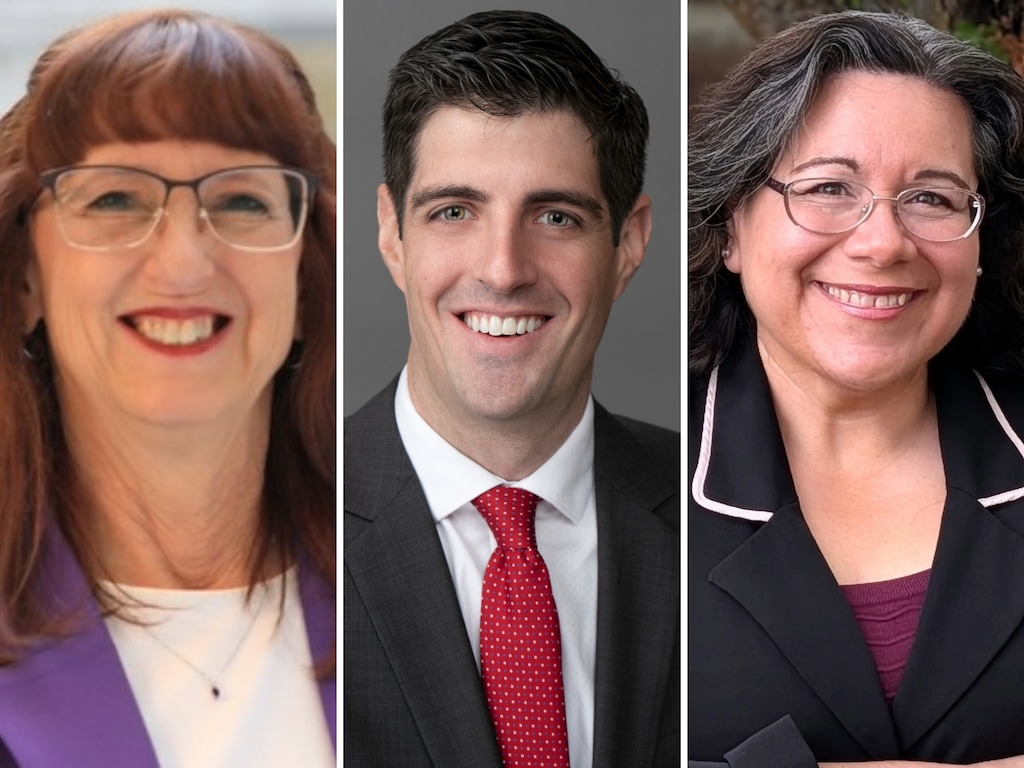
Journeyman Rep. Jason B. Kyle has plenty of competition for his House District 8 seat. Democrat Kim James and Forward Party candidate Libby Shelton are also vying to represent the district, which covers Huntsville, Eden, Liberty, Ogden, North Ogden, Pleasant View and Mountain Green.
Kyle, of Huntsville, has served on the House Business, Labor, and Commerce Committee and the House Revenue and Taxation Committee. A manager at Biometrics, a medical device manufacturer, he has prioritized reducing taxes and protecting natural resources. In 2024, he sponsored two bills that would require any citizen ballot initiative that raises taxes or creates a new tax to receive a 60% “yes” vote to pass. He also proposed a bill that would require a public university to seek legislative approval before its athletic department could enter into a deal with a private equity firm.
James recently retired after serving for a decade as an ordained Methodist minister in Ogden. On her campaign website, she said that job taught her what the people of District 8 value and what resources are available to them. Her priorities include the environment, affordable healthcare and fiscal responsibility by state leaders.
Shelton, of Pleasant View, is a therapist who specializes in substance use and domestic violence treatment. According to her website, she is the vice chair of the Weber County chapter of the Forward Party of Utah and was vice chair of her local caucus for a decade. Among her priorities are securing a free and fair voting system and protecting human and constitutional rights.
The Salt Lake Tribune posed the following questions, based on a reader survey about the issues Utahns felt were most important this election season, to all three candidates. Candidates submitted photos and answers through a questionnaire. Answers may have been edited for style and clarity. Candidate responses are listed in alphabetical order by last name.
Election Day is Nov. 3. Mail ballots must be dropped in a drop box by 8 p.m. on Election Day or — if returned by mail — in the clerk’s possession by 8 p.m. on Election Day.
Utah voters told us government corruption is their top concern in this year’s election. Why do you think voters feel this way? And why should Utahns trust you to represent them?
Kim James: In Utah, the Republican Party has held near-absolute power. With this insular power, they have dismissed the needs and will of the people, and have instead courted the benefits and favor of corporations. The U.S. Supreme Court’s 2010 Citizens United decision has allowed corporations to inject huge sums of money into campaigns and to collaborate with political leaders for their own gain at the expense of the people. Utahns can trust me because I am not beholden to any corporate interests.
Jason B. Kyle: Voters see corruption as an issue due to national scandals, and self-dealing that erodes trust. Even in Utah, audits flagging process issues remind us no place is immune. Utahns value integrity and responsibility.
My district trusts me because I treat this office as a temporary public trust, not an entitlement. I’ve backed strong ethics rules and full transparency. I keep my door open and answer hard questions. My trust has been earned daily through my actions.
Libby Shelton: Voters in Utah have observed the past few years that many Utah public servants have questionable ties to the issues or projects over which they have a say. This is sometimes observed as distain from those elected who do not communicate the issues transparently. I have experience considering how policies affect various groups, and I consider how to implement such policies with compassion and the input of those effected. I will do the same as a representative.
Utahns told us affordability is their second-highest priority in this election. How would you help Utahns afford housing, groceries, gas and other day-to-day expenses?
James: The first step in solving the affordability crisis in Utah is to stop wasting the taxpayers’ money fighting against the will of the people in the courts. We could then shift that savings toward infrastructure costs (e.g., streets, sidewalks) that would then diminish the cost of housing developments. Easing zoning to allow for more manufactured housing would also help. We could eliminate the state portion of grocery taxes, and we could extend the reduction of state taxes on gasoline.
Kyle: While the root cause of an increasing cost of living is the spending problem at the federal level, Utah can do some things to alleviate the burden. This includes lowering the property tax burden by restructuring how we pay for education, further cutting the tax on Social Security for seniors, eliminating the tax on groceries, and reining in government spending.
Shelton: Affordability is primarily a balance of housing supply and energy costs. I would support state, city and county plans to incorporate smaller/starter homes and encourage government support for renewable energy to reduce reliance on expensive petroleum sources.
Water resources were also a top concern for voters. What policies would you support as Utah looks to balance growth with preservation of the Great Salt Lake and the Colorado River?
James: The Great Salt Lake is in crisis, and we must act immediately to save it. For our physical and economic health, we must ensure that our limited rain and snowmelt reach the Great Salt Lake and aren’t diverted too much upstream. In light of climate change, the Bear River Development Project of 1991 must be abandoned. Farmers with water rights should be compensated for their losses, residential water use must be monitored, and developments must be limited. As a state, we must live within our water means.
Kyle: As Utah grows, protecting the Great Salt Lake and Colorado River is essential. I support conservation, efficient water use in cities and farms, and smart growth policies. Most importantly, we need to partner closely with neighbor states to strengthen interstate agreements, fund joint infrastructure, and secure fair, sustainable allocations so we balance prosperity with preservation for future generations.
Shelton: Water resources and population growth will require new construction to incorporate water conservation strategies. I would support legislation that encourages new home construction to incorporate these strategies in both structure and landscape. I would also support legislation that encourages existing homes to incorporate these strategies.
What is another topic you care about and want to address if elected to public office?
James: I want to seek government accountability. We need to ensure judicial independence and fairness. We need to establish fair policies for political districting into the next decade, when we will be impacted by another census. We need to limit the power of MIDA and other unelected state boards. And, we need to make sure that the citizens of Utah maintain their rights to power to initiate and affect legislation, so that the Legislature is held accountable to the people.
Kyle: Property taxes must not force seniors and fixed-income Utahns from their homes or price young families out of the American dream. I support targeted relief and fundamental restructuring of our property tax system. We need to keep our most vulnerable secure and give the next generation a fair shot at owning a home in Utah.
Shelton: I care passionately about people having a voice in the legislative process and I believe that this is best accomplished by access to voting. I would vote against any legislation to restrict voting further than the requirements of citizenship.
How will you vote on Constitutional Amendment A? If passed, the amendment will stop the practice of publishing the full text of amendments and ballot questions by lawmakers in a newspaper for 60 days ahead of an election and instead require that text to be published on two state websites.
James: Against.
Kyle: For.
Shelton: Against.
How will you vote on Constitutional Amendment B? If passed, citizen-proposed laws that increase taxes would need to be approved by 60% of voters, instead of a simple majority.
James: Against.
Kyle: For.
Shelton: Against.
What’s your favorite book and why?
James: My favorite book is the Bible. I read it daily for inspiration, guidance and cultural tradition. The Bible is a vast library that contains classic stories, poetry, history, encouragement and admonitions, and its lessons remain relevant for study.
Kyle: “Stand Fast by Our Constitution,” by J. Reuben Clark Jr. This is a great book because it still touches on themes that are important for our time: separation of powers, federalism, limited government and the Bill of Rights.
Shelton: My favorite book is “Les Misérables.” I read it first when I was 18 years old and was inspired by the themes of mercy, social justice and difficult causes.