 Robert Gehrke
Contenders in Utah’s new 1st Congressional District — Democrat Ben McAdams and Republican Riley Owen — honed in on what they would do to lower prices and help working families during the first debate between the two Tuesday.
McAdams blamed high prices on the “unconstitutional war” in Iran that has spiked gas prices and driven up the cost of food, as well as a “haphazard” policy on tariffs imposed by President Donald Trump, which he said have been “ego and vengeance driven.”
“We can stop the self-inflicted wounds, to begin with,” McAdams said, and added, “we have a Congress that hasn’t done their duty and reined in the president.”
Owen said, if elected, he would seek to expand the low-income housing tax credit and prohibit corporations from buying up housing stock. And, he said, he would propose expanding a business tax credit for employers that offer paid maternity leave.
“I want to create market-based incentives to help lower the cost of raising families and to make housing more affordable for every Utahn,” Owen said. McAdams, he said, is simply looking for bigger, government-oriented solutions.
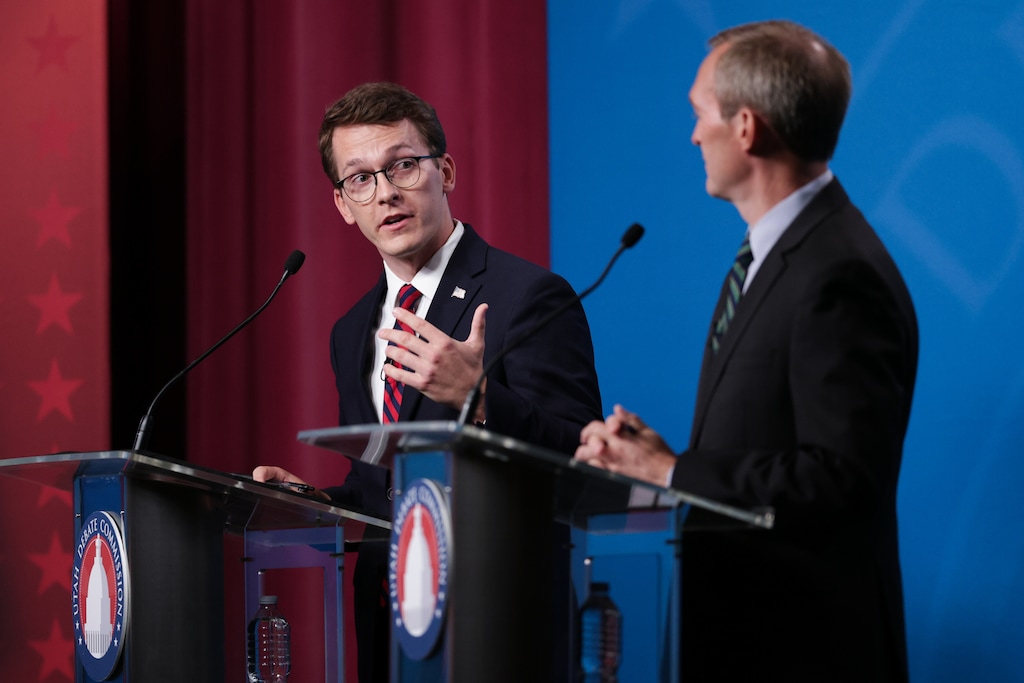
(Erin Hooley | Pool) Candidates for Utah’s 1st Congressional District Republican Riley Owen, left, and Democrat Ben McAdams participate in a debate at Salt Lake Community College, Tuesday, Sept. 29, 2026, in Salt Lake City.
The candidates spoke at Salt Lake Community College in Salt Lake City in the first of four sessions — one for each congressional district — scheduled by the Utah Debate Commission. On Friday, candidates in the 3rd Congressional District, Republican Rep. Celeste Maloy and Democrat Kent Udell, will meet at 6 p.m. at Utah Tech University in St. George.
According to a recent report from the Kem Gardner Institute, the average Utah home costs $544,000 and buyers need an annual income of close to $150,000 to afford one. Nine out of 10 renters are priced out of the market.
Gas has climbed to nearly $5 a gallon as Utahns pay the eighth highest gas price in the nation, while, according to the U.S. Bureau of Labor Statistics, food prices in the region rose 3% in the past year.
Owen and McAdams also sparred over artificial intelligence, agreeing its influence will be a generational change, but differing slightly on what the role of the Congress should be in regulating it.
Given warnings that AI could wipe out humanity, McAdams said, there need to be federal standards in place for AI development. Further, he said, the government should make sure that the economic disruption resulting from AI benefits the American people and not “tech bros and billionaires.”
(Erin Hooley | Pool) People watch a debate between candidates for Utah’s 1st Congressional District Republican Riley Owen and Democrat Ben McAdams at Salt Lake Community College, Tuesday, Sept. 29, 2026, in Salt Lake City.
Owen said AI policy is “the single issue that will have the greatest impact on Americans for decades to come,” and that governments need to protect people from deep fakes and the collection of citizens’ data to train AI models.
“We should regulate the risk and not the innovations,” said Owen, who also took a swipe at McAdams, who, during the primary, had the backing of Think Big PAC. Bankrolled by prominent AI executives, it spent more than $1 million supporting the Democrat.
Following the debate, McAdams told reporters that he didn’t ask for the money from the PAC; it was an independent expenditure used for TV ads and won’t change how he approaches the issue.
On other issues:
• Owen said he would support investing Social Security funds in the stock market. “There is more risk, but over time there’s far more growth,” Owen said.
McAdams supported a proposal backed by President Joe Biden that would extend the collection of payroll taxes that fund Social Security on high-income earners. Currently those taxes are only collected to a certain point — $176,000 for an individual in 2025 — and then no more is taken out of their checks. Removing the cap would make Social Security solvent until 2091, McAdams said.
(Erin Hooley | Pool) Candidate for Utah’s 1st Congressional District Democrat Ben McAdams participates in a debate at Salt Lake Community College, Tuesday, Sept. 29, 2026, in Salt Lake City.
• On the issue of energy production, Owen said he supports an “all of the above” approach that includes small modular nuclear reactors, like the military uses on nuclear submarines. McAdams said he wants the administration to stop “throwing a wrench” into solar and wind projects, which he said are already cheaper than fossil fuels. “Let the market compete on nuclear,” he said, “see if it’s a solution that is viable. I’m not convinced it is viable.”
• Both candidates said they support a balanced federal budget, but McAdams said the Trump administration “put the health care of 180,000 Utahns on the chopping block and gave a tax break to billionaires and corporations.” Owen said he supports the work requirements for Medicaid that were included in Trump’s “Big Beautiful Bill,” and that they were something that President Bill Clinton signed in the 1990s.
“I don’t find this unreasonable and the Democratic Party used to stand for this. I don’t know what changed,” Owen said.
(Erin Hooley | Pool) Candidate for Utah’s 1st Congressional District Republican Riley Owen participates in a debate at Salt Lake Community College, Tuesday, Sept. 29, 2026, in Salt Lake City.
McAdams said it has made it harder for people trying to get back on their feet to get and maintain Medicaid coverage, and Republicans intentionally created a “maze” of regulation in order to kick them off their health care.
Speaking to reporters after the debate, Owen avoided saying whether he supported the Trump agenda.
“I’m not running to defend President Trump or to defend a party,” he said. “I’m running to fight for the Utahns of the 1st Congressional District. There are some things he gets right. There are some things that he gets wrong, and that’s the case with every president and both parties.”Owen is an intelligence officer in the Naval Reserve, served as a policy analyst in the White House during the first Trump presidency and has worked with a drone startup and runs a wildlife conservation foundation.
McAdams is a former state senator, Salt Lake County mayor and one-term U.S. House member. Since leaving Congress he has worked as a consultant on housing and other issues.
Tuesday’s debate included only the two frontrunners for the race. Three other contenders — Libertarian candidate Jesse West, unaffiliated candidate Elias Montgomery and write-in candidate Bobby Darvish — did not receive enough support in a poll conducted on behalf of the commission to qualify to be on stage.