 Robert Gehrke
President Dallin H. Oaks’ major address last week, in which the Latter-day Saint leader called for finding compromise under competing constitutional rights while preserving religious beliefs and liberties, was embraced by a wide spectrum of Utahns across faiths, new polling shows.
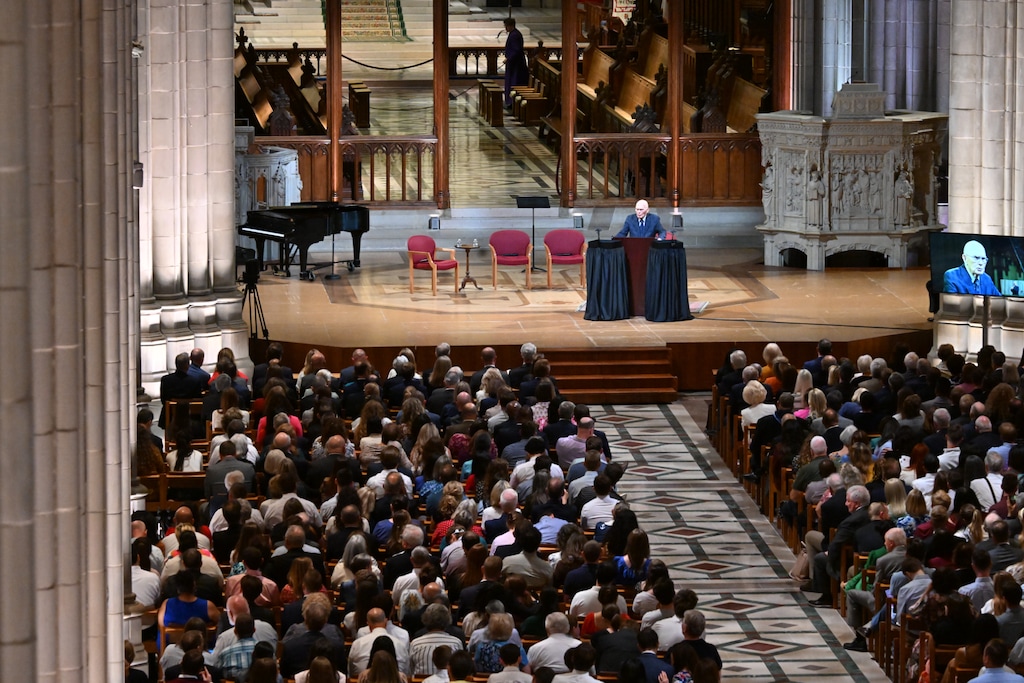
Oaks, a former Utah Supreme Court justice and global head of The Church of Jesus Christ of Latter-day Saints, spoke at Washington’s historic National Cathedral on the eve of Constitution Day, espousing his belief that, while the concepts in the Constitution are divinely inspired, the rights protected in the document are not absolute and legislative bodies need to find ways to balance competing interests.
Oaks said that the framework established by the Constitution “requires us to deal constantly with people who disagree with us.”
“It compels a divided people to build coalitions that allow them to act together for the common good,” he said. “It puts what we now call ‘peacemaking’ at the heart of the Constitution’s process for achieving freedom and unity, and fairness for all.”
(The Church of Jesus Christ of Latter-day Saints) President Dallin H. Oaks chats with several people, including the Right. Rev. Mariann Edgar Budde, far left, bishop of the Episcopal Diocese of Washington, before his speech at Washington National Cathedral in Washington, D.C., on Wednesday, Sept. 16, 2026.
The message was well received by Utahns, whether Latter-day Saint or not, according to polling by Y2 Analytics and Public Wisdom, which asked respondents if they agreed with six statements that were paraphrased from Oaks’ lecture.
A majority of Utahns completely or mostly agreed with all six.
• 89% agreed with the statement that “a person’s commitment to God requires them to treat other people fairly.”
• 79% aligned with the notion that “finding compromises between competing political interests and religious values leads to better outcomes for everyone.”
• 74% agreed with Oaks, saying that they don’t believe compromise usually weakens the integrity of religious beliefs.
• 93% agreed that “a person may have different social and political priorities than me and still be considered moral.”
• 78% were supportive of the statement that “creating common ground is a key purpose of the Constitution.”
• And 66% agreed that the “Constitution and Bill of Rights are divinely inspired.”
The sentiments generally drew support from followers of other faiths and varying levels of backing from individuals of no faith. The idea that the Constitution is divinely inspired, however, was supported by 69% of Latter-day Saints, 35% of members of other faiths and 14% of those with no religious affiliation.
Quin Monson, co-founder of Y2 Analytics and a political science professor at church-owned Brigham Young University, said Oaks’ message at the National Cathedral is similar to comments he has made for years, but this time to a wider audience.
“It’s evolved into something now that I would label as a Latter-day Saint civic theology,” Monson said Thursday. “But this was not [church] General Conference. The audience is broader. He’s trying to communicate what he sees as Latter-day Saint values to a broader audience and build common ground and common purpose.”
The polling firms Y2 Analytics and Public Wisdom surveyed 547 Utahns between Sept. 17 and 21, the days after Oaks’ speech. The poll had a margin of error of plus or minus 5.7 percentage points.
“There’s a hopeful message underneath the poll results,” Monson said, “that there is a foundation that can be built on, and it’s up to our political leaders to lead the way, because there’s an audience for it in the general public.”