 Robert Gehrke
The Utah Senate confirmed two more of Gov. Spencer Cox’s nominees to the state Supreme Court Wednesday, giving Michael Menssen and Judge Matthew Bell near-unanimous approval.
With the two selections, Cox has now appointed seven justices to the court in less than six years, more than any Utah governor in history. And, with the help of the Republican Legislature, he has drastically changed the makeup of a high court that has been a hindrance to the GOP agenda.
Menssen and Bell will step into two seats that were emptied unexpectedly by the resignation of Justice Diana Hagen amid allegations of a conflict of interest and the retirement of Chief Justice Matthew Durrant, who stepped down due to health reasons.
Two Democratic senators — Nate Blouin and Kathleen Riebe — cast the only votes against confirming the nominees.
Riebe said she was disappointed that women were not better represented among the last five nominees Cox had put forward.
“When I look at the body — our legislative body and our judicial body — I see a lack of diversity and I see a lack of women,” Riebe said. “I feel I rise in support of women that don’t see themselves in our government. So I have to vote no.”
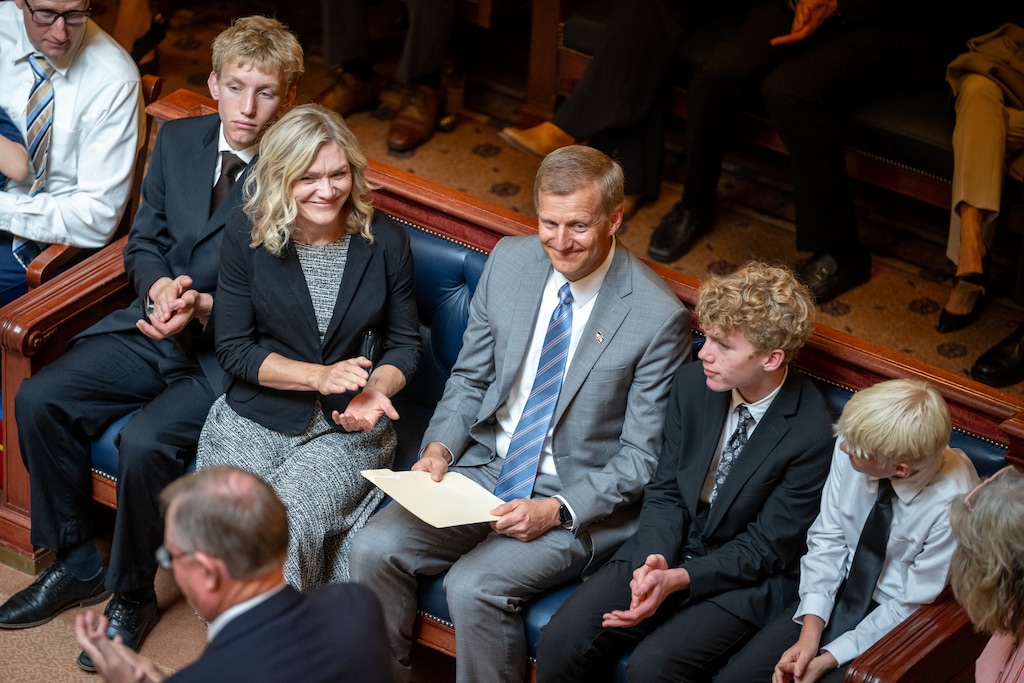
(Trent Nelson | The Salt Lake Tribune) Judge Matthew Bell sits with his wife Emily Bell in the Senate Chamber as he's confirmed to the Utah Supreme Court, at the Utah Capitol in Salt Lake City on Wednesday, Sept. 16, 2026.
Cox selected two women for his first Supreme Court appointments after becoming governor, making the five-member court majority female for the first time in history.
Late last year, the Senate confirmed Cox’s third nominee, Justice John Nielsen, who filled a vacancy created by the retirement of Justice John Pearce.
Two new seats were created when Republican lawmakers expanded the court to seven — a move critics decried as court-packing to undermine the judiciary’s independence. In June, the Senate confirmed Cox’s picks of Justices Stephen Dent and Jay Jorgensen to fill the new seats.
With Menssen and Bell confirmed, there are now two women and five men on the bench. The governor has rejected the notion that women have not been given fair consideration in recent appointments, pointing to his first two nominees.
“If that makes me a misogynist, I guess I’ll own it, but I think that’s an insane narrative,” he said earlier this year. “I don’t go into this looking at your chromosomes when I’m making an appointment. I’m trying to find the best legal minds who will represent the state of Utah.”
The Supreme Court has been a stumbling block for Republican lawmakers, stalling the state’s attempt to ban almost all abortions and limiting the Legislature’s ability to repeal ballot initiatives and to gerrymander political boundaries.
Bell reiterated sentiments that both he and Menssen expressed during their confirmation hearing — that neither would cave to pressure from the governor or Legislature, nor would they shy away from overturning previous court rulings if they believe the court ruled incorrectly.
“I vow to remain steadfast in my sworn duty to support, obey, and defend [the constitution] without regard for political pressure, public opinion or personal preference,” Bell told senators after his vote.
Bell worked his way through college as a police officer and earned his law degree from Brigham Young University law school. He has been a judge on the 5th District Court covering southwestern Utah since 2017 and previously worked as an assistant U.S. attorney and trial attorney at the U.S. Department of Justice.
Menssen had been a civil litigator at Mayer Brown LLP since 2022 and before that was a partner at Stoel Rives. He specializes in complex commercial litigation and employment law. He is on the board directors of the Legal Aid Society of Salt Lake and chair of the leadership committee of And Justice for All, both nonprofits that provide legal services to disadvantaged residents.
Menssen is a member of The Federalist Society, a national organization of conservative lawyers, and is a graduate of the University of Virginia law school. He did his undergraduate work at BYU-Idaho.