 Emily R. Anderson
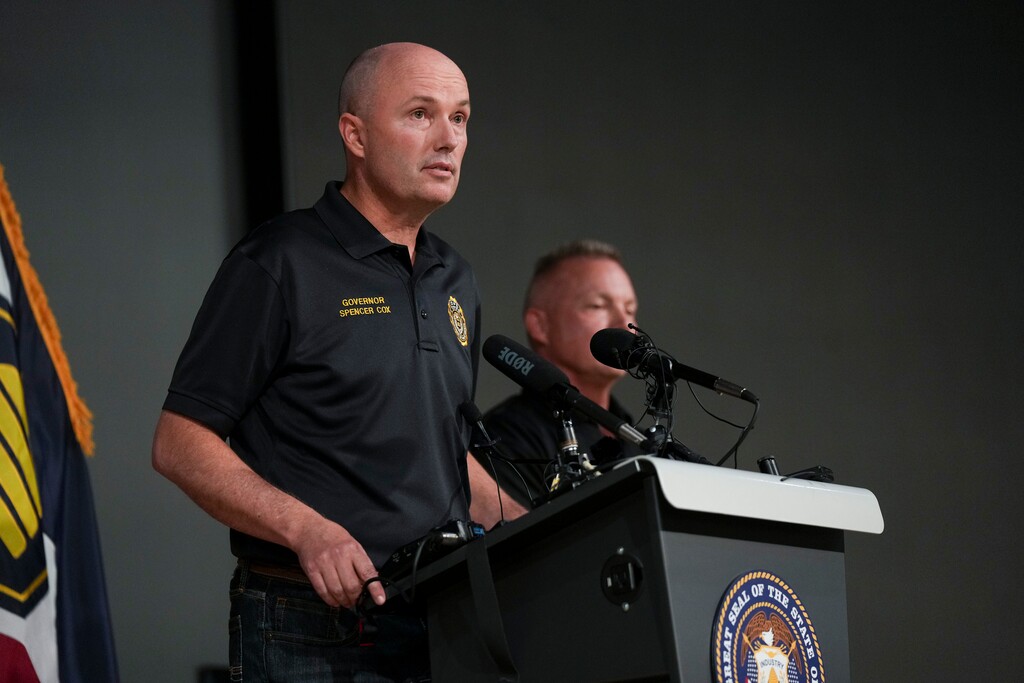
In the hours after conservative activist Charlie Kirk’s slaying in Orem one year ago, Utah Gov. Spencer Cox scrolled through social media posts that “seemed to celebrate” his death.
As he rode in his black SUV to Utah Valley University to address the world that afternoon, Cox called a fellow governor for advice — a Democratic governor.
“Remember to speak from your heart,” Cox recounted Pennsylvania Gov. Josh Shapiro counseling. “And always speak with moral clarity.”
Shapiro’s state hosted the rally where President Donald Trump was nearly assassinated the previous summer, prompting Cox to endorse the former president. And the Pennsylvania governor, who is Jewish, had been targeted for assassination himself — five months earlier, his home was firebombed on the first night of Passover as his family slept inside.
Cox prayed for help to heed Shapiro’s guidance, and determined he would ensure his global audience knew the governor’s position: “This is a political assassination,” he told cameras.
Those details came from Cox’s new book, “Off Ramp: How to Be a Peacemaker in an Age of Contempt,” released Tuesday. With it, the governor wants to provide a manual for mending a country whose political divisions, he argues, led to a political assassination on his state’s soil.
Some Utahns are skeptical of their governor’s efforts urging them to “disagree better.” In May, a Salt Lake City bookstore canceled plans to promote the book after public pressure, with many of its patrons criticizing Cox’s decision to sign a law enabling statewide book bans in public schools.
“Off Ramp” doesn’t include “any big political bombshells,” Cox says in the introduction. And the first sentence quashes any expectation of a major announcement: He’s not running for president.
The book does, however, give insight into the moments — like shepherding the response to Kirk’s killing — that shaped Cox’s “peacemaker” political philosophy, and his perspective on decisions that critics have said undermine the governor’s calls to abandon contempt.
‘Disagree Better’ started as a suggestion from a staffer
When governors across the country elected Cox to lead their association in 2023, the Utah governor gathered first lady Abby Cox and his staff to spitball ideas for the bipartisan policy issue he would select for his colleagues to focus on over the following year.
The group, he wrote, weighed the country’s most pressing problems — healthcare, energy, immigration. Then, he said, one member of his staff observed, “We can’t solve any of these big problems if we all hate each other.”
“What about trying to replicate the Chris Peterson video?” the staffer continued.
A few years earlier, while running for governor in 2020, Cox filmed a series of ads with his Democratic opponent. The duo told viewers that they would accept the results of the presidential election, that they could disagree without hating each other, and that they wanted to “show the country there’s a better way.”
(Screengrab from PSA) Utah's major party candidates for governor — Republican Spencer Cox and Democrat Chris Peterson — released three public service announcements on Tuesday, Oct. 20, 2020, to encourage the public to accept the results, regardless of the outcome, in the presidential race.
Cox said he was initially hesitant to bring that concept to the National Governors Association, “but the idea began to resonate.” He eventually named the initiative after a phrase in Harvard professor Arthur Brooks’ book “Love Your Enemies: How Decent People Can Save America from the Culture of Contempt.”
As NGA chair, Cox would call on the nation to “disagree better.”
“The name was perfect, because it focused on the importance of disagreement,” Cox wrote. “I wasn’t calling for more civility or bipartisanship. I was calling for healthier conflict.”
Cox says his mission to civilize has helped Utah
Cox recounted in his book that as he sat with then-President Joe Biden in his motorcade during the Democrat’s visit to Utah in 2023, he asked Biden to pardon Trump, who had been federally indicted over alleged efforts to overturn his 2020 electoral loss.
Nearly a year later, Cox wrote a letter to Trump following the Pennsylvania assassination attempt as he ran to retake the White House. Promising an endorsement — which the Republican governor had withheld during Trump’s previous two campaigns — Cox asked Trump to be a “Lincoln to bring us together.”
“Your life was spared,” the letter said. “Now, because of that miracle, you have the opportunity to do something that no other person on earth can do right now: unify and save our country.”
(Julia Demaree Nikhinson | AP) President Donald Trump hands a pen to Utah Gov. Spencer Cox after signing executive orders modifying Grand Staircase-Escalante National Monument and Bears Ears National Monument in the Oval Office of the White House, Monday, July 13, 2026, in Washington.
Cox received backlash when he extended a hand to Biden, but the response to his outreach to Trump, he wrote in his book, was “even more severe.” And while neither president responded as the governor desired, he sees his efforts as having paid off.
“When I spoke with President Biden, I hoped he would choose mercy over escalation,” Cox wrote. “When I wrote to President Trump, I hoped he would choose unity over retaliation. In both cases, things didn’t turn out quite the way I’d hoped. It would be fair to suggest I failed. However, I’ve come to view the work of building off ramps as a process.”
When Trump invited Cox to meet with him in the Oval Office, and drafted a Truth Social post with the governor promising to fund solutions to save the drying Great Salt Lake, Cox attributed it to their improved “friendship.”
And when Charlie Kirk’s death didn’t turn into “the match that lit the tinderbox of a nation,” Cox wrote, “I hope that at least one small reason for that was the positive relationship that has developed between the president and me.”
Cox reveals a regret
Former state lawmaker Phil Lyman’s campaign in the 2024 GOP primary challenging Cox was “based on lies and conspiracy theories,” the governor wrote. As a result, Cox believes, Republican delegates were unlikely to recognize accomplishments during his first term.
They booed him as he took the stage at that year’s Utah Republican Party nominating convention. So, Cox wrote, “I let them have it.”
(Trent Nelson | The Salt Lake Tribune) Gov. Spencer Cox at the Utah Republican Nominating Convention in Salt Lake City on Saturday, April 27, 2024.
Maybe, the governor said at the convention, delegates hated that he “signed the most pro-life legislation in Utah history,” or that he wiped out diversity, equity and inclusion initiatives.
“Or maybe it’s something much more cynical,” Cox told delegates. “Maybe you hate that I don’t hate enough.”
The speech “felt good,” Cox wrote in his book. And he said he “heard from so many people who were grateful that someone finally stood up to the unruly mob.”
But the governor concluded in the following days that he’d made a mistake.
“I returned contempt with contempt. I returned hate with hate,” Cox wrote. “It might be subtle, but I dismissed those who opposed me as ‘less than’ and put myself on a pedestal above them. I didn’t change a single heart or mind.”