 Emily R. Anderson
 Robert Gehrke
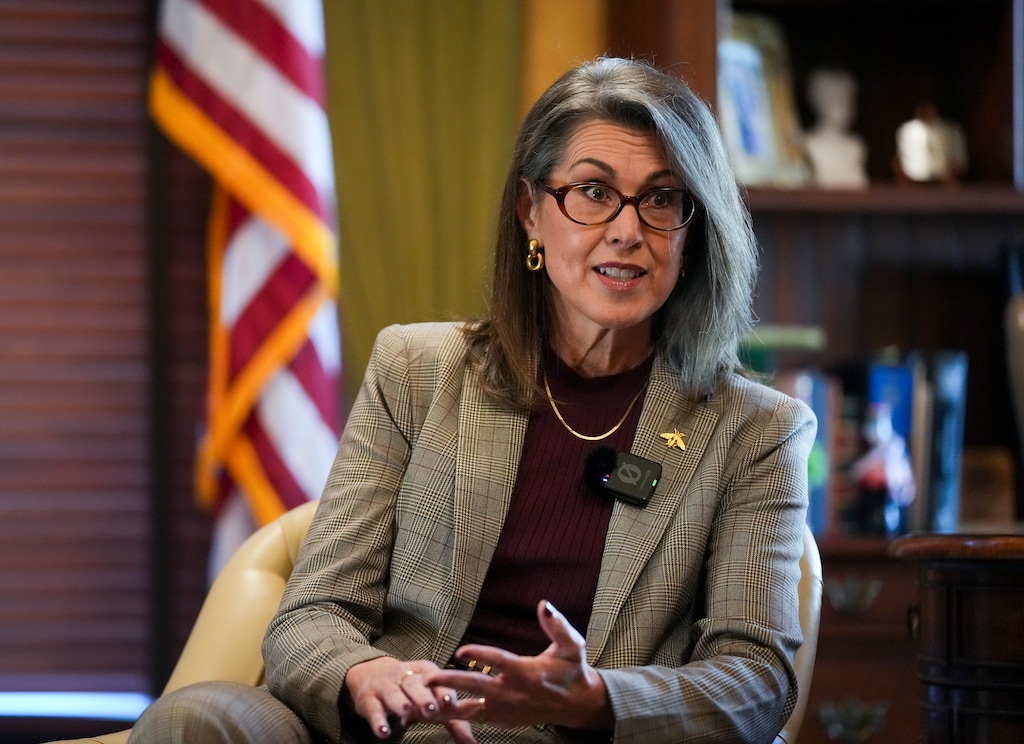
The Justice Department is investigating Utah’s top election official for refusing to hand over the state’s entire, unredacted voter database, it informed her in a letter dated Friday and obtained by The Salt Lake Tribune.
That revelation comes amid a lawsuit President Donald Trump’s DOJ filed against Lt. Gov. Deidre Henderson for not complying with that demand, an action Henderson argues has no federal legal basis and violates Utah data privacy laws.
In an interview, Henderson said officials overseeing elections in other states told her they received similar letters. Henderson told The Tribune she was not previously aware of the investigation and did not know its scope.
“As you are aware,” the letter reads, “you are currently under investigation and ongoing litigation as to the extent to which you have failed to comply with your duties under the [Civil Rights Act] as well as the National Voter Registration Act.”
A spokesperson for the Justice Department said the letter was sent to states that DOJ is suing “regarding their failure to provide the full [statewide voter registration list] as required by law.”
Thursday afternoon, Gov. Spencer Cox posted on social media that “Legal disagreements between Utah and the federal government should be resolved in court. It is wrong for the DOJ to investigate or threaten the lieutenant governor for carrying out her responsibilities under Utah law.”
Cox is Henderson’s predecessor and was serving as elections chief when the pair were first elected to their current positions in 2020.
The most recent correspondence follows separate letters signed by the DOJ’s civil rights division head, Harmeet Dhillon, and sent in July to election officers in all 50 states threatening to file criminal charges against the officials if noncitizens cast ballots in the upcoming election.
That memo went on to offer to “assist” states “in complying” with federal election laws barring noncitizens from casting a ballot. Ryan Cowley, Utah’s election director, responded with his own letter, saying, “The federal government can best assist the State of Utah by allowing us to perform our required duties without unjustified interference.”
Henderson told The Tribune that the secretaries of state she spoke to are from states that are also being sued for declining to share sensitive voter data.
Included in the data requested by the DOJ is voters’ personal information, such as birthdates, partial Social Security numbers and driver license numbers.
Utah is among 30 states the DOJ has so far taken to court for withholding their voter databases, according to a tracker maintained by the University of Wisconsin’s State Democracy Research Initiative.
So far, no federal court — on the district or appellate levels — has ruled in the department’s favor. The federal judge overseeing Utah’s case has not yet scheduled a hearing.
News of the investigation comes less than two months before mid-term elections.
“If you cared about the security of the elections, … you would not be threatening election officials with prison sentences, you would not be suing all of us, you would not be investigating all of us constantly,” Henderson said. “You would not be making it so that we’re not able to do our actual jobs.”
She has been critical of the Trump administration’s efforts to exert more federal control over elections, the administration of which the U.S. Constitution leaves to the states.
Henderson has said she is prepared to sue the U.S. Postal Service if federal courts allow a Trump executive order restricting voting by mail to take effect. The U.S. Supreme Court is weighing the legality of the plan.
On Wednesday, she and a dozen county clerks from Utah joined 25 other current and former election officials from nine other states, urging the high court not to revive the Trump administration rule, currently blocked by the courts.
(Bethany Baker | The Salt Lake Tribune) A voter drops off two ballots at a ballot drop box at the Davis Conference Center in Layton on Monday, June 22, 2026.
The directive would require envelopes to carry a unique barcode and be tracked through the process, start to finish, with each ballot compared against a list of eligible voters provided by the U.S. Department of Homeland Security.
In their brief, the election officials contend that absentee ballots have already been mailed to voters in some states with others going out soon.
The new USPS requirements would upend those preparations and leave election officers without enough time to redo the ballot envelopes and mail them in time for the Nov. 3 election. Even if they could, none of the states have budgeted for the revisions.
Additionally, a federal ballot portal — designed to help track ballots mailed to voters — was released just days ago and has not been adequately tested, they argue.
“Attempting to implement this rule now significantly increases the risks of problems to the election,” the brief states. “Those problems could be different in each jurisdiction, but election officials know that late changes almost always lead to unforeseen consequences.”
The burdens of the new rule would disproportionately impact rural voters and potentially lead to eligible voters being disenfranchised, casting doubt on the outcome of close races, it states.
Henderson called the administration’s rule “impossible” to implement, but said she is hopeful the court will recognize as much.
“We are ready to defend our state if we need to,” Henderson said. “I’m still confident that things will go as planned for this election, and that voters can have confidence that they’ll get their ballot in the mail, that they can return their ballot by mail or by drop box, or vote in person if they want to.”
The president has for years claimed, without evidence, that voting by mail enables widespread fraud and that noncitizens are voting en masse. In reviews of Utah’s elections, legislative auditors have found places the state can improve, but have concluded, “We did not find significant fraud.”
A comprehensive audit of Utah’s voter rolls by Henderson’s office earlier this year found 27 noncitizens and 25 “probable noncitizens” — less than a hundredth of a percentage point of the more than 2 million voter records it reviewed. Officials immediately canceled noncitizens’ registrations and gave probable noncitizens 30 days to prove their citizenship.
Note to readers, Sept. 10, 3:20 p.m. • This story has been updated to add comments from Gov. Spencer Cox.