 Emily R. Anderson
Utah is a finalist to host a U.S. Department of Energy campus that would attempt to close the nuclear fuel cycle, which the federal government says would bring billions of dollars and thousands of jobs — but with it would come a significant portion of the nation’s nuclear waste.
In exchange, as the state negotiates a potential deal with the agency, Utah Office of Energy Development Director Emy Lesofski told The Salt Lake Tribune it is asking for help in addressing one of Utah’s most pressing environmental crises: the drying Great Salt Lake.
“[The agreement] has to be something that is a good deal for us and that makes sense for us, and that also helps us solve some of the challenges that we have,” Lesofski said in an interview. “We think that the Great Salt Lake is a really important national treasure, as well as Utah treasure, and so we want to make sure that anything we’re doing, we can utilize it to provide some measure of assistance for that.”
The proposed site for the campus in Tooele County’s remote West Desert is roughly 10 miles from the Great Salt Lake, which could hit a record low again this year, resulting in more toxic dust storms for the heavily populated Wasatch Front.
Utah is one of five states — including Idaho, Louisiana, Oklahoma and Tennessee — that are contenders for a “nuclear lifecycle innovation campus,” DOE announced Tuesday, which would aim to host facilities for the full nuclear fuel cycle in one place, co-locating fuel fabrication and enrichment with reprocessing used nuclear fuel and disposition of waste.
Sites may also host nuclear reactors and data centers, according to the agency.
Lesofski said federal officials have previously indicated that they could select three states of the more than two dozen that applied for a campus. At the behest of Gov. Spencer Cox and the Republican-led Legislature, Utah joined the competition for a federal nuclear hub in April.
DOE did not respond to questions about the number of states it will select and how it plans to approach negotiations with finalists.
Cox signed a memorandum of understanding with U.S. Energy Secretary Chris Wright on Monday, obtained by The Tribune, in which the parties agreed to “cooperate in good faith” to realize their “shared vision … to unlock the full value of the nuclear fuel cycle.”
But Lesofski emphasized the governor’s signature does not mean Utah is sold on building a campus.
“If we are in a position where we don’t think it’s safe and we don’t think it’s good for Utah, we won’t do it,” she said, adding, “And we have no reason to think we won’t be able to get there — DOE’s been a good partner, and we work well together, but we always reserve the right to say it’s not the right thing to do.”
According to the memorandum, if both parties do not sign onto a host agreement by Sept. 30, “either party may terminate this MOU.”
That two-month timeline, Lesofski said, is “a big lift, but we’re committed to working through it responsibly and safely and thoroughly. The state energy director added that she wasn’t sure if the end of September was a final date for approval.
Will Utahns be involved?
There are lengthy permitting processes that both the state and federal government must go through before beginning development on a campus, Lesofski noted, and they include opportunities for the public to weigh in.
In Monday’s agreement, both federal and state entities said they would “work collaboratively with local communities, including counties, municipalities, and other governmental entities, to coordinate development activities and ensure robust community engagement and transparency.”
Lesofski said her office has been working to engage Utahns on the issue for months.
As part of Cox’s “Operation Gigawatt” seeking to double the state’s electricity generation, with a focus on fast-tracking nuclear development, it put $1.8 million toward a public relations campaign to convince Utahns of the value of nuclear energy, The Tribune reported last year.
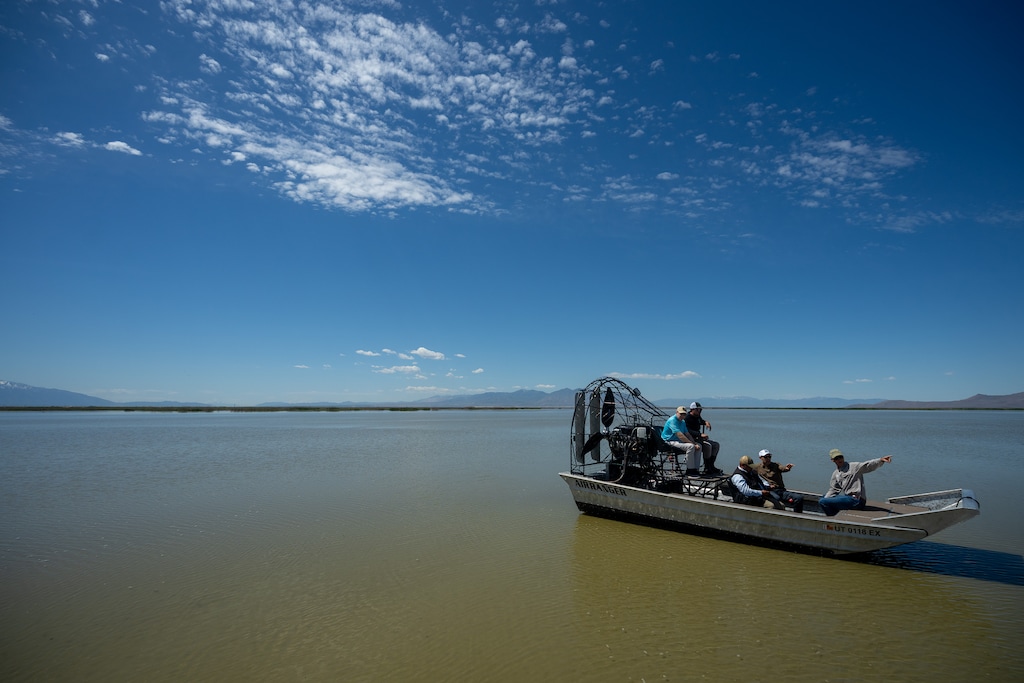
(Francisco Kjolseth | The Salt Lake Tribune) Gov. Spencer Cox, who just signed an Executive Order establishing a statewide framework to guide the evaluation and development of large data center projects in Utah, briefly participates in a service project near the Great Salt Lake on Friday, May 29, 2026.
Even if a host site deal comes with help for the Great Salt Lake, environmental advocates remain wary of how storing spent nuclear fuel could impact the health of Utahns and the lake itself.
“Make no mistake, as part of its obligation to protect its citizens, the federal government should absolutely provide meaningful and effective support to save Great Salt Lake,” said Carmen Valdez, a senior policy associate for Healthy Environment Alliance of Utah. “But this trade-off is not worth the price.”
“Practically,” Valdez added, “accepting the nation’s nuclear waste would mean transporting high-level radioactive waste by rail and road, through communities across Utah and around the lake, and storing highly radioactive materials within its watershed, dramatically increasing the potential for leaks or accidents, possibly in perpetuity.”
The proposed campuses across the country come as President Donald Trump’s administration looks to quadruple nuclear energy production, but has not found a solution for the radioactive waste.
A leaked White House plan indicates he is pushing federal lawmakers to abandon plans to store high-level nuclear waste at Yucca Mountain in Nevada, POLITICO reported, and pass laws allowing the waste to be sent to campus host states.
Ahead of any hubs being built, Lesofski noted, “because Yucca Mountain is the law of the land, there are things that have to be changed on the federal level, and that’s something that we are watching closely.” She said her office has been working with Utah’s Sen. Mike Lee on the issue.
Lee chairs the Senate Energy and Natural Resources Committee, giving him an influential role in where policy conversations land. His office did not respond to a request for comment.
“We got to figure out something to do with that,” Lee told POLITICO on Wednesday when asked about Trump’s plan, adding he’d “quite possibly” introduce legislation himself.