 Emily R. Anderson
 Leia Larsen
Utah is among a handful of states that are finalists for a massive federal campus that would take on a range of nuclear work — from creating fuel to later recyling it and storing radioactive waste, the U.S. Department of Energy announced Tuesday.
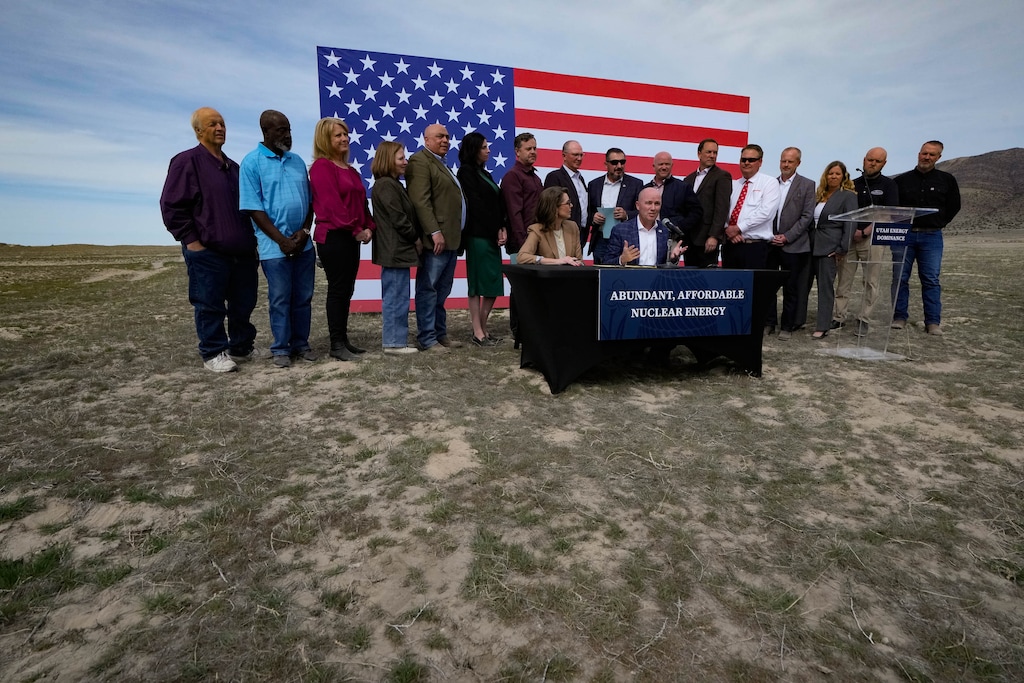
Gov. Spencer Cox signed a memorandum of understanding with the federal government Tuesday, which Utah’s Office of Energy Development said is “one of several next steps” in the federal agency’s selection process.
The public will have opportunities to comment on the project as the federal review continues, the state energy office added.
Cox said in March that if Utah is chosen, the development would bring tens of thousands of jobs, rivaling the economic boost brought by Hill Air Force Base. “America’s future depends on affordable, abundant energy,” Cox said in a news release Tuesday.
A spokesperson for the state energy development office was not immediately able to provide a copy of the new agreement. The memorandum does not guarantee Utah will be selected as a nuclear campus, the office noted.
Utah joined the competition to host a “nuclear lifecycle innovation campus” in April at the direction of Cox and Utah’s GOP Legislature. More than two dozen states responded to the call for applications over the spring, and Utah is one of five states — including Idaho, Louisiana, Oklahoma and Tennessee — that have risen to the top.
According to DOE’s announcement, “States that choose to pursue hosting an innovation campus will sign hosting agreements with the Department at a later date.”
Before the federal government potentially moves forward with building a campus in Utah, the energy office said, there must be “additional analysis, stakeholder engagement and future agreements.”
The new campus approach aims to build facilities for the full nuclear fuel cycle in one place, co-locating fuel fabrication and enrichment with reprocessing used nuclear fuel and disposition of waste, DOE said.
Sites may also host nuclear reactors and data centers, according to the agency.
The agency believes the “proposed innovation campuses have the potential to attract up to $50 billion in capital investment, generate as much as $10 billion in state and local tax revenue, and create nearly 25,000 jobs,” it said in a news release.
The state’s 150-page proposal envisioned a campus in Tooele County’s remote West Desert, but also pitched a “nuclear energy ecosystem” spanning the state.
It would include a planned nuclear training center in Box Elder County, Valar Atomics’ experimental Ward 250 TRISO-fueled microreactor in the central part of the state and the White Mesa uranium mill in San Juan County.
The governor’s “Operation Gigawatt” has become a key part of his platform of his second term. It seeks to more than double the state’s electricity generation — with a heavy focus on nuclear energy development — over the next decade. The rise of artificial intelligence, data centers and electrification of transportation are spiking demand.
“We’re doing it through responsible stewardship of the land and resources we’ve been entrusted with,” Cox said in Tuesday’s statement.
The White House has largely abandoned incentives for renewable energy projects, but has embraced a “golden era” of nuclear development.
“The innovative concept is a direct result of President Trump’s leadership and ambitious directives to restore the domestic nuclear fuel cycle,” U.S. Energy Secretary Chris Wright said in a news release, “and get America’s nuclear industry growing again.”
The Trump administration is also pushing federal lawmakers to abandon plans to store nuclear waste at Yucca Mountain in Nevada, according to Politico.
Correction • 12:00 p.m., July 29, 2026: This story has been corrected to report that Gov. Spencer Cox signed the memorandum of understanding with the U.S. Department of Energy.