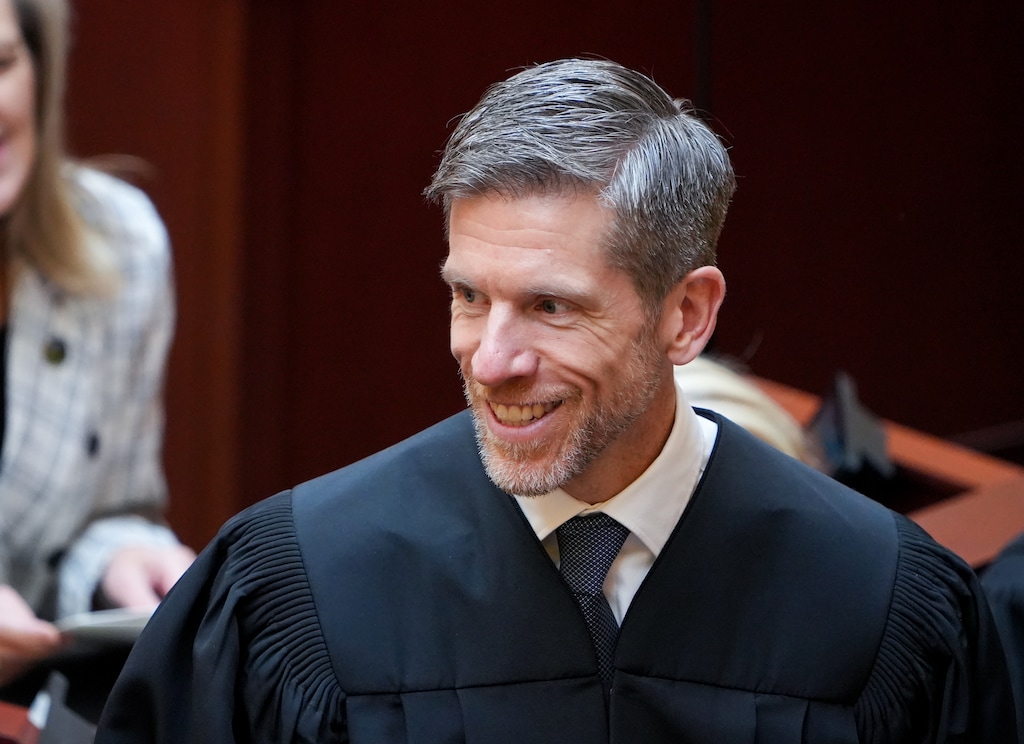
 Robert Gehrke
Challengers to Utah’s law banning nearly all abortions in the state want a Supreme Court justice disqualified from hearing an upcoming case because he had previously represented a group that argued the ban didn’t violate the Utah Constitution.
Before joining the court last year, Justice John Nielsen co-authored a brief on behalf of Pro-Life Utah that argued that Utahns at the time of statehood and decades after viewed abortion as reprehensible and the framers of the state’s constitution could not have intended the document to protect access to the procedure.
“Based on these facts,” attorneys for Planned Parenthood Association of Utah (PPAU) wrote in their motion, “an objective observer might reasonably question whether Justice Nielsen is able to act as an impartial adjudicator in a case where he previously argued that PPAU should lose on the merits.”
At the heart of the case is Utah’s 2020 “trigger law,” which sought to ban nearly all abortions in the state, except in narrow circumstances — when the pregnancy threatens the life of the mother, resulted from rape or incest, or if doctors agree the fetus is not viable.
The law took effect after the U.S. Supreme Court struck down Roe v. Wade, but Planned Parenthood has been fighting it in court for years.
A district court judge blocked the law from going into effect until there is a ruling on its constitutionality. The Utah Supreme Court upheld that decision, meaning abortion remains legal in Utah up to 18 weeks.
In September, Planned Parenthood will be back before the Utah Supreme Court. It is one of several parties arguing a law passed this year by the Legislature overstepped its authority by giving a special panel of three judges the power to rule on challenges to state laws — including the abortion challenge.
One of the other groups challenging the three-judge panel is the League of Women Voters, which has spent years fighting the Legislature’s repeal of a citizen initiative that banned gerrymandering. Nielsen recused himself from hearing the League’s challenge to the judicial tribunal because he had written a brief opposing the citizen initiative power and because he had consulted with the Legislature on its legal strategy for repealing the initiative.
Planned Parenthood contends Nielsen also has a conflict in its challenge and he should have done the same.
“The rules about recusals are objective and clear,” said Shireen Ghorbani, president and CEO of Planned Parenthood Association of Utah. “A judge should recuse when their impartiality might be reasonably questioned.”
A spokesperson for the courts declined to comment. Judicial rules provide options for how the Supreme Court handles motions and the spokesperson said the justices have not decided how the motion to disqualify Nielsen will be addressed.
A note from the court sent to the parties on July 8 disclosed the brief he had filed for Pro-Life Utah, along with former Justice Tom Lee, who is Sen. Mike Lee’s brother. The memo said that “Justice Nielsen does not believe that amicus representation is a basis for disqualification.” But he disclosed it, the memo said, in case lawyers wanted to move to disqualify him.
Nielsen was asked during his confirmation hearing last year if he would recuse himself in the abortion case and others in which he had represented clients. He did not commit either way but said he would “follow the established rules for recusal.”