 Robert Gehrke
When Utah Gov. Spencer Cox issued an order restricting fireworks over July Fourth, Clinton Mayor Marie Dougherty huddled with city officials to assess the danger.
They determined the risk for the city west of I-15 in Davis County was limited and enough firefighting resources were available for the holiday, so they opted to let people ignite fireworks over most of the city.
She wasn’t prepared for the explosion of hate and vitriol that followed.
“I got hit harder than I’ve ever been hit before as an elected official,” Dougherty, who first served on the city council in 2021, said in an interview.
“I was getting hit from all over the state,” she said. “People were doxing my address all over social media, saying, ‘Let’s go light off fireworks at her house.’”
“I had a threat to burn down my house made against me,” the mayor said, and that people attacked her character and accused her of not caring about Utahns.
It was a different story in Bountiful, where Mayor Kate Bradshaw said she faced a very different set of factors and opted to ban fireworks citywide. She received “thank you” notes — a rarity for public officials.
Now, ahead of Pioneer Day, faced with a similar decision — albeit with a different process — both mayors say they made the right decision and are sticking with their conclusion for the July 24th holiday.
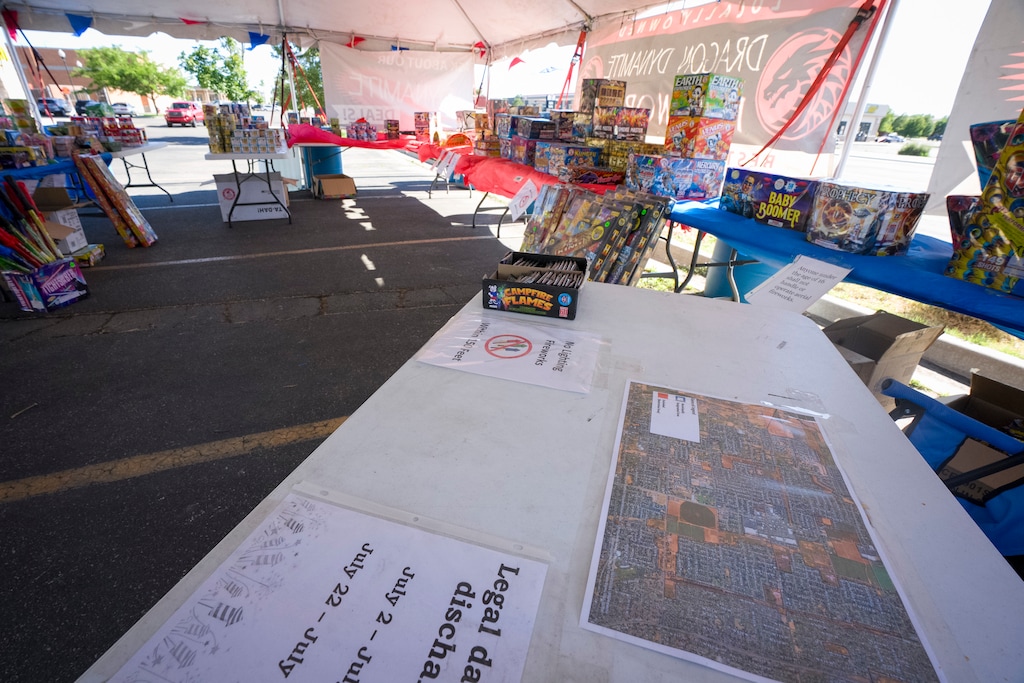
(Bethany Baker | The Salt Lake Tribune) Signs hang from a table where fireworks sit at a Dragon Dynamite Fireworks stand in Clinton on Monday, June 29, 2026.
On Tuesday, mayors statewide submitted their proposed fireworks restrictions to the state forester, a response to the risk posed by drought conditions across the state. Dougherty and Bradshaw are again taking different approaches, putting nearly the same areas off limits as they did three weeks ago.
Bradshaw said it’s a recognition of the conditions in their respective cities. Parts of eastern Bountiful run right up to the foot of the mountains, abutting trees and shrubs that pose a serious risk should it ignite.
Bradshaw said she remembers anxiously waiting in 2019 for word on whether they needed to evacuate after a wildfire burned not far from her neighborhood. That fire wasn’t ignited by fireworks but it drove home the danger posed by fires in the foothills and the tremendous resources needed to fight them.
“Talking with my council, talking with my [fire] chief … we were doing all those same things [as Clinton] to try to make the best decision," said Bradshaw. “And our best decision ended up being: We think that going with a ban works better for us and preserving those resources.”
By contrast, Dougherty said, Clinton is a suburban community with almost no wildland-urban interface, as it is called. The mayor said she looked at data from past summers that were even drier than 2026, and there were only a couple small fires that resulted from fireworks.
There were still several areas that Clinton put off-limits — three times the amount of land that had ever been under restrictions before, Dougherty said — but it didn’t diminish the backlash.
Dougherty said she ended up being the focus of the fury because Clinton was one of the first cities to opt not to have the total ban because she wanted residents to be able to plan for the holiday. The outcry got even stronger, she said, when three firefighters were killed fighting a blaze in Colorado a day later, but after a few days, the feedback shifted to mostly positive.
Moreover, unlike Bountiful, where the wildland firefighters have been called on to help neighboring cities, Clinton doesn’t have a wildland division, meaning its firefighters would be on hand in the event of an emergency and the city can call on neighboring jurisdictions, if needed.
As it turned out, the South Davis Metro Fire Department, which serves Bountiful and other cities, responded to a serious traffic accident on July Fourth that could have posed a problem if there had also been a fire that evening, Bradshaw said.
When the firefighters returned from the crash and backed their engine into the station, the mayor said a group of people across the street from the fire station were lighting banned fireworks and lit a tree on fire.
“It takes someone special to decide you’re going to defy the ban in front of the fire department,” said Bradshaw. “But also, they’re right there and luckily they were back.”
Dougherty said she prefers the governor’s decision to give cities more discretion to ban fireworks on Pioneer Day, as opposed to imposing the blanket ban he did on July Fourth and giving local officials the option of opting out.
With the blanket ban, she said, the narrative in the minds of voters became, “How dare you defy the ban? You need to have solidarity with the ban.”
“It shouldn’t be based on solidarity,” the mayor said. “It should be based on data and analysis and the actual conditions that boots-on-the-ground experts are seeing in our own communities.”
Note to readers, 11:10 a.m. • This story has been updated with additional details about the comments to Clinton Mayor Marie Dougherty and to provide the full name of the fire department serving Bountiful.