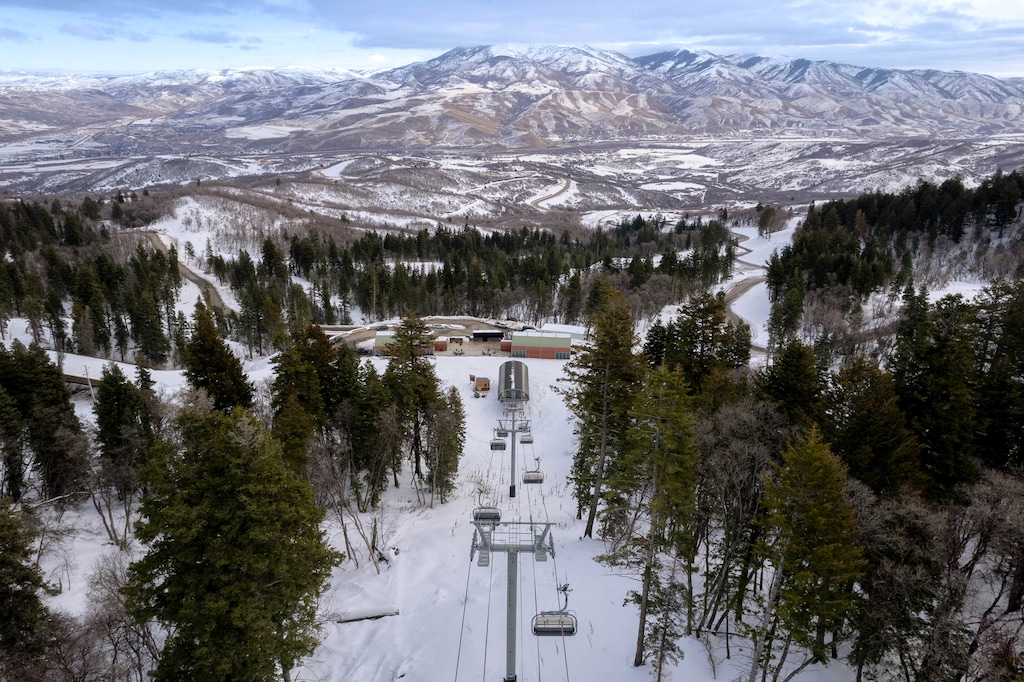
 Julie Jag
Utah will explore developing a state-funded ski area — just not in all the places project organizers hoped.
On Monday, the Utah Outdoor Adventure Commission approved spending $400,000 on a site exploration and feasibility study for the Utah Public Ski Area Coalition. The money is a share of nearly $28 million in funds the commission distributed as part of its Outdoor Recreation Initiative. That money can be used to look into the viability of building a public ski and snowboard area in northern Utah.
A similar request to explore sites on the Wasatch Front and in the Oquirrh Mountains was denied.
Despite the split decision, coalition founder Clint Richins said he appreciated the commission’s support.
“I’m excited,” he said, “because we’ll be able to answer the question whether it’s feasible.”
Richins, a Logan resident, early this fall floated the idea of creating a state-funded ski area as a way to make the sport more accessible and affordable for Utahns. He has consistently said the project’s success will hinge on three elements: affordability, challenging terrain and a central location.
In an interview with The Salt Lake Tribune, Richins noted that Beaver Mountain near Bear Lake is affordable with challenging terrain, but is not central to the state’s population. Conversely, Nordic Valley Resort in the Ogden Valley, he said, is affordable and centrally located, but does not have terrain on par with some of the state’s premier resorts.
(Emma Mortensen, @photofilmbyem) Clint Richins, 31, of Logan started the nonprofit Utah Public Ski Area Coalition in September 2026. The organization is advocating for the development of a state-funded ski and snowboard area with the intent of getting more Utahns on the slopes.
With its decision not to fund a feasibility study along the Wasatch Front, the commission may have made achieving that trifecta more difficult.
“The sites that are available to this project are mostly based in the northern region. The populace that would benefit comes from the Wasatch Front region,” Richins told the commission. “So, if we get funding, that’ll be something that we, as a state, want to keep in mind: Who’s going to be able to use this?”
Richins added that “our goal is to provide something that is close to home to a lot of Utahns.”
Richins said he has about 10 locations in mind for the ski area but is continually scouting others. Most, but not all, of those he has identified are in what the commission has deemed the Northern Region. It includes Summit, Wasatch, Cache, Rich, Box Elder and Morgan counties.
Those counties contain six of Utah’s 16 public ski resorts — including Deer Valley Resort, Park City Mountain and Sundance Resort — plus the private Wasatch Peaks Ranch.
The Wasatch Front Region has seven resorts, all located within Weber and Salt Lake counties. Among them are the four Cottonwood Canyons ski areas as well as Nordic Valley, Snowbasin Resort and Powder Mountain in the Ogden Valley.
The difference in funding came down to a difference in priorities. The commission asks each regional council to rank its projects in order of what it believes most deserves funding. The Northern Region ranked the feasibility study No. 1 out of five projects on its list. The Wasatch Front’s council ranked funding the public ski area’s exploratory mission last out of 10 projects.
As a result, the funding request was the subject of considerable debate.
At first, the commissioners unanimously approved funding the request in the Northern Region. Later on, however, Bountiful Mayor Kate Bradshaw questioned that approval. Bradshaw, a commissioner who represented the Wasatch Front Region at the meeting, asked the commission if funding the feasibility study might be a waste of money.
“This is a newer organization,” she said, “and I just wonder, with some of the other projects that are on [the projects list], whether this one has enough steam power and legs for the fortitude it will take to really [fulfill] its promise.”
Rep. David Shallenberger, meanwhile, asked if the Utah Public Ski Area Coalition had sought outside partnerships, such as with Matthew Prince, Utah’s richest resident. Prince has been outspoken about his displeasure with the way Park City Mountain has been managed and has offered to buy that resort.
(Rick Egan | The Salt Lake Tribune) The base of Park City Mountain Resort as seen on Tuesday, Dec. 23, 2025.
Jason Curry, the director of the Utah Division of Outdoor Recreation, reminded the commission that the purpose of the feasibility study was to reveal whether a state-funded ski area could be viable.
“It’s pretty clear that if the feasibility study doesn’t support and doesn’t find that this is a worthwhile pursuit, that [Richins’ coalition] would recognize that,” Curry said. “And I think they view that as within the realms of possibility.”
Richins procured quotes from two companies — the SE Group and Ecosign — to perform feasibility studies on the three most promising sites in each region. The total cost of the studies ranged from $150,000 to $350,000.
Just before the commission voted to approve all of its project selections, commissioner Jeff Hartley voiced support for Richins’ concept of a state-funded ski area.
“I think that’s an awesome idea because it is so bloody expensive to ski, and a lot of people can’t afford to ski,” said Hartley, a managing partner at the lobbying firm Sage Government Solutions. “And while it will never be cheap to operate a ski resort, if there’s a way to do it in a nonprofit way, it’s going to lower the barrier of entry for a lot of people that can’t afford to do it.”
The Utah Public Ski Area Coalition website says lift tickets for Utah residents could cost as little as $59 compared to $139 for out-of-state visitors.
Richins said he won’t stop searching for potential sites along the Wasatch Front just because he did not receive funding for that area from the commission. The money for a feasibility study there could come through other channels, he said.
Still, he’s surprised his idea has drawn so much controversy.
“I understand that $400,000 is a lot of money, but it’s such a big question” his group is seeking to answer, he said. “And the amount of benefit that would come from it, if it’s possible, would be immense.”
The state-funded ski area wasn’t the only ski-related project rejected in the Wasatch Front region. The Silo Slopes Snow Park, which would have provided skiing on an artificial surface in South Jordan, was also denied funding.
Almost 50% of the funds the commission allocated Monday went to infrastructure renovation projects like campgrounds and cabins. A third of it went to new infrastructure. That included — after considerable debate — money toward the installation of several all-wheels skate and bike parks across the state.