 Leia Larsen
Note to readers • This story is made possible through a partnership between The Salt Lake Tribune and Grist, a nonprofit environmental media organization.
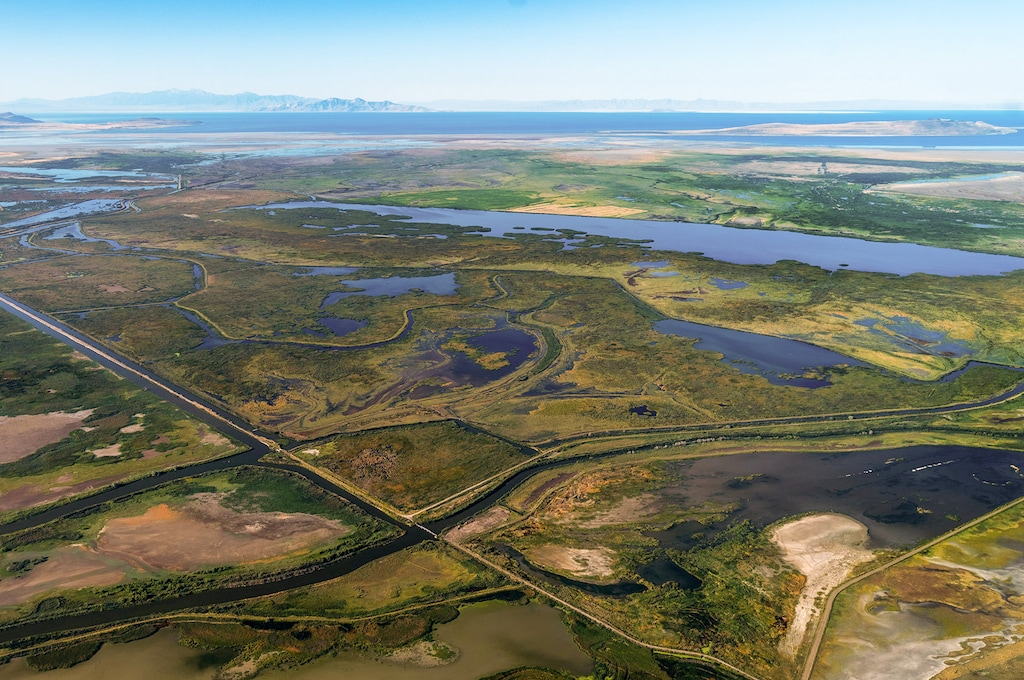
The Salt Lake City International Airport is preparing to sell nearly 1,000 acres of wetlands near the Great Salt Lake.
Airport officials plan to sell the land to the Utah Department of Natural Resources. Both agencies call the transfer a win, because the airport is in the business of travel, not managing waterfowl habitat and invasive species. The state, meanwhile, has the resources needed to preserve the wetlands and maintain their ecological function.
But advocates worry hundreds of acres of bird habitat could instead become a new waterfowl hunting ground.
“We’re only asking that when the land is transferred, the protections are sold with the property in perpetuity,” said Punita Koustubhan, founding chair of Bird Safe Utah. “So even if the state purchases the property, they need to honor the no-hunting-allowed mitigation rules.”
Compounding Koustubhan’s concerns is the fact that the Department of Natural Resources already acquired 665 acres between the wetland parcels and the airport in 2023, which it established as the Blackhawk Waterfowl Management Area.
The Division of Wildlife Resources said in a statement that the state’s intent in purchasing the site is to preserve more Great Salt Lake habitat that’s critical for waterfowl like ducks and geese.
“DWR hopes to expand waterfowl hunting opportunities and protect the wildlife habitat in the area through this purchase,” a spokesperson confirmed. “If the acquisition is approved, the DWR would add the parcel to the Blackhawk Waterfowl Management Area to be managed as one WMA.”
State-run waterfowl and wildlife management areas are typically available for part of the year to hunting and other recreation. Blackhawk has yet to open to the public due to access issues, which Koustubhan said may have led to the state’s interest in the airport’s wetlands.
“Blackhawk WMA has a lot to benefit from purchasing this property,” Koustubhan said, “so they can build roads and parking lots and such to get to their traditional hunting grounds.”
Any disturbance, whether it’s road construction, gunshots or a person simply walking through wetlands, can cause birds to flush and potentially abandon nesting sites, she added. Human activity can keep flocks on high alert, causing them to burn energy they should be storing for migration.
“These rest stops only work if birds can actually rest,” Koustubhan said.
Bird advocates are carefully monitoring the sale. They’re also encouraging Salt Lake City residents to participate in two public comment periods on Tuesday, when the City Council will hold hearings on a possible conservation easement for the site and collect feedback on its sale to the state.
“We’re not anti-hunter,” Koustubhan said. “But there are so many WMAs all over ... do we really need to be opening everything up to hunting?”
How the airport came to own hundreds of acres of wetlands
The Salt Lake City International Airport acquired about 951 acres northwest of its runways in the early 1990s. It was part of an expansion project meant to facilitate the influx of international traffic brought by the 2002 Winter Olympics. Federal regulators required the airport to create and protect new wetlands to offset wetlands it would destroy during construction.
The airport only needed to create about 450 acres of wetlands to meet requirements by the U.S. Army Corps of Engineers, but it ended up acquiring 500 more because preserving open space was in the facility’s best interest, according to Bill Wyatt, executive director of the airport.
“We don’t have a use for it,” Wyatt said, “but also don’t want to see any development on it.”
(Francisco Kjolseth | The Salt Lake Tribune) Jason Hardman, Salt Lake City Mosquito Abatement District operations supervisor, pulls a sample of water while demonstrating how he looks for mosquito larvae in the wetlands east of the Great Salt Lake on Thursday, April 10, 2025.
The airport’s 1993 Monitoring and Maintenance Plan for the wetland site, required by the Army Corps, already allowed for “limited hunting” on the site, documents show. But the property was “unlikely” to generate much interest, Wyatt said.
“If you want to hunt ducks there,” he said, “you’re in for a hike.”
The airport spends between $70,000 and $100,000 a year monitoring and maintaining the wetland property, he said. But like many areas around the Great Salt Lake, it has become invaded by water-guzzling phragmites over the decades. Airport employees are not equipped to manage the reeds.
“It’s not part of our core competency,” Wyatt said. “It’s not what we were created to do.”
Officials with the Department of Natural Resources approached the airport about its wetlands property after the Great Salt Lake hit a record low in 2022 and faced ecological collapse, Wyatt said. The state wanted to take a more aggressive role in managing Utah’s iconic inland sea.
Utah resources managers have invested $58,500 in removing invasive species and introducing native vegetation at the Blackhawk WMA to better support nesting habitat and improve water quality.
Much of the West has lost significant chunks of wetland habitat over the last century due to human expansion and development. Utah lost around 30% of its natural wetlands by the 1980s, according to the U.S. Fish and Wildlife Service, and Great Salt Lake wetlands face increasing development pressure from encroaching data centers and inland port projects.
The state’s purchase price for the airport wetland property will likely land at $4.1 million based on appraisals by the Federal Aviation Administration, Wyatt said. That money will support airport operations. The Salt Lake City Council will also consider a resolution that places the land under a permanent conservation easement and waives any fees for those protections prior to the transfer, protecting it as open space regardless of who buys it in the future.
That includes the 400-plus additional acres the airport purchased that go beyond the requirements of the Army Corps of Engineers, which were open to development otherwise. A draft of the conservation easement allows for non-motorized hunting along with horseback riding, birdwatching, hiking and other recreation.
Mayor Erin Mendenhall will have the final say on the property transfer, which does not require the City Council’s approval, a city spokesperson confirmed.
And Wyatt has his doubts that the airport wetlands were ever a meaningful resting place for significant flocks of migratory birds anyway. Airport personnel regularly visit the site to chase them off, he said.
“Our staff has and will continue to have access to that property for the sake of hazing birds,” Wyatt said, “because birds and airplanes don’t mix.”