 Brooke Larsen
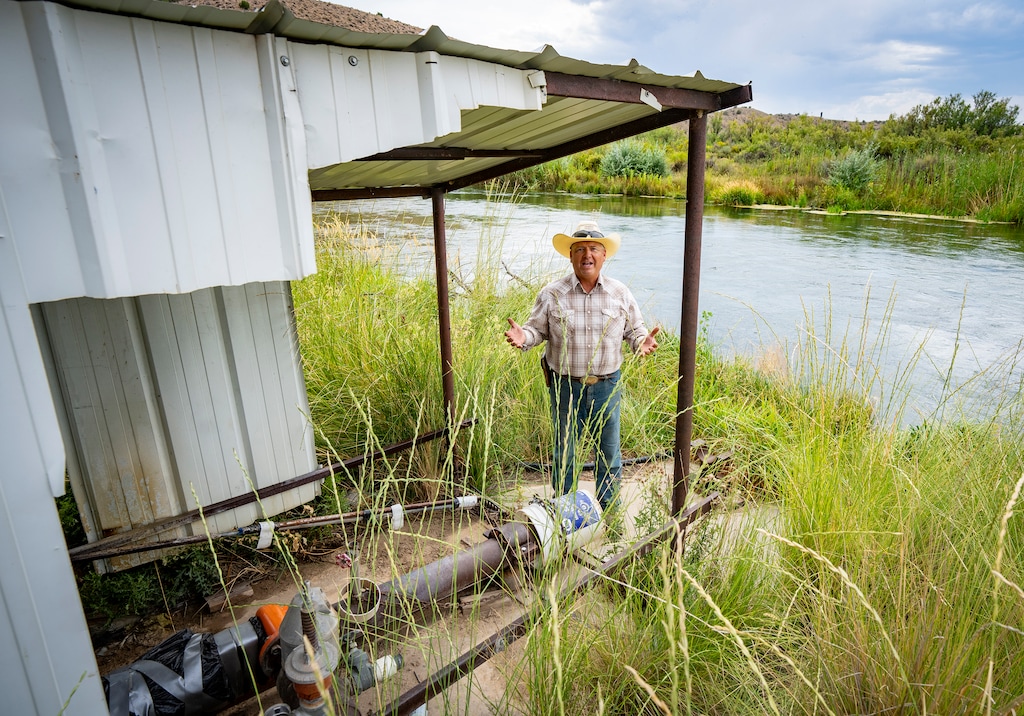
Green River • Ranch manager Kent Nelson flipped open the cap on a water meter and pointed to the words “EMPTY PIPE” on the screen. Chains normally connected to a pump pulling water from the Green River hung loose.
Marc Stilson, the principal engineer for the Colorado River Authority, looked at the meter and checked the pump. But it didn’t take much close examination to see that one of Ruby Ranch’s nearby fields wasn’t receiving water. It was shades of brown and tan, blending in with the surrounding sandstone while standing out against the neighboring bright green irrigated fields.
This year, Ruby Ranch enrolled two alfalfa fields in Utah’s Demand Management Program, which pays Colorado River water users to temporarily and voluntarily send water downstream. The ranch, owned by Noel and Carrie Vallejo from Pleasant Grove, sits at the confluence of the San Rafael River and the Green River, about an hour’s drive south of the town of Green River.
Utah is betting that voluntary conservation like this can help protect the state as the Colorado River shrinks and the seven states that depend on it fight over who should use less.
“We want to develop a block of water in Powell with Utah’s name on it, so if we have to do mandatory curtailment, that’s the first block of water that we have to use to meet that demand,” Stilson said.
Throughout the year, Stilson checks on each enrolled project to verify water is being conserved.
“Lower Basin states want to make sure we’re being legitimate,” Stilson said as he looked at Ruby Ranch’s shut-off irrigation pump.
(Brooke Larsen | The Salt Lake Tribune) Marc Stilson, engineer with the Colorado River Authority of Utah, verifies that Ruby Ranch has shut off irrigation to a fallowed field enrolled in Utah's Demand Management Program on Monday, Aug. 10, 2026.
Those states — Arizona, California and Nevada — and Upper Basin states — Colorado, New Mexico, Utah and Wyoming — have been in tense negotiations about how to share the diminishing Colorado River. With no deal reached, the Bureau of Reclamation moved forward with a plan that requires the Lower Basin to conserve 1.25 million acre-feet of water next year, with steeper cuts possible in the future.
The plan includes no mandatory cuts in the Upper Basin, just a goal to conserve 200,000 acre-feet per year.
Given the Upper Basin’s limited conservation in the past, that’s a “very ambitious goal,” said Eric Kuhn, retired manager of the Colorado River Water Conservation District.
The burden of conservation has been a major sticking point among the states: if the Lower Basin has to take cuts, those states want the Upper Basin to commit to measurable conservation. But Utah and its neighbors argue that Mother Nature already forces shortages in dry years.
If states can’t agree, the Lower Basin could sue the Upper Basin over the Colorado River Compact in an attempt to force cuts to water use. So Utah is preparing. By paying water users to temporarily send water downstream, it’s hoping to bank credit to pay for future cuts.
At Ruby Ranch, an estimated 633 acre-feet of water that alfalfa would normally drink up across 200 acres has remained in the Green River, flowing past the western edge of the ranch and continuing 100 miles south to Canyonlands National Park, where it joins the Colorado River before reaching Lake Powell.
(Brooke Larsen | The Salt Lake Tribune) A sprinkler hangs dry from a pivot system on a fallowed field at Ruby Ranch on Monday, Aug. 10, 2026.
The state uses satellite data to track the total conservation amount and gauges that measure the actual “wet water” in the river system, Stilson said.
Utah launched the Demand Management Program as a pilot two years ago with state funds. Recently, the federal government awarded Utah and other Upper Division states $100 million for water conservation efforts. So the authority has removed “pilot” from the program’s name and plans to continue it into the future.
Other Upper Basin states are taking their own approach. New Mexico has a Strategic Water Reserve Program, which includes leasing 20,000 acre-feet of water per year from the Jicarilla Apache Nation. Wyoming created a program similar to Utah’s earlier this year, and Colorado just approved a near-term water contribution program in mid-September.
Upper Basin states told the Interior Department that they should receive credit for conserved water in a letter on Sept. 11.
“We have not, as yet, heard yay or nay on that,” Amy Haas, executive director of the authority, told The Tribune. “That is a big deal for us in Utah. … Sending conserved water to Lake Powell only to increase releases from Glen Canyon Dam is not something that we would support. We want this water to be neutral, and we want to get credit for it.”
Utah will also seek retroactive credit for water conserved over the past two years.
(Chris Caldwell | Special to The Tribune) Lake Powell and the Glen Canyon Dam is seen from Wahweap Overlook near Page, Ariz., Wednesday, Sept. 23, 2026.
Building up a bank of water in Lake Powell is just one goal of Utah’s conservation program, though, Stilson said. Helping agricultural producers improve their operations and use water more efficiently is another priority.
The program has been a success in that regard, Nelson said.
“It’s given us the opportunity to improve the fields that we’ve taken out,” he said. “Plus, in the future, I can see it making us be wiser about our water use.”
‘Win-win’
Alfalfa hay bales filled a barn near one of Ruby Ranch’s irrigated fields where antelope grazed and a coyote pup wandered as Stilson conducted verification checks in August. Alfalfa is the ranch’s main money maker, along with 120 head of cattle.
Agriculture is the biggest user of Colorado River water, accounting for over 70% of human use of the river. Alfalfa and other hay crops make up the bulk of that, accounting for 46% of direct consumption, according to a 2024 study.
The plant can keep producing forage for livestock for four to five seasons before its quality begins to diminish. The two fields that Ruby Ranch enrolled in the program had reached that point this year.
Typically, Nelson and the ranch crew would rotate out alfalfa and plant corn or Sudangrass for a year or two. But this year, the Demand Management Program allowed them to rest the field and send water downstream — all while still getting a paycheck. The authority pays $390 per acre-foot delivered from fallowing projects and $150 per acre-foot for projects that hold water in a reservoir and release it downstream after the irrigation season.
“If every three or four years you can take a field out and we can lease the water, build up a bank of water in Powell,” Stilson said, “I think it works pretty good.”
“I think it’s a win-win,” Nelson added, as they talked next to one of the ranch’s fallowed fields.
(Brooke Larsen | The Salt Lake Tribune) An alfalfa field at Ruby Ranch that's enrolled in Utah's Demand Management program sits dry and brown on Monday, Aug. 10, 2026.
Duchesne ranchers and farmers Trent and Eileen Potter were also drawn to the program because of the practical benefits. One of their pastures had drainage issues, so fallowing it gave them time to improve the property.
Over the past five years, the Potters have had to reduce their cattle herd by 30%. “That’s about what we can run with the drought,” Trent Potter said.
Without adequate water, the Potters’ eastern Utah rangeland can’t support the herd. “So we chose to cut back on animals instead of feeding hay,” said Trent Potter, who also serves on the Agriculture Advisory Council for the authority.
Their land within Duchesne, though, has reliable water, which made their pasture on the banks of the Strawberry River a more ideal project to enroll in the Demand Management Program.
(Rick Egan | The Salt Lake Tribune) Trent and Eileen Potter on their farm in Duchesne, on Tuesday, Aug. 11, 2026.
Beneficial use
A few years ago, the Potters and Ruby Ranch wouldn’t have considered letting their water flow downstream because they’d risk losing it. Under Utah water law, water rights holders must put their water to a beneficial use. “Use it or lose it,” as the adage goes.
But in 2023, the Legislature passed a bill that added delivery to a Colorado River system reservoir under an approved conservation program as a beneficial use.
The program’s early days have not come without hiccups, though. Water users who want to participate must apply to temporarily change the use of their water rights — a process that typically takes six to eight months.
That has had consequences: the Potters submitted their application to the division in January, but didn’t get approval until June.
The Potters typically start irrigating in April, though, so they sent water downstream for two months without certainty of payment, Trent Potter said.
“It went down the river,” Eileen Potter added. “But it didn’t get counted as being conserved.”
There’s some nuance: if the river flow between June and Sept. 30 produced sufficient volume to satisfy the Potters’ contracted amount, the authority will fully compensate them, Stilson said. If not, the authority will reduce their payment proportionally.
(Rick Egan | The Salt Lake Tribune) Trent Potter's farm in Duchesne, on Tuesday, Aug. 11, 2026.
The Utah Legislature passed a bill in 2026 that added a new dedicated water application that should cut processing time down to about 12 to 14 weeks, said Teresa Wilhelmsen, state engineer and director of the division.
Once a dedicated water application is approved, the water user must let the division know how they plan to use their water right by March 1 each year.
“It’s a pretty exciting amendment that I think is going to really streamline the process,” Wilhelmsen said, “not only keep it voluntary, but give flexibility to water users, and then certainty as to where that water needs to go.”
The law also only allows farmers and ranchers to fallow fields for two years in a five-year period. The state wants to make sure that farmers continue to farm.
“We don’t want to take the land out for long periods of time because it’s hard to get it back in production,” Stilson said.
The authority still has to convince producers of the perks to participate, though.
“It’s going to take a mind shift, especially in some of the older generation, to see the purpose of it,” Nelson said. “As a farmer, the water is like your largest asset, your largest tool, because without water, this is just dry desert ground.”
“It hurts a little bit to see a dead field like that,” Nelson added as he looked over one of Ruby Ranch’s fallowed fields. “As a farmer, I want to make things grow.”
(Brooke Larsen | The Salt Lake Tribune) Kent Nelson stands on an irrigated field at Ruby Ranch, which he manages, on Monday, Aug. 10, 2026.
(Rick Egan | The Salt Lake Tribune) Trent Potter shares his experience with the Demand Management Program at his fallowed pasture in Duchesne, on Tuesday, Aug. 11, 2026.
Farmers are farming because they want to farm, Trent Potter said.
“If they wanted to make millions of dollars, they’d sell their property, just be done,” he added. “They enjoy farming and producing something.”
Some also worry if they let their water flow on by, it will just go to an irrigator downstream.
“A lot of people look at it like, ‘Well, you’re just wasting water. You’re just sending that water down the river, selling it to California’ — which is not what we’re doing,” said Bill Butcher, a cattle rancher and president of the Price River Water Users Association.
But others in his area have seen the benefit. The association has enrolled some water stored in Scofield Reservoir for Price River area farmers who want to participate. Some installed more efficient irrigation systems while their land was fallowed. Others are trying to convert their fields to organic agriculture after letting the land rest.
It was worth it for the association to participate “to try to help out the Colorado River situation,” Butcher said.
(Rick Egan | The Salt Lake Tribune) Bill Butcher at his farm near Price, on Tuesday, Aug. 11, 2026.
The authority wants the program to benefit both the agricultural producer and Utah’s long-term water security. “We don’t want it just to work for one or the other,” Stilson said. “It’s got to work for both.”
While the state strives to create a program that keeps farmers farming, Colorado River experts question whether temporary fallowing will solve long-term supply issues.
“In the long run, reducing the irrigation footprint, the number of acres permanently, is really the solution that works,” Kuhn told The Tribune.
“The amount of water we’ve been using in the Colorado River Basin has exceeded the supply consistently for nearly 30 years,” Kuhn added. “It’s a permanent problem. It’s not a temporary problem.”
The Demand Management Program “IS NOT” a “buy and dry” program, though, nor is it meant to conserve water to benefit the larger Colorado River system, as the authority outlines on its website.
Meanwhile, the state faces another hurdle: how to conserve when the water isn’t there.
‘Whatever the skies give us’
As Wolf Creek flows down the Uinta Mountains, it reaches a metal grate on its usual path toward the Duchesne River. The water drops down to a concrete tunnel that diverts the water to Strawberry Reservoir and across the Wasatch Mountains to Utah’s major cities.
For the past two years, the creek has continued flowing to the Duchesne, though. The Central Utah Water Conservancy District covered the diversion and decided to enroll two diversions on Wolf Creek in the Demand Management Program.
(Rick Egan | The Salt Lake Tribune) A metal plate covers the Rhodes Diversion on Wolf Creek on Wednesday, Aug. 12, 2026.
(Rick Egan | The Salt Lake Tribune) Dylan Dastrup talks about the Rhodes Diversion on Wolf Creek on Wednesday, Aug. 12, 2026.
The decision initially had another purpose. After the Yellow Lake Fire burned the steep forested slopes around Wolf Creek in 2024, the district worried monsoon rains would fill the diversion with mud and ash. Covering the diversions would protect the system while also sending more water downstream, district manager Dylan Dastrup told The Tribune in August.
The district estimated they’d send 4,500 acre-feet of water downstream in 2025 and 2026 based on historical flows of the creek. Both years have been closer to 1,000 acre-feet because of the drought, though.
“That just tells the story of the whole Upper Colorado River Basin,” Dastrup said. “We can say, ‘oh, we get so much water,’ but at the end of the day, we get what we get, right? We can look at all the data and say, ‘well, we think we should be getting 4,500 acre-feet out of here,’ but the reality is whatever the skies give us.”
Because of the unreliable water supply, Utah is “reluctant” to set conservation goals for the program, Haas told The Tribune. “We can have targets, we can have goals, but again, if the hydrology doesn’t deliver, it’s going to be really hard to satisfy those goals.”
Officials estimated that the program would conserve 10,705 acre-feet in 2025, but due to the drought, water users conserved closer to 5,000, according to Stilson and provisional data shared with The Tribune.
‘Scary’ future
Atop a hill overlooking the Potters’ fallowed field, the family’s irrigated alfalfa spanned the horizon. There, one of the Potters’ sons, JT, was busy working during his summer break from Utah State University where he has been studying plant science.
(Rick Egan | The Salt Lake Tribune) Trent and Eileen Potter's farm in Duchesne, on Tuesday, Aug. 11, 2026.
(Rick Egan | The Salt Lake Tribune) J.T. Potter on the family farm in Duchesne, on Tuesday, Aug. 11, 2026.
“It’s kind of scary,” he said while leaning against a truck, “pretty discouraging just seeing that it’s like a 26-year drought that we’ve been in. Going to school — I don’t want to say it’s made me into a tree hugger — but it’s made me take serious a lot of the scary stuff.”
Climate change has taken its toll on the Colorado River Basin, diminishing snowpacks and drying up the rivers and streams of Utah and neighboring states. Meanwhile, too many straws keep sucking out of a shrinking glass.
Letting some of their fields go dry and sending water elsewhere for compensation may be a better way for them to use their water, J.T. Potter said.
But he also doesn’t want his family to stop farming, and he hopes to work the land when he’s done with school. “It’s definitely my first choice, but I know it’s not my only option for my life,” he said. “It’d be very sad if I had to do something else.”
If the Demand Management Program achieves its goals, though, it may keep Utahns farming while also preparing Utah for water battles ahead.
“Everything that we do at the authority is to protect Utah’s right to use its water,” Stilson said back on the hot August day at Ruby Ranch.
“The point is not to use it to quit farming,” Nelson chimed in, “but use it as a tool.”
This story was reported in partnership with the Colorado River Collaborative, with support from The Water Desk at the University of Colorado, Boulder.