 Julie Jag
The Cottonwood Fire erupted in the pine forests east of Beaver on June 22. A day later, Nathan Allen’s phone also blew up. As the fire made national news, guest after guest called to cancel reservations made with Allen’s Big Rock Adventure rafting and recreation business located on the other side of the mountain range in Marysvale Canyon.
Allen tried to calm his nervous clients with the facts he had on hand: Marysvale was not directly in the fire’s path. The air quality was good and was expected to remain that way. The water in the Sevier River was clear and flowing.
It was no use. They weren’t just canceling their rafting trips. They were canceling their entire Utah vacations. And it was unclear when or if they would be back.
“They just decide to cancel their stays in the RV parks or in the Airbnbs and nearby hotels,” Allen said. “They just kind of canceled their whole trip and scheduled somewhere else.”
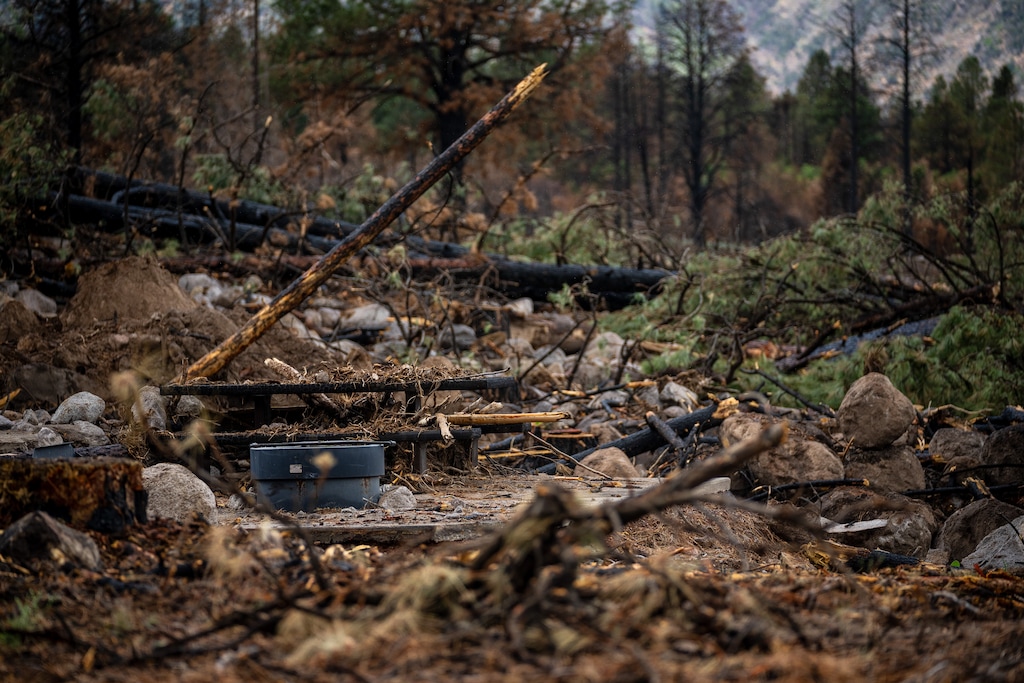
Such was the cost of wildfire on recreation in an area that didn’t even burn. On the other side of the Tushar Mountains, flames reduced entire campgrounds and picnic areas to soot and the trees that had hidden them to charred matchsticks. The ripple effects of that destruction have been felt not only by local outfitters like Allen, but by grocery and convenience store operators, by towns and counties miles away and by anyone looking for an outdoor escape.
And they won’t dissipate anytime soon.
“Wildfire changes recreation patterns in an area completely,” said Jason Curry, the director of the Utah Division of Outdoor Recreation. “Whether it’s a trail or a day-use or camping or anything else, the effects go on and on and on for many years.”
Not when, but if they reopen
For evidence of the often glacial pace of recovery for recreation areas affected by wildfires, look no further than Yankee Meadows in the Dixie National Forest, just 50 miles south of Beaver. The Brian Head Fire engulfed the campground in 2017. It took six years to reopen. Nearly a decade later, though, the skeletal remains of burned pine trees still dominate the hillsides. Their slender trunks provide little shade, and their propensity to fall poses a danger to hikers, hunters and more.
The damage caused by the Cottonwood Fire in the Fishlake National Forest near Beaver could take even longer to repair.
(Francisco Kjolseth | The Salt Lake Tribune) A tour of Eagle Point Resort, one of the smallest ski and snowboard areas in Utah, reveals what remains for one of the first areas to fall victim to the Cottonwood Fire in late June, pictured Thursday, July 9, 2026.
Fixing State Route 153 alone is expected to be a massive undertaking. The highway connecting Beaver to Eagle Point Resort and its surrounding communities was completely washed out in some areas by flash floods carrying a sludge of debris stripped from the burn scar. The Utah Department of Transportation began emergency work on the road in late August but said the roadway would not open to the public this year. The agency gave no timeline for completing the highway’s repairs.
The road’s destruction will likely also extend the timeline for reconstructing campgrounds and picnic areas in Fishlake National Forest. The forest can still be accessed from the east via SR 153 out of Junction, but that is a much slower route, and it is also typically closed in the winter.
“The amount of damage in Beaver Canyon is staggering,” Devin Squire, UDOT’s Region 4 project manager, said in a statement. “Pictures really don’t capture the scale of it. Almost everyone we take into the canyon says the same thing: it’s much worse than they expected, and the damage just keeps getting worse the farther up you go.”
(Bethany Baker | The Salt Lake Tribune) Heavy machinery is seen in the burn scar of the Cottonwood Fire near Beaver on Thursday, Aug. 6, 2026.
Six campgrounds were burned to varying degrees in the Cottonwood Fire, according to Dan Child, a spokesperson for the Fishlake National Forest. In an email to The Salt Lake Tribune, Child said this is the first time Fishlake National Forest, which sees about 343,000 visitors each year, has lost campsites to a wildfire.
Still, Child is optimistic the campgrounds that weren’t “catastrophically impacted” will open again as soon as next year. The fate of the others is less certain.
“We’re still figuring out what to do with those that were destroyed,” he said. “If we do rebuild them, it will take years.”
The time frame for each site, Child said, hinges on several factors: the severity of the damage, the area’s post-fire flood risk and how quickly adjacent landscapes can be stabilized. Funding availability and staffing also factor into the equation, he said.
Those last two are particularly relevant right now, said Alyssa Ravasio, the founder and CEO of the campsite-finding app Hipcamp. The Forest Service lost about 15% of its workforce during Department of Government Efficiency layoffs late last year. Meanwhile, the 2027 federal budget calls for reducing the Forest Service’s discretionary funding — which can be used for repairing and reconstructing campgrounds — by 75%. It is difficult to say how that might affect post-wildfire reconstruction, though, since much of it is currently funded through the 2025 American Relief Act.
Maybe the best question, Ravasio said, isn’t: How long until a camping area reopens?
“I would ask a different question,” she said, “which is: Are they going to reopen?”
In her experience, the answer is usually no.
‘Significant and lasting declines in visitation’
(Rick Egan | The Salt Lake Tribune) Pine Valley campground, on Wednesday, August 13, 2025.
Hipcamp does not track campground closures due to wildfires. However, Ravasio said of the handful of campgrounds she knows of that were destroyed by fire — most of which are in California, where she is based — none have been rebuilt.
“I’m seeing a lack of commitment and capital going toward maintaining our outdoor recreation infrastructure right now,” Ravasio said, “and I think that is really shortsighted.”
Slow or nonexistent reconstruction of recreational facilities puts pressure on both campers and on the recreation industry writ large. Camping has boomed since 2020, according to a report compiled by the campsite-finding website The Dyrt. That report said 82.4 million Americans camped in 2025, second only to the 84.8 million in 2023. The report estimated about 2.4 million of the 2025 campers were first-timers.
If it becomes too much of a hassle to book a site, though, people will abandon camping for something else, Ravasio predicted. And as more campgrounds are taken offline by wildfires and floods, she said that’s a more likely scenario. According to the Dyrt report, more than half of campers who booked a site said it was “difficult” because campgrounds were full.
When a campground, picnic area or off-highway vehicle trail is slow to be restored — or if it isn’t restored at all — would-be visitors will find other options. In the first year after a wildfire, a study published by The Conversation found, visitation to burned areas in Colorado and California dropped between 8% and 33%. Five years later, those sites continued to see “significant and lasting declines in visitation.”
Not only are those losses hard on campers, recreationists and outdoor retailers, they’re hard on local economies.
Towns seeking tourism
(Francisco Kjolseth | The Salt Lake Tribune) The remains of the Canyonside Lodge at Eagle Point Resort, one of the smallest ski and snowboard areas in Utah, reveals what remains for one of the first areas to fall victim to the Cottonwood Fire started in late June, Thursday, July 9, 2026.
When Dacie Derbidge projects the impact the Cottonwood Fire will have on Beaver, she mentions the cancellation of the Beaver Canyon Half Marathon and the Crusher in the Tushar gravel biking race and the temporary shutdown of the Eagle Point ski area.
Derbidge, a board member of the Beaver, Iron and Garfield Chamber of Commerce, also mentions the empty seats at restaurants and fewer shoppers at the local grocer, Mike’s Food Town.
“It’s really hard to see that in a whole being lost,” she said.
Federal lands and waters make up the bulk of the nation’s $1.2 trillion outdoor recreation economy, according to a report released last year by the Outdoor Recreation Roundtable. The report found recreational visitors to federal public lands nationwide generate $72 billion in direct annual spending. Tourist spending accounts for 44% of Beaver County’s local sales tax revenue, the Kem C. Gardner Institute reported in 2024. It’s 25% in Piute County, where Allen operates his rafting business.
Experience has taught Child that locals will return to recreational areas in burn zones as soon as the infrastructure allows. Out-of-town visitors, he said, are typically slower to come back.
Curry said it’s critical they do — sooner rather than later — for the financial good of the surrounding towns.
“These counties — I think the worst-case scenario for them is that people automatically just think, ‘Well, it’s all burned, and so there’s nothing to do there,’” Curry said. “It’s just not true. You just might have to go someplace different and experience something new.”
That’s the pitch Allen has been making to customers, too.
On July 3 — less than two weeks after guests began canceling reservations out of concern about the Cottonwood Fire — water levels in the Sevier River dropped too low to allow rafting. It was yet another vexation in a season full of them. However, Allen said rather than cancel, he encouraged customers to switch their reservations to one of Big Rock Adventure’s other activities: a suspension bridge, an aerial park and a zip line. By next year, Allen said he also expects to offer a via ferrata adventure, where climbers scale and descend cliffs while harnessed to a steel cable.
“We still are very confident that when people plan their vacation around our area, that we have so many other things to do,” he said. “It doesn’t have to be make-or-break on the trip.”
One more thing he’s building up on his property: the campground. He’s heard that these days there just aren’t enough sites to go around.