 Leia Larsen
Note to readers • This story is made possible through a partnership between The Salt Lake Tribune and Grist, a nonprofit environmental media organization.
This story is also an excerpt from the Open Lands newsletter, delivered to inboxes every Tuesday. For a sneak peek from the environment team about what we’re working on and news we’re following, sign up to have Open Lands delivered to your inbox.
Last week we traveled to the headwaters of the Bear River and saw firsthand how logging that helped unite our nation is still taking a toll on the environment.
More than a century ago, this serene place in the Uinta Mountains buzzed with human activity as loggers felled stands of big pines that would become railroad ties as the nation rushed to build its first Transcontinental Railroad.
“If you’ve driven across Wyoming, around Laramie you have trees, [but] you don’t have trees until you get here,” said Mike Fiorelli, a biologist and project manager for the conservation group Trout Unlimited. “So they filled in that gap where they needed the railroad ties with these trees.”
The project required an enormous amount of timber, and relics from that history remain littered across the forest: Old logging cabins that have since blown over. Tin cans, broken glass and the sole of an old shoe. Logs still stuck in the streambed.
(Leia Larsen and Francisco Kjolseth | The Salt Lake Tribune) Remnants of sawmill buildings and logging activities are pictured on Wednesday, Sept. 9, 2026. Trout Unlimited is restoring parts of the Bear River headwaters where trees were harvested to build the first Transcontinental Railroad more than 150 years ago.
And, of course, the old stumps – which you can still find jutting out about three or more feet above the ground.
The stumps are tall because loggers harvested trees during the winter, loaded the timber in horse-drawn sleighs, then floated the processed ties downstream during spring runoff. The West did not have an extensive road system at the time.
The Bear River is the largest tributary that feeds the Great Salt Lake, and the longest river in North America that does not reach the ocean. It forms when a series of small creeks and streams meet in the north slope of the Uinta Mountains.
(Francisco Kjolseth | The Salt Lake Tribune) Mike Fiorelli, left, and Nick Gann along with his dog Gannett, tour an area of the Bear River headwaters where trees were harvested to build the Transcontinental Railroad, Wednesday, Sept. 9, 2026.
It’s hard these days to imagine a deluge of 8-foot-long logs moving down tiny tributaries to the Bear, like North Fork Mill Creek or Mill City Creek, parts of which ran completely dry this year after our winter of dismal snowpack.
The railroad needed about 5,200 crossties per mile of the Union Pacific Railroad, according to research published in the Spring 2016 edition of Utah Historical Quarterly. That’s the equivalent of 2,600 trees for each mile of track. Tie cutting was one of the most lucrative jobs for folks living on the Western frontier, according to historians.
(Francisco Kjolseth | The Salt Lake Tribune) Ryan Meredith, left, and Sebastian Melrose with Anabranch Solutions cut down trees as they lay out a foundation for dam like structures in a sub watershed of the upper Bear River on Wednesday, Sept. 9, 2026. Trout Unlimited is restoring parts of the Bear River headwaters where trees were harvested to build the first Transcontinental Railroad over 150 years ago.
The transcontinental railroad, of course, culminated with driving the Golden Spike near the Great Salt Lake in 1869, about 100 miles as the crow flies from the Bear River’s headwaters. But the market’s appetite for Utah timber remained insatiable for decades after.
“After the railroad was built, they needed charcoal for the steam engines,” Fiorelli said.
Hilliard Flat, about 13 miles south of Evanston, had dozens of beehive-shaped kilns for that purpose.
At their peak, spring tie floats in the Uintas’ North Slope sent about 1 million trees each year down the Bear River, Blacks Fork and Smiths Fork.
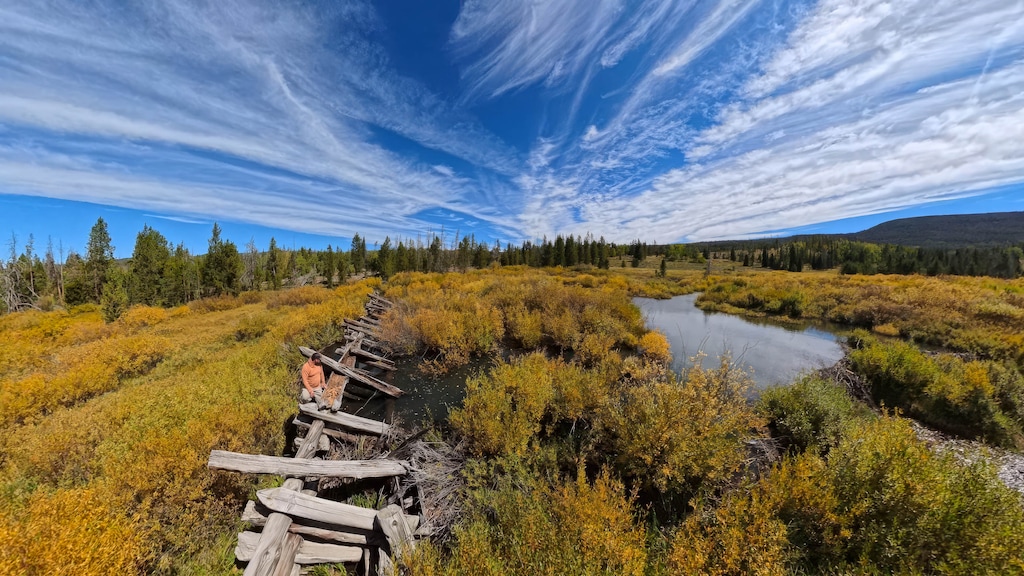
(Francisco Kjolseth | The Salt Lake Tribune) A “splash dam,” once used to build up enough water in the spring to release freshly cut railroad ties harvested from the Bear River headwaters to Evanston, Wyoming for the building of the Transcontinental Railroad, is pictured on Wednesday, Sept. 9, 2026.
(Francisco Kjolseth | The Salt Lake Tribune) Nick Gann with Trout Unlimited stands on the remnants of a “splash dam,” once used to build up enough water in the spring to release freshly cut railroad ties from the Bear River headwaters to Evanston, Wyoming for the building of the first Transcontinental Railroad, Wednesday, Sept. 9, 2026.
It helped build the West as we know it today. But it also did a lot of damage, and the streams still haven’t recovered all these decades later.
“When we think about [how] a stream naturally would be,” Fiorelli said, tracing S-curves in the dirt with his shoe, “it’s sinuous. ... But if we put a bunch of logs down it, it starts to straighten out.”
Because of the timber runs, the creeks essentially became canals. It didn’t help that the fur trade was nearly wiping out beavers to near extinction at the same time.
Beaver dams help create those winding paths creeks typically follow. The dams also turn the ground into a giant sponge that slowly releases water throughout the season, keeping rivers cool for fish and other wildlife through the hot summer months. They even prevent pollution from heavy sediment by slowing the water’s flow.
“We all share a common resource, and that’s water,” Fiorelli said. “What’s good for the native trout is great for humans too.”
(Francisco Kjolseth | The Salt Lake Tribune) A Bear River cutthroat is held by Mike Fiorelli of Trout Unlimited during a visit to North Fork Mill Creek, a tributary of one of the sub watersheds of the Upper Bear River where trees were harvested to build the first Transcontinental Railroad, Wednesday, Sept. 9, 2026.
Trout Unlimited has opted to build artificial beaver dams – called beaver dam analogs – to help return creeks in the Upper Bear River back to their natural form. They’re rather simple – workers pound posts into the ground and weave logs and branches around them. They don’t require heavy equipment or large crews. Ideally, beavers will move back in and maintain the dams because they create the kind of environment the critters like, typically abundant with willows.
The nonprofit has invested $2 million in such dams across the Upper Bear, with about $3 million in matching funds from the Biden-era Bipartisan Infrastructure Law, funneled through the U.S. Forest Service. Trout Unlimited has completed about 29 of the project’s 35 miles since work began in 2021.
(Francisco Kjolseth | The Salt Lake Tribune) Mike Fiorelli with Trout Unlimited fishes for Bear River cutthroat near a beaver dam analog in the North Fork Mill Creek, a tributary of one of the sub-watersheds of the upper Bear River, Wednesday, Sept. 9, 2026. Trout Unlimited is restoring many of the drainages with these post-assisted log structures to add habitat complexity for stream health.
Nick Gann, a spokesperson for the organization, says it’s an example of how residents in the West have an ever-evolving view of our streams and forests, and the value they provide. For the first chapter of our nation’s history, we used them for timber and transportation. While they support a much smaller logging industry today, the Uintas are now mostly used by people for hunting, fishing, hiking and other recreation.
“These are working lands, and we expect a lot of them,” Gann said. “It’s kind of a long, continuing journey.”
(Francisco Kjolseth | The Salt Lake Tribune) A “splash dam,” once used to build up enough water in the spring to release freshly cut railroad ties harvested from the Bear River headwaters to Evanston Wyoming for the building of the Transcontinental Railroad, is pictured on Wednesday, Sept. 9, 2026.