 Julie Jag
Park City • On a warm day in June — as one of the worst wildfire seasons in Utah’s history was looming but the smoke hadn’t yet sullied the air — a group of federal, state and conservation leaders stood in the tall grass along the banks of McLeod Creek below the McPolin Barn.
They’d come to examine and extol an action landowners can take to stymie both the spread of wildfires and the impacts of flash floods. The measure could also recharge groundwater, improve drought resilience and create healthier wildlife habitats.
While the proposal is truly ground-moving, it isn’t new.
At its core, “low-tech, process-based restoration” — the name bestowed on the process — entails simply letting creeks and streams do what they’ve done for millions of years: Go with the flow.
When water bodies are confined within their banks, they cut deep channels in the ground, said Isobel Lingenfelter, conservation director for the nonprofit Utah Wildlife Federation. That, in turn, increases the flow rate and reduces opportunities for the water to seep into the ground. When left to their own devices, though, creeks and streams will create the bountiful and resilient environments that drew settlers to the meadows around the creeks in the first place, she added.
“Over the past 150 years, the major paradigm of water management has been: How can we move water from A to B as fast as possible?” Lingenfelter said. “When you have that channelization, that accomplishes that [A to B] goal. But then we’re losing so much of the ecology, the complexity and the benefits that we get from having healthy wetlands.”
Rep. Doug Owens, D-Millcreek, joined agents from the U.S. Forest Service, the Utah Division of Water Quality and the Utah Division of Wildlife Resources, among others, on the tour. Despite the plan’s deep roots, Owens said he never heard a whisper of it in his six years of serving on the House Natural Resources, Agriculture and Environment Committee. He called the low-tech approach “exciting.”
“I don’t think anybody’s really heard of this,” he said.
(Bethany Baker | The Salt Lake Tribune) A group tours the McLeod Creek Low-Tech, Process-Based Restoration Project, where officials showcased how restoring natural stream functions can help landscapes retain water longer, support healthier vegetation, and create natural fire-resistant corridors near Snyderville on Thursday, June 11, 2026.
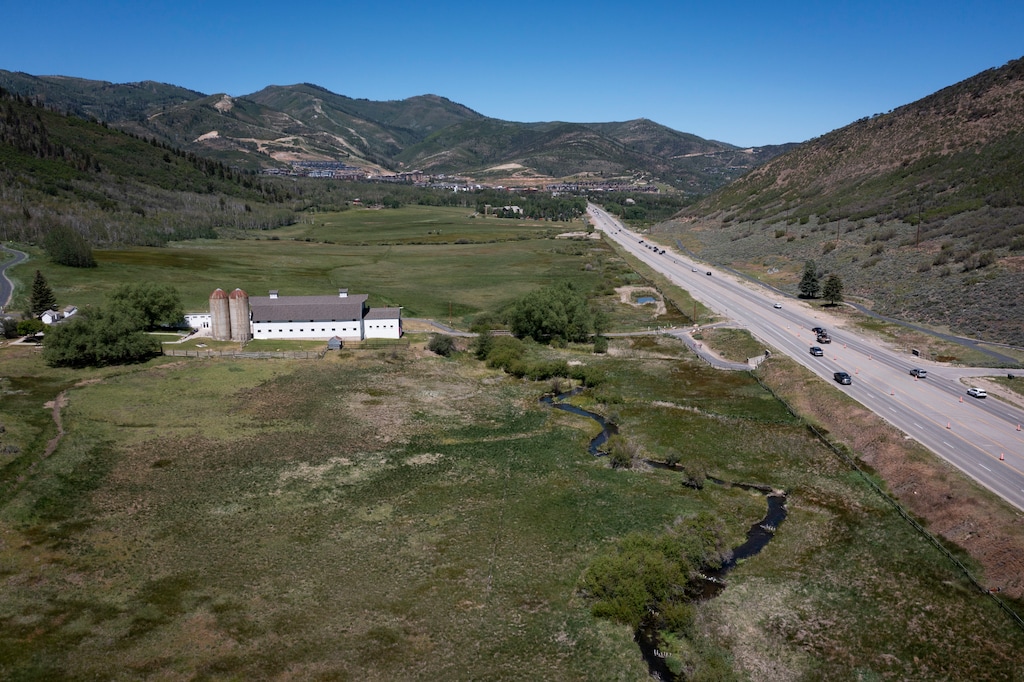
McLeod Creek, nestled between the white barn and busy Highway 224, served as an ideal specimen for the tour group. There, in the span of a few hundred yards, they could see both what has been and what could be.
Rose Smith, a stream ecologist with the nonprofit conservation group Sageland Collaborative, pointed out several of the stream’s maladies where it passes under a bridge. A few willows crowd its banks, but most of the creek is exposed to the sun. That has created water temperatures too high for trout and other fish and bugs to find a home there, she said. And since the creek rarely spills over its banks in that area, other vegetation isn’t likely to take root.
A short walk south, though, changes are taking place.
In 2021, Smith and a group of Sageland employees and volunteers placed human-made beaver dams along McLeod Creek. These “analog dams” are obstacles that force the stream to break out of its rut.
(Bethany Baker | The Salt Lake Tribune) A small dam is seen during a tour the McLeod Creek Low-Tech, Process-Based Restoration Project, where officials showcased how restoring natural stream functions can help landscapes retain water longer, support healthier vegetation, and create natural fire-resistant corridors near Snyderville on Thursday, June 11, 2026.
When it meanders rather than rushes, the stream is more likely to drop fine sediment in its path, which allows the water levels to rise. The water can then spill over the banks, where it is sopped up by the parched ground and allowed to trickle into the groundwater. The replenished ground becomes more fertile for plant growth and more impervious to wildfires. The sponginess of the soil also helps it absorb floodwaters rather than speeding them downstream.
“There are places where yes, you do need the stream to behave,” Smith said from the bridge. “And then there’s places upstream of here and downstream of here where the stream can play, to use the child metaphor. But it needs that complexity. It needs structure.”
The analog dams currently give the river that structure. They are temporary fixtures in the creek, and if they work right, the waters will begin to bypass them or will push them downstream, where they can become habitat for fish and bugs. Their ephemerality is at the root of both their beauty and the consternation surrounding them.
“That’s why engineers hate them so much. It’s because you build them to fail,” said James Spencer, a wildlife biologist for the federal Natural Resources Conservation Service. “And they fail by the stream filling up the channel and then going around them. That’s why beavers are so busy.”
(Bethany Baker | The Salt Lake Tribune) Rose Smith, right, who leads Sageland CollaborativeÕs Riverscape Restoration Program, speaks during a tour the McLeod Creek Low-Tech, Process-Based Restoration Project, where officials showcased how restoring natural stream functions can help landscapes retain water longer, support healthier vegetation, and create natural fire-resistant corridors near Snyderville on Thursday, June 11, 2026.
Beavers historically provide stream complexity, Smith said, until they were hunted to near extinction during the fur trade. The 2018 book “Eager” by conservation journalist Ben Goldfarb links their decline to a parallel drop in fire and flood landscape resilience and a reduction in biodiversity.
Today, their numbers are rebounding. Yet they’re often still considered nuisances for building the same dams and obstructions that the group at McLeod Creek is trying to encourage. Still, Smith said, not only do beavers restore stream habitats more effectively and adaptively than engineered options, they also cost less.
Putting in the analog dams costs between $20,000 and $30,000 per mile of waterway, Smith estimated. An engineered fix — including securing permits, hiring an excavator and laying down stones or concrete chunks — would likely cost closer to $300,000 per mile, she said.
“When beavers move in,” Lingenfelter said, “they do all of this for free — if you’re OK with coexisting with them.”
Still, members of the group agreed that the stigma around beavers and what their dams will do to pastures and crops will likely be the biggest barrier to widespread adoption of the low-tech model by private landowners. Emily Bishop-Valles, the watershed coordinator for the Utah Department of Agriculture and Food, said landowners may soon be able to receive a federal stipend of $300 per acre per year to let streams run their course. Owens added that he would like to see the state Legislature back the program, financially or otherwise.
(Bethany Baker | The Salt Lake Tribune) A barn is seen near the McLeod Creek within the Weber River watershed near Snyderville on Thursday, June 11, 2026.
In an interview Friday, Owens said the House Natural Resources, Agriculture and Environment Committee has agreed to hear a presentation on beaver dam analogs during its fall interim committee meeting. He also plans to meet with representatives from state agencies to determine the best bill or appropriation request to present during the full legislative session next year.
“It seemed to me clearly an idea whose time has come,” Owens said. “You just get a lot of bang for the buck for restoring stream health and also storing water right underground at higher elevation with no evaporation. So it seemed like something we really need to be attending to.”
But incentives likely wont be enough to sway ranchers worried about the impact on their pastures, Spencer said. He suggested proponents instead focus on the legacy of the action.
“The benefit isn’t going to come from the money that they get,” Spencer said. “The benefit is going to come from the expanded green footprint of that stream, and it may not be manifest to them in the first 20 years. But maybe their grandkids will eventually say, ‘Oh yeah, look at how great my pasture is.’”
(Julie Jag | The Salt Lake Tribune) McLeod Creek meanders through a beaver dam analog as it threads the meadow between the McPolin Barn and Highway 224 on June 11, 2016.
Correction: Aug. 17, 2026, 4:15 p.m. • Emily Bishop-Valles, the watershed coordinator for the Utah Department of Agriculture and Food, said soon landowners could receive a federal stipend of $300 per year for each acre returned to the floodplain.